OPTIFLUX 6300 hygienic electromagnetic flowmeter and how its code works
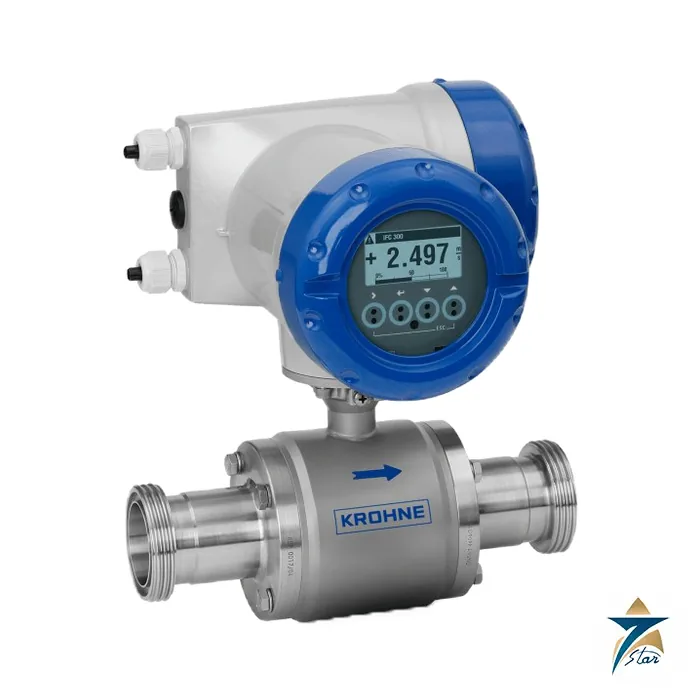
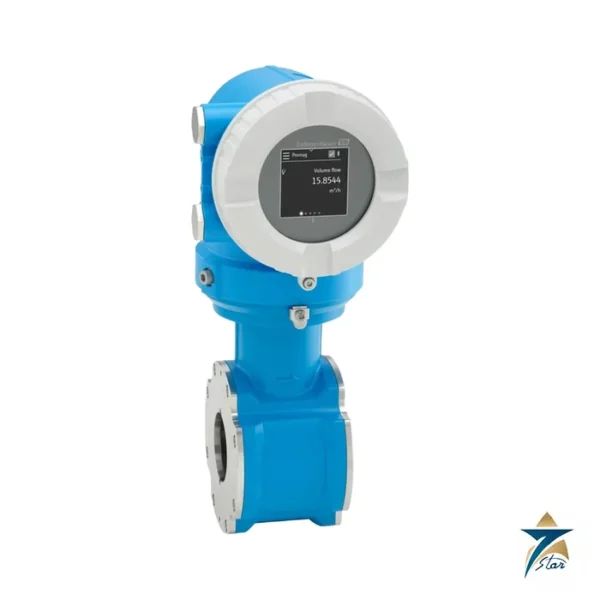
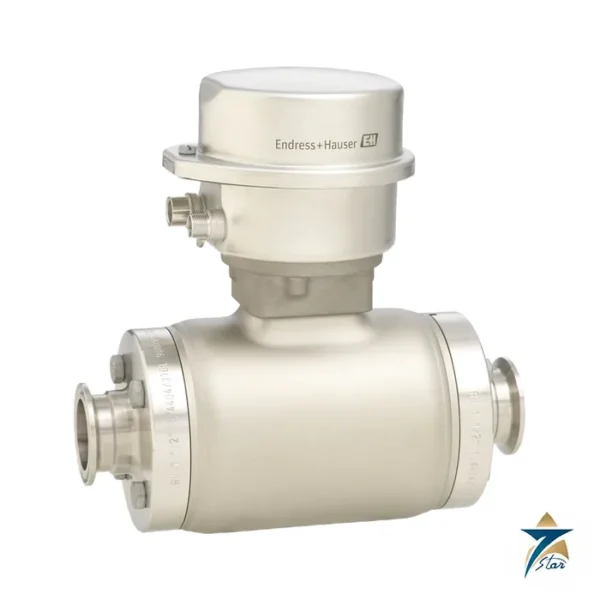
The KROHNE OPTIFLUX 6300 is a high-end electromagnetic flowmeter for hygienic and sanitary liquids. It combines the OPTIFLUX 6000 sensor, built without crevices, gaps or blind spots for CIP and SIP cleaning, with the IFC 300 signal converter. The sensor wetted parts follow EC 1935/2004 and FDA food-contact rules, and the sensor is certified to EHEDG and 3A. A measuring error down to 0.2% of the measured value (plus 1 mm/s) suits blending, dosing and batching, and the meter can still read liquids with low conductivity of 1 µS/cm or more, such as glucose syrup and fruit concentrates.
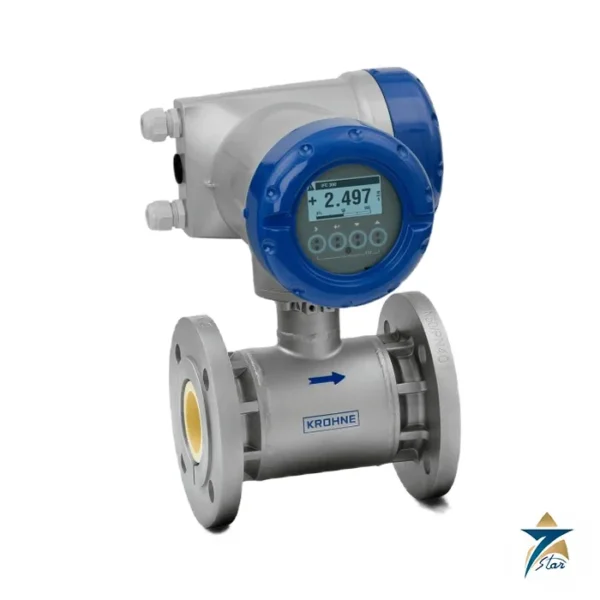
The sensor family is OPTIFLUX 6000 and the converter fixes the last two digits: 6050 uses the IFC 050, 6100 the IFC 100, and 6300 the IFC 300. C denotes the compact build with the converter on the sensor, while W, F and R are remote wall, field and rack versions. Compact versions with a stainless steel converter housing are listed for wash-down plants. Nominal sizes run from DN2.5 to DN150.
Technical specifications of the OPTIFLUX 6300
| Parameter |
Specification |
| Manufacturer / part number |
KROHNE / OPTIFLUX 6300 (C, W, F and R versions) |
| Measuring principle |
Faraday induction; conductive liquids |
| Maximum error (IFC 300) |
Down to 0.2% of MV ± 1 mm/s for DN10 to DN150; 0.3% ± 2 mm/s for DN2.5 to DN6; repeatability ±0.1% |
| Nominal size |
DN2.5 to DN150 (1/10 to 6 in) |
| Process temperature |
-40 to +140 °C (compact with IFC 300 and remote); ISO 2852 and Tri-Clamp versions -40 to +120 °C |
| Conductivity |
1 µS/cm or more; water 20 µS/cm or more |
| Solids and gas |
Up to 70% solids by volume; gas up to 5% (IFC 300) |
| Liner and electrodes |
Reinforced PFA liner; Hastelloy C electrodes standard, Hastelloy B2, platinum, stainless steel, tantalum or titanium optional |
| Hygienic connections |
DIN 11850/11866, DIN 11851, DIN 11864-2A, DIN 32676, ISO 2037, ISO 2852, SMS 1146, Tri-Clamp |
| Housing |
Sensor 304 stainless steel (duplex for DN2.5 to 15); IP66/67, IP68 and IP67/69 options |
| Hygienic certification |
3A and EHEDG; EPDM gasket standard, silicone option for non-Ex |
| Outputs (IFC 300) |
Multiple 4-20 mA, HART, Modbus, Foundation Fieldbus, Profibus and PROFINET variants |
Limits shown come from the OPTIFLUX 6000 datasheet and the product page; the converter documentation governs inputs and outputs.
How the OPTIFLUX 6300 stays clean and accurate
As conductive liquid flows through the magnetic field, a voltage proportional to velocity is picked up by the electrodes, the same principle used in every electromagnetic meter. The difference here is mechanical. The PFA liner has an embedded stainless steel grid that keeps its form under vacuum and at temperature, which protects accuracy over time. A unique L-shaped gasket sits in an expansion chamber so that during CIP and SIP cycles it does not bulge into the measuring tube, extending gasket life and keeping the bore smooth.
Measurement remains stable with pulsating flow and with fibrous or particulate products such as yoghurt containing fruit or cereal pieces, because the IFC 300 permits solids content up to 70% by volume. Diagnostics cover conductivity, electrode errors and ambient and process temperature, and the OPTICHECK tool can verify the meter on site.
Where the OPTIFLUX 6300 fits and related KROHNE flowmeters
The 6300 belongs on liquid food, beverage, dairy and pharmaceutical lines, and on CIP supply and return lines carrying acid and caustic cleaning solutions. For general process and utility liquids our site lists the OPTIFLUX 2000, 2300, 4100 and 4300, and for water networks the WATERFLUX 3070, 3100 and 3300. For corrosive or abrasive service, the OPTIFLUX 5300 uses a ceramic tube. Choose the 6300 when hygienic certification and clean-in-place compatibility drive the specification.
Selection and ordering checklist for the OPTIFLUX 6300
- Product, conductivity, temperature and cleaning regime including CIP and SIP temperatures.
- Line size and the hygienic connection standard and insertion length of the plant.
- Compact, wall, field or rack converter, and stainless steel housing if wash-down is frequent.
- Electrode material for aggressive cleaning agents.
- Gasket choice: EPDM standard or silicone; FDA guidance restricts EPDM to media with 8% fat or less.
- Output and fieldbus requirement.
- IP rating, hazardous-area option and calibration certificate needs.
Installation, commissioning and maintenance
Keep the sensor full at all times, with at least 5 DN straight inlet and 2 DN outlet. In hygienic piping, orient it so it drains freely and does not trap air at the top. Use the connection type and insertion length the plant already uses, so no adapters are needed. Torque tri-clamp or union connections to the hygienic fitting vendor guidance, and ground the sensor correctly; metallic piping normally ensures reference potential.
Commissioning includes entering the sensor size and calibration data, checking conductivity diagnostics and zeroing with the line full and flow stopped. Gaskets are the main wear item, and the datasheet stresses the lifetime benefit of the L-shaped design. With no moving parts there is no mechanical maintenance, and verification can be done without removing the meter.
Typical applications in Oman and the GCC
The Gulf has growing dairy, juice, bottled-water, beverage and pharmaceutical production, and these plants use hygienic electromagnetic meters for batching, dosing and filling control. Sites also use them on CIP circuits, on process-water and utility lines needing a clean connection, and in desalination post-treatment where remineralisation chemicals are dosed. High ambient temperature makes a stainless steel converter or a remote one in a shaded panel a sensible choice, and washdown routines favour IP67/69 or IP68 housings.
Converter versions
| Version |
Converter |
Mounting |
| OPTIFLUX 6050 |
IFC 050 |
Compact or wall |
| OPTIFLUX 6100 |
IFC 100 |
Compact or wall; stainless option |
| OPTIFLUX 6300 C |
IFC 300 |
Compact; aluminium or stainless |
| OPTIFLUX 6300 W / F / R |
IFC 300 |
Wall, field or rack remote |
Information to send with an RFQ for the OPTIFLUX 6300
- Product name, conductivity, temperature and pressure, with CIP and SIP parameters.
- Size and hygienic connection standard, with insertion length.
- Converter version, housing material and signal or bus.
- Electrode and gasket materials, and certificate needs.
- Quantity and delivery timing.
Documents and quotation
A KROHNE technical datasheet for the OPTIFLUX 6000 sensor is attached on this page. Send the details above and we will confirm availability and prepare a quotation for the OPTIFLUX 6300 in Oman and the GCC. Seven Star LLC is an independent supplier in Muscat.




















Reviews
There are no reviews yet.