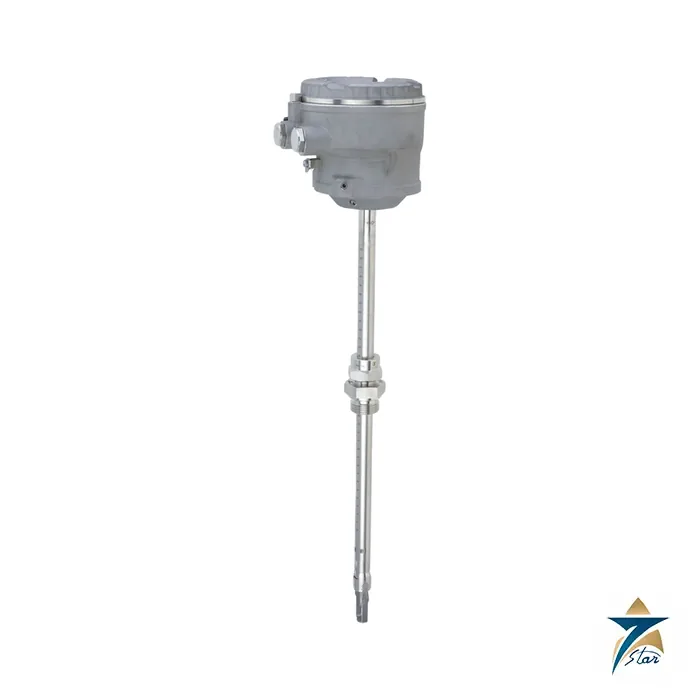
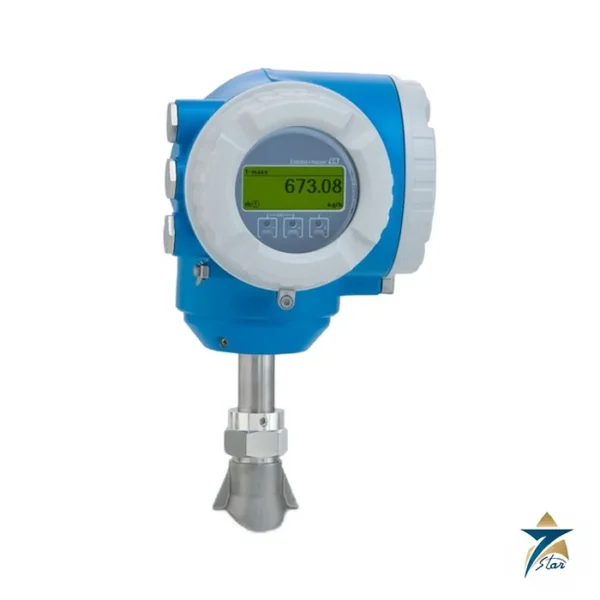
Endress+Hauser t-mass I 500 insertion thermal mass flowmeter with remote transmitter
The Endress+Hauser t-mass I 500 (product root 6I5B) combines the insertion probe used for large pipes and ducts with a remote Proline 500 digital transmitter. The probe covers circular pipes from DN 80 to 1500 (3 to 60″) and rectangular ducts, and the transmitter, with up to four I/Os, is placed up to 300 m away at a point where operators can reach it. It is the version to select when the pipe is high, hot, outdoors on a rack, or inside a classified area but the display and wiring should be elsewhere. Seven Star LLC supplies Endress+Hauser instruments in Oman and the GCC as an independent supplier in Muscat.
Reading the t-mass I 500 designation
I means insertion, 5 means the Proline 500 digital transmitter in a separate housing, and 6I5B is the product root. The probe, sensing element and Gas Engine are the same as in the compact t-mass I 300. What changes is the electronics architecture: the sensor connection housing contains the ISEM (intelligent sensor electronics module), the cable carries a digital signal, and the transmitter housing is made of coated aluminium or polycarbonate. This difference gives a few practical advantages and one extra installation task, which is running and terminating the cable.
t-mass I 500 technical specifications
| Parameter |
Specification |
| Manufacturer / part number |
Endress+Hauser / t-mass I 500 (6I5B) |
| Measuring principle |
Thermal mass flow, insertion probe |
| Nominal diameter |
DN 80 to 1500 (3 to 60″), circular pipes and rectangular ducts |
| Measured variables |
Mass flow, temperature, standard volume flow, volume flow, free air delivery, velocity, heat flow, energy flow, density |
| Measuring range |
20 to 733501 kg/h (44 to 1669340 lb/h), depending on gas and pipe |
| Max. measurement error (gas) |
1.0 % o.r. from 10 to 100 % o.f.s.; 0.1 % o.f.s. from 1 to 10 % |
| Medium temperature / pressure |
–40 to +180 °C; –0.5 to 20 bar gauge |
| Sensor lengths |
235 / 335 / 435 / 608 mm |
| Wetted materials |
Stainless steel 1.4404 (316/316L); Alloy C22 sensing element option for corrosive gas |
| Transmitter to sensor link |
Digital cable, max. 300 m (Zone 2 / Div 2) or 150 m (Zone 1 / Div 1) |
| I/O |
Up to 4; HART, pulse/frequency/switch, relay, current input, status input |
| Ambient temperature |
–40 to +60 °C (–50 °C with option JP) |
| Power supply |
DC 24 V ±20 % or AC 100 to 240 V |
| Functional safety |
SIL 2 sensor (application package) |
Principle and calibration of the I 500
A heated element and a reference thermometer in the probe tip work as in all Endress+Hauser thermal meters: the heating power needed to hold a constant temperature difference is proportional to the mass flow that passes. The meter is calibrated with air with an operable range of 200:1, repeatability of ±0.25 % of reading above 1.0 m/s and typical response of under 3 s for 63 % of a step. The Gas Engine converts the air calibration to the actual gas, so users do not have to buy gas-specific calibration. As a point measurement, the reading is scaled to full pipe flow using the pipe diameter entered during commissioning.
Probe fitting and installation of the t-mass I 500
The same insertion rules as for the I 300 apply. Insertion depth = (0.3 × A) + B + (C1 + C2), where A is the internal diameter or duct dimension, B the wall thickness, and C1 + C2 the mounting kit and compression fitting; the minimum is 100 mm. With Endress+Hauser bosses C1 + C2 is 105 to 112 mm depending on thread. Tube length is chosen from 235, 335, 435 or 608 mm so that the depth lies within the adjustment range. Metal ferrules deform on the first installation and fix the depth, so measure carefully before tightening.
On the electrical side, keep the sensor cable shielded and keep the length within the conductor-size limit given in the datasheet. For standard cable the range is 80 m for 0.34 mm² to 300 m for 1.5 mm². The transmitter can be wall or pipe mounted, with a weather protection cover for open air. The datasheet warns that the lower end of the transmitter housing should stay below 80 °C, so leave the neck exposed.
Hot tap and sealing choices
| Option |
Detail from datasheet |
| Compression fitting |
Ferrule PEEK (up to 140 °C), PVDF (up to 110 °C) or 1.4404 (up to 180 °C) |
| Sealing ring |
EPDM up to 140 °C; FKM up to 180 °C |
| Cold/hot tap, medium pressure |
20 bar process, 16 bar extraction, extraction temperature max. 50 °C, sensor length at least 435 mm |
| Cold/hot tap, low pressure |
4.5 bar extraction pressure; usable with 335, 435 and 608 mm lengths |
| Hot tap gas type |
Only non-toxic, innocuous gases at process pressure |
Where the t-mass I 500 fits and related models
The I 500 is the remote-transmitter partner of the t-mass I 300, with the same probe lengths and gas data. For smaller lines the inline t-mass F 300 and t-mass F 500 cover DN 15 to 100, and the t-mass A 150 handles basic compressed-air metering. The I 500 usually feeds a DCS or SCADA system through HART or a bus option, while pulse and relay channels support local totalising and alarms.
Selection checklist for t-mass I 500
- Pipe or duct dimensions, wall thickness and available tapping.
- Gas and composition; choose Alloy C22 sensing element for corrosive gas.
- Process pressure up to 20 bar gauge, gas temperature, and matching seal and ferrule material.
- Fixed fitting or hot tap with withdrawal under pressure.
- Distance between probe and transmitter and cable cross-section; hazardous zone of each location.
- Unidirectional, bidirectional or reverse-flow version.
- Number of I/Os (up to four), bus type, power supply and approvals.
Commissioning and maintenance
Power up, set the pipe inner diameter and the gas in the Make-it-run wizard and confirm the zero reading. Check that the probe orientation matches the arrow and that the sensing element is aligned within 3 degrees for bidirectional use. Plan periodic checks of the sensing element for oil mist, dust or condensate, and use Heartbeat Technology verification where ordered. Keep spare ferrules and seals on hand, since ferrules cannot be reused after the first installation.
Typical applications in Oman and the GCC
The remote version is attractive on elevated headers and duct runs where the pipe is hard to reach, such as combustion air ducts on boilers and heaters, flue gas ducts, aeration air lines at wastewater and desalination plants, and large compressed-air or nitrogen headers at oil and gas sites. Placing the transmitter in a shaded, easily reached location is a practical response to Gulf summer heat, and a short cable run to a control cabinet avoids climbing to the pipe for every reading.
Information to send with an RFQ for t-mass I 500
Please send gas and composition, pipe or duct dimensions, flow range, pressure and temperature, desired probe length and tapping, hot tap need, distance to the transmitter, hazardous-area classification, I/O and communication requirements and power supply.
Documents and quotation
The Endress+Hauser technical information for the t-mass I 500 is attached on this page as a datasheet, with cable data, insertion depth calculations and ordering options.
Send the order code or the pipe and gas data and Seven Star LLC will prepare a quotation for Oman and the GCC.
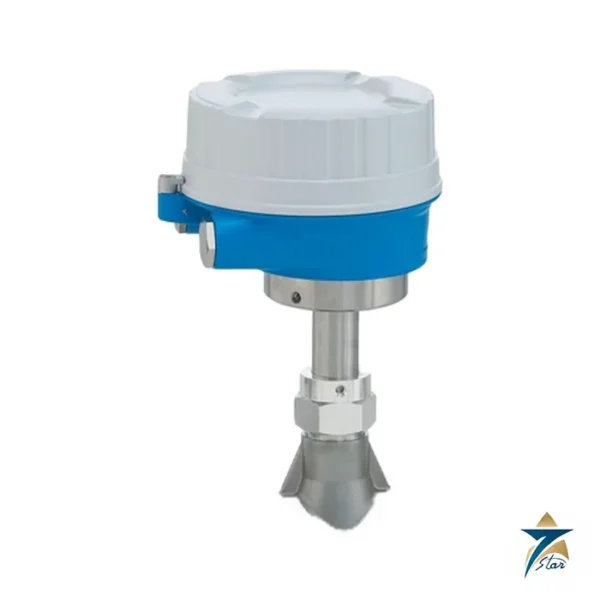
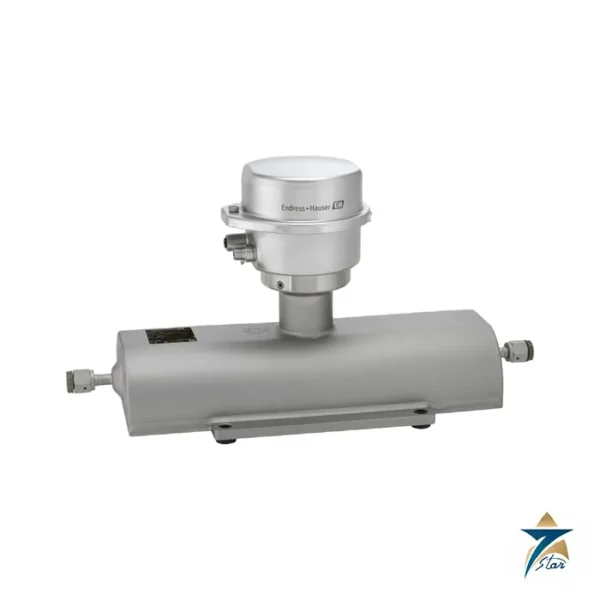
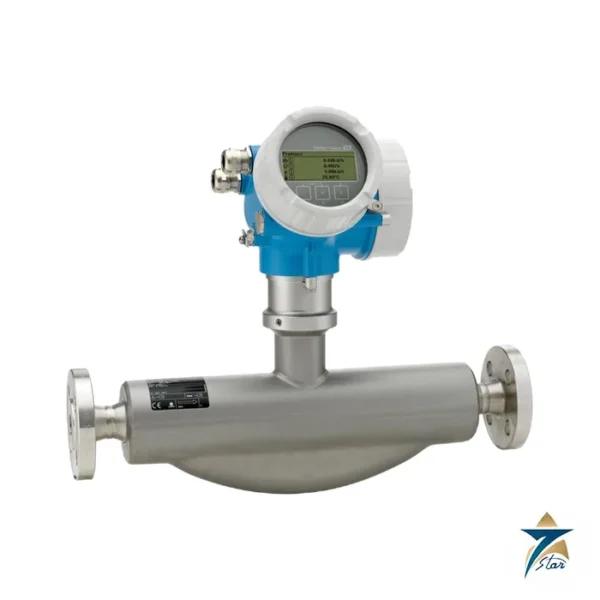
Other Models in the Eh Tmass Thermal Range
Seven Star LLC supplies models from the Eh Tmass Thermal range in Oman and the GCC. Compare the related models below and request a quote for the one that matches your application.




















Reviews
There are no reviews yet.