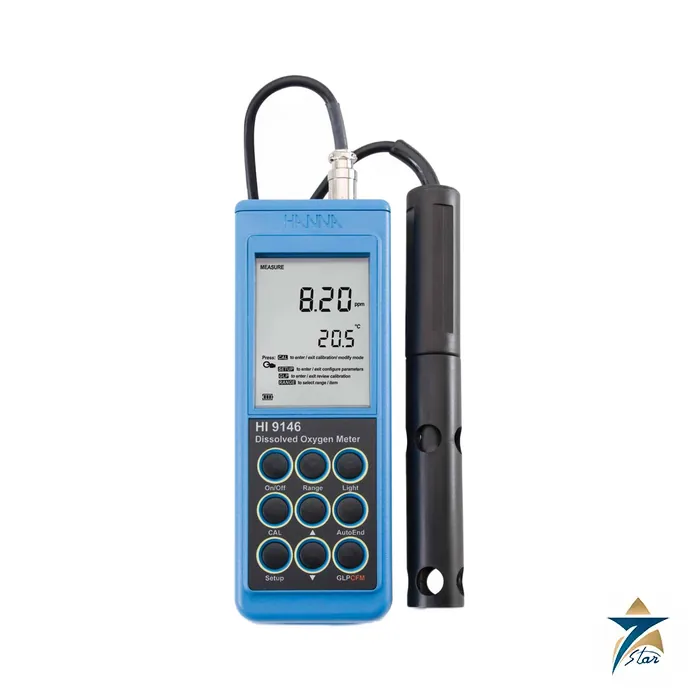
Hanna HI9146 portable polarographic dissolved oxygen meter
The Hanna HI9146 is a heavy-duty portable dissolved oxygen meter with a polarographic probe, designed for laboratory-grade results in rough industrial conditions. It reads DO in mg/L (ppm) and percent saturation, with temperature and the option to correct for salinity and altitude. Seven Star LLC is an independent supplier in Muscat and is not affiliated with the manufacturer.
The part number names a complete kit: the meter, HI76407 polarographic probe, two HI76407A membrane caps, HI7041S electrolyte, batteries and a rugged carrying case.
HI9146 technical specifications
| Parameter |
Specification |
| Manufacturer / part number |
Hanna Instruments HI9146 |
| DO range |
0.00 to 45.00 ppm (mg/L); 0.0 to 300.0 % |
| DO resolution |
0.01 ppm; 0.1 % |
| DO accuracy |
±1.5 % of full scale or ±1 digit, whichever is greater |
| Temperature |
0.0 to 50.0 °C; resolution 0.1 °C; accuracy ±0.2 °C excluding probe |
| Calibration |
Single or double point at 0 % (HI7040 zero solution) and 100 % in air |
| Compensation |
Automatic temperature 0 to 50 °C; altitude 0 to 4,000 m in 100 m steps; salinity 0 to 80 g/L in 1 g/L steps |
| Probe |
HI76407 polarographic DO probe with built-in thermistor and DIN connector |
| Power |
Three 1.5 V AAA cells; about 200 hours without backlight, 50 hours with |
| Environment / size |
0 to 50 °C, up to 95 % RH non-condensing; 185 × 72 × 36 mm, 300 g |
| Warranty |
Two years |
How the HI9146 works
A polarographic probe holds a platinum cathode and silver/silver-chloride anode behind a gas-permeable PTFE membrane. When a polarising voltage is applied, oxygen that diffuses through the membrane is reduced at the cathode and the resulting current is proportional to oxygen partial pressure. A thermistor in the probe supplies temperature for compensation.
The meter adds an Auto Endpoint function that freezes the display on the first stable reading, a Battery Error Preventing System, GLP display and an entry for an instrument ID code. Salinity and altitude settings correct the oxygen solubility so that values are comparable between brackish water and elevated sites.
Where HI9146 fits: sensors, accessories and related models
The HI9146 uses the HI76407 probe with HI76407A membrane caps and HI7041S electrolyte; the zero-oxygen solution is HI7040. A galvanic alternative is available in the HI9147 (HI76409 probe), which needs no warm-up or polarisation time but is calibrated by trimmer instead of by key sequence.
The table compares the two portable DO meters so the right sensing principle is chosen for the duty.
HI9146 family comparison
| Model |
Sensor type |
DO range |
Calibration |
| HI9146 |
Polarographic (HI76407) |
0.00 to 45.00 mg/L; 0.0 to 300.0 % |
0 % and 100 %, one or two points |
| HI9147 |
Galvanic (HI76409/4 or /10) |
0.0 to 50.0 mg/L; 0 to 600 % |
Manual, 100 % in saturated air |
Polarographic probes such as the HI76407 need a short polarisation period after switch-on but give stable readings in long runs and are common in laboratories. Galvanic probes warm up faster and suit spot checks.
Selection and ordering checklist for HI9146
- Confirm the oxygen range: up to 45.00 mg/L and 300 % saturation covers most water work
- Decide between polarographic (HI9146) and galvanic (HI9147) sensing
- Quote spare membranes HI76407A, electrolyte HI7041S and zero solution HI7040
- Note the DIN probe connector and the probe cable length supplied
- Check whether altitude or salinity correction will be used on site
Installation, calibration and maintenance of HI9146
Probes ship dry. Soak the lower 2.5 cm of the probe in HI7041S for five minutes, fill a rinsed membrane cap with fresh electrolyte, tap out bubbles gently and screw it on with the sensor facing down. Allow the probe to polarise before calibration.
Calibrate at 100 % in air and, where accuracy at low levels matters, at 0 % in HI7040. Provide sample movement across the membrane, either by stirring or by agitating the probe, because still water depletes oxygen at the membrane. Replace membranes and electrolyte regularly and rinse the probe with deionised water after use.
A few habits improve repeatability. Keep the membrane free of fingerprints and scratches, never wipe it dry with a rough tissue, and store the probe with a little moisture in the protective cap. If readings drift upward or respond slowly, replace the electrolyte and membrane before suspecting the meter.
The GLP key shows the date and result of the last calibration, which helps document that the instrument was verified before a compliance sampling run. The meter also lets the user enter an ID code so that results can be traced to a particular instrument.
Typical applications of HI9146 in Oman and the GCC
In Oman the HI9146 suits wastewater aeration basins, aquaculture and hatchery ponds, cooling-water and effluent discharge checks, and laboratory BOD set-up. Hot surface water lowers oxygen solubility, so the automatic temperature compensation and the percent-saturation scale are valuable on summer surveys.
Because the case is rugged and the display is easy to read in bright sun, the unit is practical on open basins and jetties where laptops and benchtop meters are not.
Information to send with an RFQ for HI9146
- Quantity and any spare membrane caps, electrolyte and zero solution
- Whether an extended cable or protective sleeve is needed
- Application and temperature range
- Delivery location and lead time
- Project or tender reference
Storage, handling and spares for the Hanna HI9146
Store the Hanna HI9146 in its case in a clean, dry place. Keep probes, electrodes and reagents as described in the user manual, as many of them need a storage solution or have a limited shelf life. In the GCC climate, keep reagents away from heat and direct sun and check expiry dates before use.
- Calibrate the instrument with fresh standards at the interval your procedure requires.
- Rinse probes and sample cells after each use and inspect them for scratches or deposits.
- Keep spare consumables, such as reagents, standards, cuvettes and electrode solutions, in stock.
- Record calibration results so that drift or probe ageing can be seen early.
When you order the Hanna HI9146, list the consumables and standards you need in the same RFQ, so the instrument can be used from the day it arrives.
Documents and quotation
The instruction manual for the HI9146 is attached on this page for specifications, calibration procedures and maintenance steps.
Send the part number HI9146, the quantity and your delivery location and we will reply with availability and a quotation.
























Reviews
There are no reviews yet.