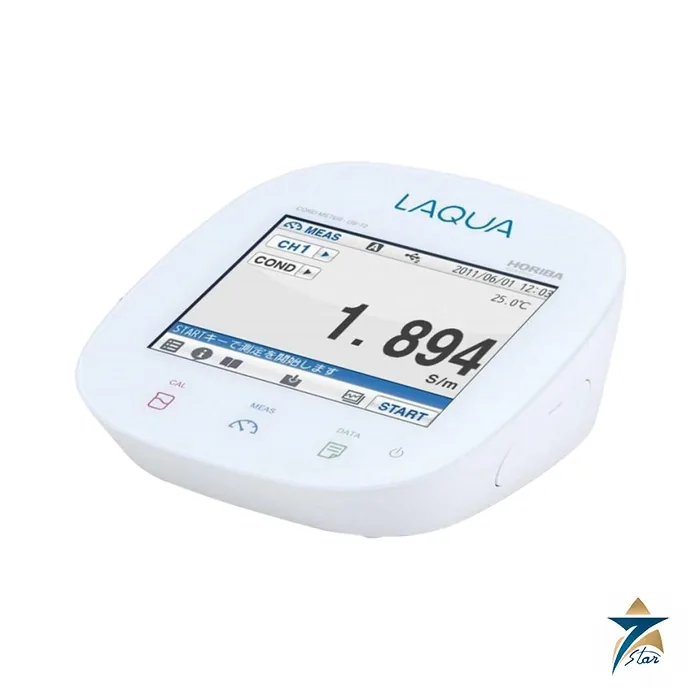
DS-72 is HORIBA’s high-end benchtop conductivity meter in the LAQUA range. It measures conductivity from 0.000 µS/cm up to 1.999 S/cm, converts to resistivity, salinity and TDS, runs pharmacopoeia-style checks for pure water, and records 2000 results through a colour touch screen.
Conductivity from ultrapure water to strong electrolytes
The DS-72 uses an AC bipolar method and covers three cell-constant ranges. With a k = 0.1 cm-1 cell the range is 0.000 µS/cm to 19.99 mS/cm, with k = 1.0 it is 0.00 µS/cm to 199.9 mS/cm and with k = 10.0 it runs 0.0 µS/cm to 1.999 S/cm. Repeatability is ±0.5 % ±1 digit and resolution 0.05 % of full scale. Resistivity follows the same cell choice and reaches 199.9 MΩ·cm with the k = 0.1 cell, which is the range used for ultrapure water.
Salinity (0.00 to 80.00 ppt, or 0.000 to 8.000 %) and TDS (0.01 mg/L to 1000 g/L) are converted from conductivity, so one measurement gives four parameters. HORIBA states that the meter complies with industrial pharmacopoeia standards (JIS, USP, EP, JP and CP) for pharmaceutical water applications, and the manual describes a pharmacopoeia inspection mode that checks the cell constant and measurement repeatability.
Functions listed on the product page
- Capacitive colour touch screen with digital, graph and analogue display and an on-screen guide with a problem-solving section.
- Auto diagnostic function and periodic check; distilled-water temperature conversion.
- Selectable units (S/cm, S/m, fixed) and auto or manual temperature compensation.
- Results saved with sample name, user ID and calibration information; up to 2000 sets.
- USB-PC communication, USB memory and a GLP/GMP printer connection at the same time.
Technical specification
Conductivity, resistivity, TDS, salinity
| Parameter |
Specification |
| Model |
LAQUA DS-72 |
| Conductivity range |
k = 0.1 cm-1: 0.000 µS/cm to 19.99 mS/cm; k = 1.0: 0.00 µS/cm to 199.9 mS/cm; k = 10.0: 0.0 µS/cm to 1.999 S/cm |
| Method / resolution / repeatability |
AC bipolar / 0.05 % of full scale / ±0.5 % ±1 digit |
| Resistivity range |
k = 0.1: 0.00 kΩ·cm to 199.9 MΩ·cm; k = 1.0: 0.000 kΩ·cm to 19.99 MΩ·cm; k = 10: 0.0 Ω·cm to 1.999 MΩ·cm |
| Salinity |
0.00 to 80.00 ppt (0.000 to 8.000 %), converted from conductivity, 0.01 ppt resolution |
| TDS |
0.01 mg/L to 1000 g/L, converted from conductivity, 0.01 mg/L resolution |
| Temperature |
-30.0 to 130.0 °C, 0.1 °C resolution, ±0.1 °C ±1 digit |
Interfaces and instrument data
| Parameter |
Specification |
| Input / output |
BNC and phono inputs; USB, RS-232C and analog outputs |
| Data memory |
2000; data search and ID input |
| Display |
Colour LCD touch screen; English, Japanese, Chinese, Korean |
| Security / upgrade |
Password setting; software upgrade function |
| Operating temperature |
0 to 45 °C |
| Power |
AC adapter, 100 to 240 V, 50/60 Hz |
| Dimensions / weight |
170 (W) x 174 (D) x 73 (H) mm; 700 g |
Kits and standards
| Parameter |
Specification |
| DS-72G |
Meter, electrode stand, protection cover, universal AC adapter with 6 plugs, instruction manual |
| DS-72A-S |
DS-72G plus 3552-10D platinum black glass-body k = 1.0 conductivity electrode with temperature sensor and 503-S standards: 84 µS/cm, 1413 µS/cm, 12.88 mS/cm, 111.8 mS/cm (250 mL each) |
| DS-72A-S-CFR |
As DS-72A-S plus LAQUA 21 CFR Part 11 software |
| Option part numbers |
AC adapter 3200647413; USB cable 3200373941; electrode stand 3200382557 (standard) or 3200382560 (long); X-52 digital simulator for conductivity |
Cell constant, kit and check method
Pick the cell to match the water: a k = 0.1 cell for pure and ultrapure water, k = 1.0 for general water and process samples and k = 10 for concentrated solutions. The DS-72A-S kit supplies a k = 1.0 platinum black glass cell and four standards; the DS-72G is for laboratories with their own cells. Order the CFR variant only if your quality system will use the Part 11 software.
Two periodic checks are built in. In pharmacopoeia mode the cell constant must be within 5 % of the value written on the electrode, standard solutions are measured three to five times with error within 5 % and relative standard deviation within 2 %, at 20 °C ±0.1 °C with an accurate thermometer. The manual says this follows the 16th Japanese Pharmacopoeia but is not fully compliant with it. In X-52 checker mode the instrument is checked on span, linearity and temperature.
Setup, calibration and temperature compensation
Enter the cell constant printed on the electrode before automatic calibration, then calibrate with the matching standard. In ATC the meter reads the solution temperature from the electrode and compensates standard-solution values; if the temperature terminal is not connected it falls back to MTC and uses the temperature you type in. For samples of known temperature behaviour, switch on the temperature conversion and enter the coefficient so that values are shown at 25 °C.
Because conductivity depends strongly on temperature and on air exposure for pure water, measure ultrapure water in a flow cell or sealed vessel and keep the electrode clean.
Utility, pharmaceutical and laboratory water
Typical uses are checking reverse-osmosis and demineralised water, boiler and cooling water, pharmaceutical purified water, and salinity of seawater intake or brine. For Gulf desalination and utility laboratories the combined conductivity, salinity and TDS display speeds up routine QC.
Related items
The F-72 pH and ion meter and the PH1100 pH meter use the same bench format, and conductivity cells such as the 3552-10D are available on request.
Frequently asked questions
What conductivity range can the DS-72 measure?
From 0.000 µS/cm to 1.999 S/cm depending on the cell constant (k = 0.1, 1.0 or 10.0).
Does it convert to salinity and TDS?
Yes. Salinity 0.00 to 80.00 ppt and TDS 0.01 mg/L to 1000 g/L are converted from conductivity.
Which kit contains the electrode and standards?
DS-72A-S contains the 3552-10D cell and the 503-S standard set; DS-72G is the meter only.
Can it print or export data?
Yes: USB-PC, USB memory and RS-232C for a printer, with 2000 records stored.
Is Seven Star LLC a Horiba distributor?
No. Seven Star LLC is not a Horiba distributor; it is an independent Muscat-based supplier that quotes Horiba products on request.
Documents and quotation
This page carries the official Horiba instruction manual for DS-72. Seven Star LLC is an independent supplier in Muscat and sources Horiba products on request; tell us the quantity and delivery point to receive a quotation. Always confirm the order code and technical values in the document first. See more in the product category.









Reviews
There are no reviews yet.