- Automation & ControlView all 3,146 products
- Automation Accessories
- AC Drives
- PLC & I/O Cards
- Industrial Communications
- Vibration Monitoring
- Controllers & Data Acquisition
- Isolator & Barrier
- Safety Switches & Guard Locking
- Encoders
- Motor Soft Starters
- CCTV & Security
- Pneumatic Cylinders
- HMI Displays
- Servo Drives
- Industrial Computers
- Machine Vision
- Automation Software
- Robotics
Brand: SICK
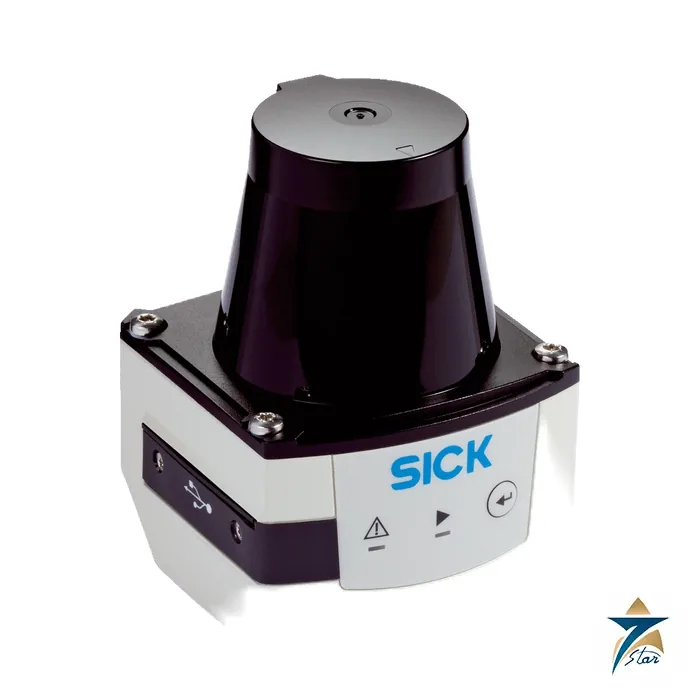
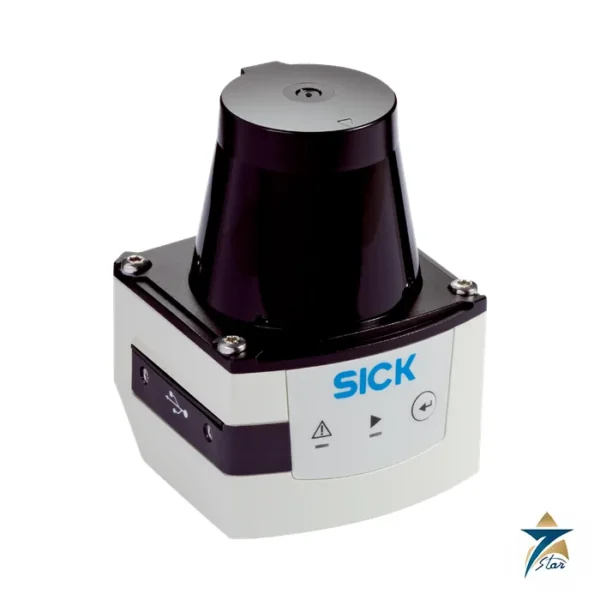
SICK TiM561-2050101 2D LiDAR Sensor, 270 deg, 10 m, Ethernet
Description
Overview
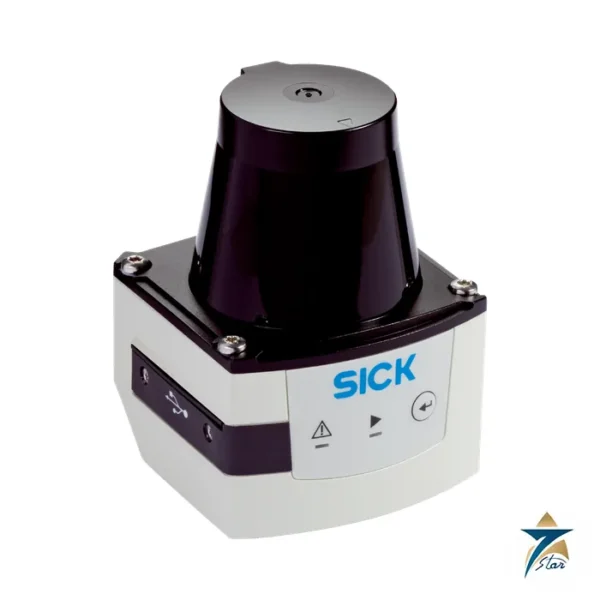
The SICK TiM561-2050101 is a compact two-dimensional LiDAR sensor from the TiM family, built for tasks that need a wide field of view in a very small housing. A laser diode and a rotating mirror inside the 60 mm by 60 mm by 86 mm body scan a 270 degree sector 15 times per second and deliver a distance value every 0.33 degrees. Using the manufacturer HDDM+ measurement principle, the unit records the contour of anything within 10 m and sends it to a computer or controller over Ethernet.
This is the Ethernet version with a working range of 0.05 m to 10 m. It weighs just 250 g without cables, which is why it is common on mobile platforms, automated guided vehicles and small gantries where weight and mounting space are tight, but it works equally well fixed to a wall or post for area and object detection.
Seven Star LLC is an independent supplier serving Oman and the GCC. This page contains data from the manufacturer data sheet for part number 1071419.
Scan geometry and accuracy of the TiM561-2050101
The aperture angle is 270 degrees, the scanning frequency is 15 Hz and the angular resolution is 0.33 degrees. The scanning range on a target with 10 percent remission is 8 m, and the full working range is 0.05 m to 10 m. The detectable remission factor runs from 4 percent to 1,000 percent when reflectors are used. Systematic error is plus or minus 60 mm and statistical error is under 20 mm, both typical at 90 percent remission up to the maximum scanning range and dependent on ambient conditions.
Response time is typically 67 ms for one scan and up to 134 ms for two scans, measured at plus 45 to plus 225 degrees of the working range, and at most 150 ms in the sector from minus 45 to plus 45 degrees. The sensor outputs measurement data only; there is no built-in field evaluation, so decisions are made by the host controller or PC.
Technical specifications of the SICK TiM561-2050101
| Parameter | Value |
|---|---|
| Type / part number | TiM561-2050101 / 1071419 |
| Application | Outdoor, indoor |
| Measurement principle | HDDM+ |
| Light source / laser class | Infrared 850 nm / class 1 |
| Aperture angle | 270 degrees |
| Scanning frequency | 15 Hz |
| Angular resolution | 0.33 degrees |
| Working range | 0.05 m to 10 m |
| Scanning range at 10 percent remission | 8 m |
| Remission factor | 4 percent to 1,000 percent (reflectors) |
| Systematic / statistical error | plus or minus 60 mm / under 20 mm |
| Response time | typically 67 ms (1 scan), up to 134 ms (2 scans) |
| Supply voltage | 9 V DC to 28 V DC |
| Power consumption | typically 4 W |
| Output current | 100 mA or less |
| Connections | Ethernet M12 4-pin, power/sync M12 5-pin, Micro USB |
| Digital output | 1 PNP, SYNC / device ready |
| Enclosure rating | IP67 with Aux interface cover closed |
| Protection class | III |
| Dimensions (L x W x H) | 60 mm x 60 mm x 86 mm |
| Weight | 250 g without cables |
| Operating temperature | minus 25 to plus 50 degrees Celsius |
| Storage temperature | minus 40 to plus 75 degrees Celsius |
| Ambient light immunity | 80,000 lx |
| MTBF / MTTFD | more than 100 years / 100 years |
How TiM561-2050101 differs from other TiM variants
The TiM family combines several ranges and interfaces. The SICK TiM561-2050101 has a 10 m working range and an Ethernet interface. The TiM571-2050101 is a longer-range type with a working range of 0.05 m to 25 m and a different weight and power budget, while codes with other suffixes add data interfaces such as CAN or different field evaluation functions. Because all of them look the same from outside, confirm the full code and the part number 1071419.
A further point is the supply: the data sheet allows 9 V to 28 V DC, drawing about 4 W, which is lower than the heated LMS1xx scanners. If your vehicle or panel has only 12 V or 24 V available, this sensor is straightforward to power.
Typical applications in Oman and the GCC
Typical uses include object detection and positioning on automated guided vehicles, collision-avoidance warnings on forklifts and cranes, volume and profile measurement of goods on conveyors, and area monitoring around docks and gates. The small housing makes retrofitting simple: the sensor can be fixed to a machine frame with a single bracket.
In the Gulf region, the combination of IP67 housing, 80,000 lx ambient light immunity and a range down to minus 25 degrees Celsius up to plus 50 degrees Celsius is useful for outdoor logistics areas and port yards, provided the maximum ambient temperature is respected in direct sun.
Installation and commissioning of the TiM561-2050101
Mount the sensor with a clear view over the full 270 degree sector and avoid placing surfaces within 0.05 m of the optics. Connect the supply to the 5-pin M12 plug and the Ethernet cable to the 4-pin M12 socket, and keep the plastic cover of the Aux interface closed after configuration, because the IP67 rating applies only in that condition.
Use the Micro USB service port with the vendor configuration tool to set parameters, then read measurement data through the Ethernet interface. The single PNP output works as a SYNC or device-ready signal, and two LEDs indicate power and device-ready state.
Maintenance of the SICK TiM561-2050101
Keep the optics window clean with a soft cloth and a mild cleaner, and avoid scratching the surface. Check bracket screws and connectors after vibration, as the sensor is tested to the shock and vibration classes in its data sheet but loose mounts degrade data quality. Update the configuration file when the geometry of the installation changes.
Record the part number 1071419 and type code so that an identical unit is ordered when a replacement is needed.
Environmental testing in the data sheet is extensive: sine and noise vibration tests, shocks of 50 g for 11 ms and continuous shocks of 25 g and 50 g, temperature cycling between minus 25 and plus 50 degrees Celsius and damp heat cycles at 95 percent relative humidity. These tests give confidence for vehicle mounting, but the operating humidity limit of under 80 percent non-condensing should still be respected in unsheltered installations.
Related items you may also need: SICK IMF18-08BPSNC0S IMF Inductive Proximity Sensor | SICK VL18-4P3240 M18 Metal Retro-Reflective Sensor, 3 m | SICK IME12-04BPOZC0S M12 Inductive Sensor, 4 mm, PNP NC | All SICK products.
Documents and quotation
The manufacturer data sheet for the SICK TiM561-2050101 accompanies this page and shows the dimensional drawing, connection details and the working range diagram.
Send your RFQ with the part number TiM561-2050101, the quantity and the delivery location in Oman or the GCC. Seven Star LLC will check availability of the SICK TiM561-2050101, and brackets and cables can be quoted in the same request.
Datasheets & Documents
- Datasheet SICK TiM561-2050101 2D LiDAR Sensor, 270 deg, 10 m, Ethernet Datasheet Download
Reviews (0)
How would you rate this product? Cancel reply
About brand
SICK is the German maker of industrial sensors: photoelectric and proximity sensors, safety laser scanners and light curtains, encoders, distance sensors, code readers and gas analysers. Erwin Sick, an optics engineer, founded it in Munich in 1946, and in 1952 it introduced its first marketable accident-prevention light curtain, which protected press operators by stopping the machine when a hand broke the light beam. The company moved to Waldkirch in the Black Forest in 1956 and is still headquartered there. It is a privately held company, and has been an Aktiengesellschaft (AG) since 1996.
SICK company profile
| Founded | 1946, Munich, Germany, by Erwin Sick (1909–1988) |
|---|---|
| Headquarters | Waldkirch, Baden-Württemberg, Germany (since 1956) |
| Ownership | Privately held; after the founder's death in 1988 his widow Gisela Sick became the main shareholder. Legal form SICK AG since 1996 |
| Size | More than 12,000 employees and group revenue of about EUR 2.3 billion (company figures for 2023) |
| First breakthrough | Accident-prevention light curtain for presses, shown in Hanover in 1952 |
| International growth | First foreign subsidiary in France in 1972, United States in 1976; today sales and service companies worldwide |
| Product families | Photoelectric, inductive, capacitive, magnetic and ultrasonic sensors; safety laser scanners, light curtains, safety controllers and relays; encoders and motor feedback systems; distance sensors and LiDAR; barcode and 2D code readers and machine vision; gas analysers, dust and flow measurement for process and emissions monitoring |
Milestones
- 1946: Erwin Sick receives a licence to run his engineering firm in Munich.
- 1952: The first marketable accident-prevention light curtain is presented in Hanover and goes into series production.
- 1956: The company moves to Waldkirch with 25 employees.
- 1972 and 1976: Subsidiaries are founded in France and the United States.
- 1996: SICK becomes an Aktiengesellschaft.
- Today: Sensors for factory and logistics automation, machine safety and process analysis, with a large share of revenue outside Germany.
Choosing a SICK sensor
For object detection, the sensing principle comes first. A retro-reflective sensor (WL series) sends light to a reflector and switches when an object breaks the beam; it is reliable over long distances and easy to align. A sensor with background suppression (WTB series) detects an object at a set distance and ignores what is behind it, which suits conveyors with shiny or dark backgrounds. A through-beam pair (WS/WE) gives the longest range and the highest reliability in dust. For transparent bottles and film, use a model built for transparent objects (for example WL12G-3B or WL150-P420). The digits in the code also matter: "P" usually means a PNP output and "N" NPN, and the last digits set the connector or cable. For machine guarding, a safety laser scanner such as nanoScan3 or microScan3 protects an area, while a safety controller such as Flexi Soft combines several safety devices.
Where SICK products are used
In Oman and the GCC, SICK sensors are used in packaging and bottling lines, food and beverage plants, logistics and airport baggage handling, cement and steel plants, ports and cranes, automated warehouses, and on machines built by European OEMs. SICK safety scanners guard robots and automated guided vehicles, and its encoders give position feedback on motors, hoists and conveyors.
SICK products we list
| Family | Examples |
|---|---|
| Photoelectric sensors | WL12-3P2431, WTB12-3P2431, GTB6-P4211, VL18-4P3240, WL12G-3B2531, WS/WE100, KT5W contrast, W26 IO-Link |
| Proximity, cylinder and ultrasonic sensors | IME12-08NPSZC0S, IME18-05BPSZC0S, MZT8, UM18 4-20 mA, UM30, UFN3 fork |
| Machine safety | nanoScan3, microScan3, S300 Professional, Flexi Soft FX3-CPU1, FX3-XTIO, ReLy OSSD |
| Encoders and motor feedback | DFS60B, AFM60 PROFINET, AFS60 SSI, ATM60 PROFIBUS, SRS50, EFS50 |
| Distance sensors and code readers | DT50, DL50, DT35, Lector632 |
Ordering SICK products: what we need
Send the type code and the 7-digit SICK part number from the label (for example WTB12-3P2431 together with its part number). For a replacement sensor, add the output (PNP or NPN), connection (M8, M12 or cable) and sensing distance. For encoders, add the interface (incremental, SSI, PROFIBUS, PROFINET), resolution and shaft type. For safety scanners, tell us the model and whether the existing configuration needs to be kept.
Frequently requested SICK models: SICK WTB4-3 Miniature Photoelectric Proximity Sensor, SICK IME18-08NPSZW2K Inductive Proximity Sensor, SICK DT35-B15251 Laser Distance Sensor, SICK microScan3 Safety Laser Scanner, SICK RZT7-03ZUS-KWB T-Slot Cylinder Sensor.
Facts checked against SICK's published company history and annual figures, October 2026.
Browse SICK products by category: Sensors & Transmitters.
FAQ
Questions about the SICK TiM561-2050101 2D LiDAR Sensor, 270 deg, 10 m,
Answers from our engineering team on installation, compatibility and integration.
01What is the working range of the TiM561-2050101?
The working range is 0.05 m to 10 m, with a scanning range of 8 m on a target with 10 percent remission.
02What scan angle does the TiM561-2050101 have?
It scans 270 degrees at 15 Hz with an angular resolution of 0.33 degrees.
03What interface does the TiM561-2050101 use?
It uses Ethernet TCP/IP for measurement data, a Micro USB port for service and parameterization, and one PNP SYNC or device-ready output.
04What supply does the TiM561-2050101 need?
It needs 9 V DC to 28 V DC and draws typically 4 W.
05How large is the TiM561-2050101?
The body is 60 mm by 60 mm by 86 mm and weighs 250 g without connecting cables.


Reviews
There are no reviews yet.