Endress+Hauser FMU42 Prosonic M flanged ultrasonic level transmitter, 10 m
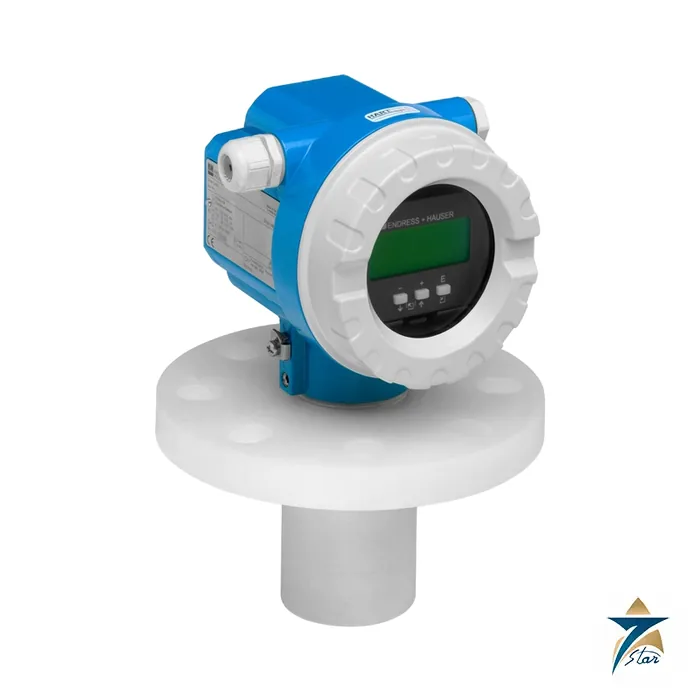
The Endress+Hauser FMU42 is the long-range flanged member of the Prosonic M family. It is a two-wire ultrasonic transmitter with 4 to 20 mA HART that measures up to 10 m in liquids and 5 m in bulk solids from a universal flange or a mounting bracket. The FMU42 is built for taller vessels and for installations where a flanged nozzle, rather than a thread, is the standard. Seven Star LLC, an independent supplier in Muscat, supplies the FMU42 and related level instruments in Oman and the GCC.
It differs from the threaded FMU40 and FMU41 in more than the connection: the sensor is larger (about 70 mm in diameter), the frequency is lower at roughly 42 kHz, the blocking distance is longer at 0.4 m, and the accuracy figure is relaxed to ±4 mm. Those trade-offs buy the extra range.
FMU42 technical specifications
| Parameter |
Specification |
| Manufacturer / part number |
Endress+Hauser / FMU42 (Prosonic M) |
| Measuring principle |
Ultrasonic, time of flight |
| Maximum range |
Liquids 10 m (33 ft); bulk solids 5 m (16 ft) |
| Blocking distance |
0.4 m (1.3 ft) |
| Accuracy |
±4 mm or ±0.2 % of the measured distance, whichever is larger |
| Resolution |
2 mm |
| Operating frequency |
Approx. 42 kHz; beam angle 9 ° |
| Max. sound pressure level |
149 dB directly in front of the sensor |
| Output / communication |
2-wire 4 to 20 mA with HART |
| Process temperature |
-40 °C to 80 °C (-40 °F to 176 °F) |
| Process pressure |
0.7 bar to 2.5 bar abs (10 psi to 36 psi) |
| Process connection |
Universal flange DN80 PN16 / ANSI 3″ 150 lbs / JIS 10K 80; DN100 PN16 / ANSI 4″ 150 lbs / JIS 16K 100; mounting bracket |
| Wetted parts |
PVDF sensor; EPDM or FKM seal; flange in PP, PVDF or 316L |
| Housing / protection |
Aluminium F12 or T12; IP66/NEMA 4X and IP68/NEMA 6P |
| Weight |
Approx. 3 kg |
| Approvals listed |
ATEX, FM, CSA, IEC, INMETRO, NEPSI |
Decoding the FMU42 flange choices
The FMU42 is listed with flange and bracket connections only, with no threaded version. Its universal flange fits one of two nozzle sizes and carries several pressure standards on the same plate, which is useful when you must match an existing nozzle but are not sure of the drilling.
- DN80 PN16, ANSI 3″ 150 lbs or JIS 10K 80 for smaller nozzles.
- DN100 PN16, ANSI 4″ 150 lbs or JIS 16K 100 for four-inch nozzles.
- Mounting bracket where the sensor is hung over an open pit, channel or non-hazardous area, with no nozzle at all.
The flange material can be PP, PVDF or 316L stainless steel, and the seal is EPDM or FKM. This is the main choice that decides chemical compatibility, and it should be confirmed against the medium and its vapour before ordering.
How the FMU42 measures
The transducer sends an ultrasonic burst and measures the time until the echo returns from the surface. Distance is c times t over two, and level is the empty distance minus that value. An integrated temperature sensor corrects the sound speed. Mapping suppresses stationary echoes from welds and fittings, and linearization converts level into volume or flow with up to 32 table points and preset tank shapes. At 10 m the beam is about 9 degrees wide and has a radius near 0.79 m at the far end.
Range, attenuation and what it means in the field
At 42 kHz the signal survives longer air paths, but the data sheet still asks the engineer to total the attenuation: waves at 5 to 10 dB, strong turbulence at 10 to 20 dB, heavy dust at 5 to 20 dB, a filling curtain at up to 40 dB, and a temperature difference between sensor and surface of up to 20 dB. Rough solid surfaces cost 40 dB or more. The range chart then converts the total into metres. A 10 m figure on the nameplate is therefore the best case, and difficult vessels deserve a quick check.
Where the FMU42 fits: related Endress+Hauser parts
For vessels under 8 m with a threaded nozzle, the FMU41 or FMU40 are simpler and more precise. The FMU95 multi-channel transmitter is an alternative when many measuring points feed one unit, and the FTW31 and FTW32 supply conductive switch points as independent overfill alarms. The product page for the FMU42 itself points to the FMU44 or an FDU92 sensor for foam and strong turbulence, and to the FMU90 with FDU9x sensors for fast filling and emptying or limit detection.
FMU42 selection and ordering checklist
- Check that the empty distance is within 10 m (5 m for solids) and the full level stays below 0.4 m.
- Confirm the nozzle: DN80 or DN100, and its length, which is limited to 250 mm for DN80 and 300 mm for DN100.
- Choose flange material and seal for the vapours present.
- Check pressure against 0.7 to 2.5 bar abs, lower than the threaded models.
- Decide on housing, cable entry and hazardous-area approval.
- Select the 4 mm class accuracy as acceptable, or step to a shorter-range model if tighter figures are needed.
Installation, commissioning and maintenance of the FMU42
Keep nozzle interiors smooth and deburred, ideally with a 45 degree edge, and stay within the maximum nozzle length for the nozzle diameter. Mount the sensor perpendicular to the surface, away from the filling stream and from other ultrasonic devices. Use a weather cover where the unit sits in direct sun. The housing can be turned up to 350 degrees after releasing the securing screw, and the LCD works with limits below -20 °C and above 60 °C.
During commissioning set empty and span, record the interference map at a known level, and test the HART loop with a 250 Ω resistance. Maintenance means wiping deposits from the PVDF face and re-mapping after tank modifications.
Typical FMU42 applications in Oman and the GCC
Large water storage tanks, seawater intake and brine buffer tanks, tall process tanks and wastewater lift stations are natural candidates, as are open reservoirs and channels where a bracket suits better than a nozzle. Plants near the coast should pick the flange and seal materials with salt-laden air and cleaning chemicals in mind, and shade or cover the transmitter against roof heat.
Prosonic M family comparison
| Item |
FMU40 |
FMU41 |
FMU42 |
| Liquid range |
5 m |
8 m |
10 m |
| Accuracy |
±2 mm |
±2 mm |
±4 mm |
| Max. pressure |
3 bar abs |
3 bar abs |
2.5 bar abs |
| Connection |
1 1/2″ thread |
2″ thread |
Flange DN80/DN100 |
Information to send with an RFQ for the FMU42
- Part number FMU42 and quantity, or the order code if replacing a unit.
- Medium, vapour and foam conditions, vessel height and level limits.
- Nozzle size and length, flange standard and material preference.
- Pressure, temperature and hazardous-area classification.
Documents and quotation
The Technical Information for the FMU42 is attached on this page. Compare it with the order code you need, since options differ by configuration.
Send the FMU42 part number or the nameplate order code, the quantity and the delivery location, and Seven Star LLC will confirm availability and lead time.
Other Models in the Prosonic Ultrasonic Level Range
Seven Star LLC supplies models from the Prosonic Ultrasonic Level range in Oman and the GCC. Compare the related models below and request a quote for the one that matches your application.


















Reviews
There are no reviews yet.