- AC Drives
- Industrial Communications
- PLC & I/O Cards
- Automation Accessories
- Vibration Monitoring
- Controllers & Data Acquisition
- CCTV & Security
- Safety Switches & Guard Locking
- Encoders
- Industrial Computers
- Servo Drives
- Motor Soft Starters
- HMI Displays
- Pneumatic Cylinders
- Isolator & Barrier
- Automation Software
- Machine Vision
- Robotics
Brand: SICK
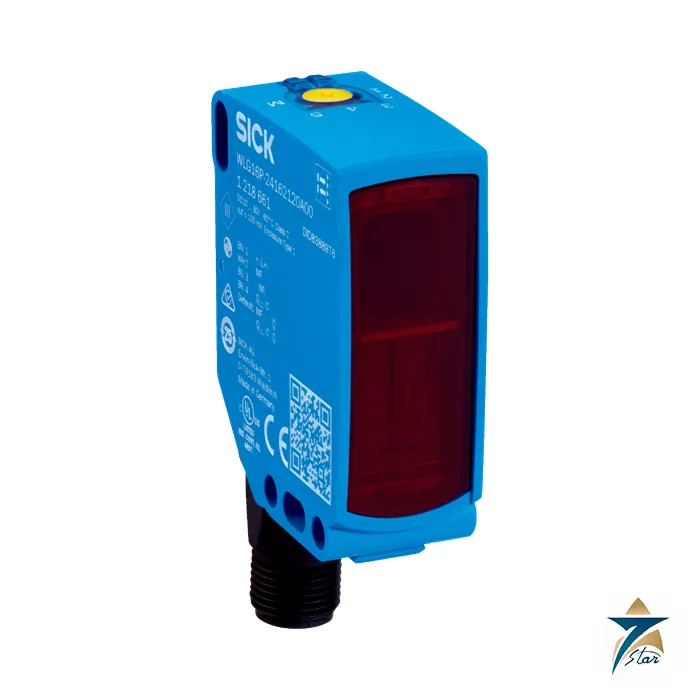
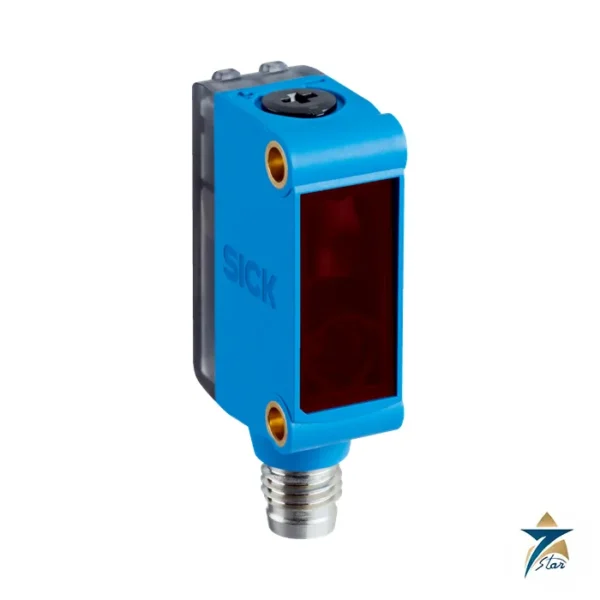
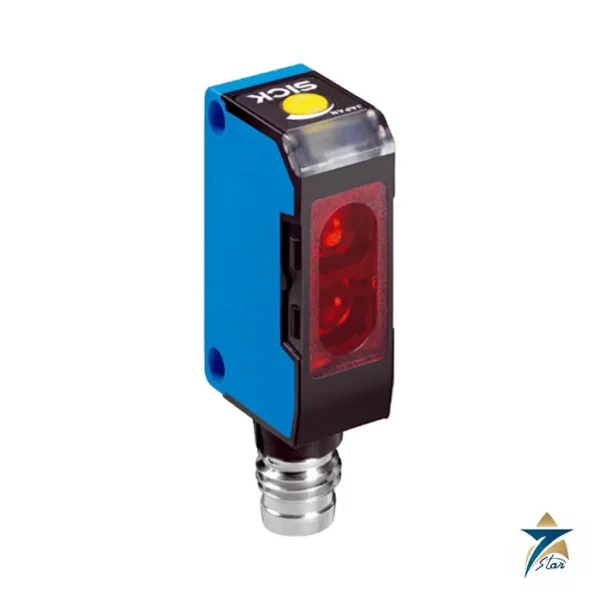
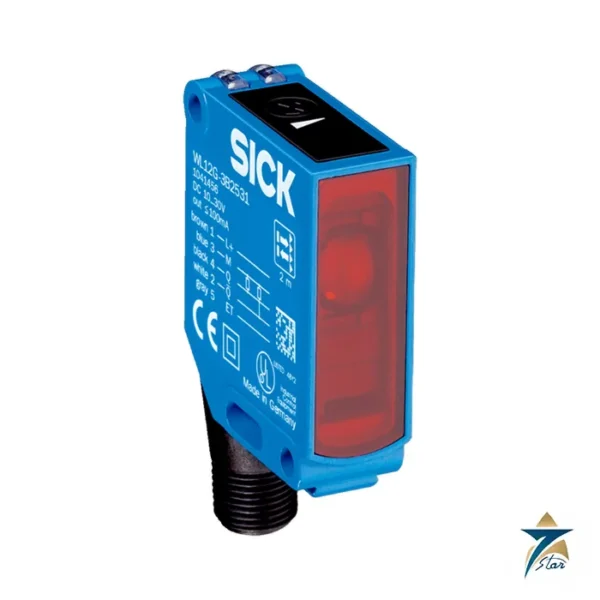
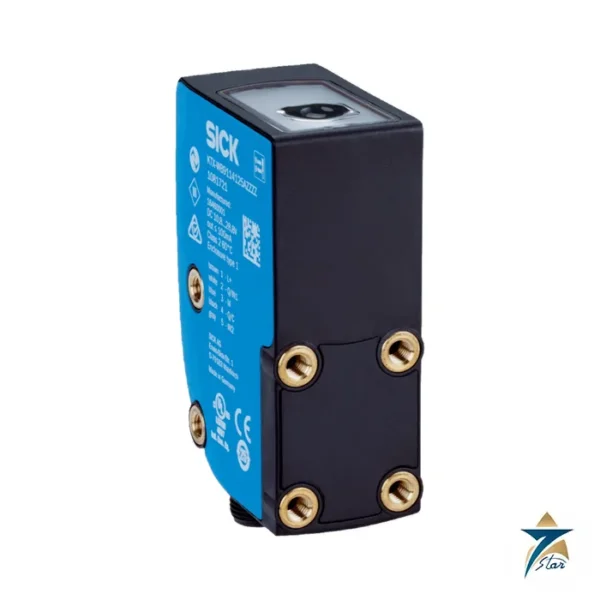
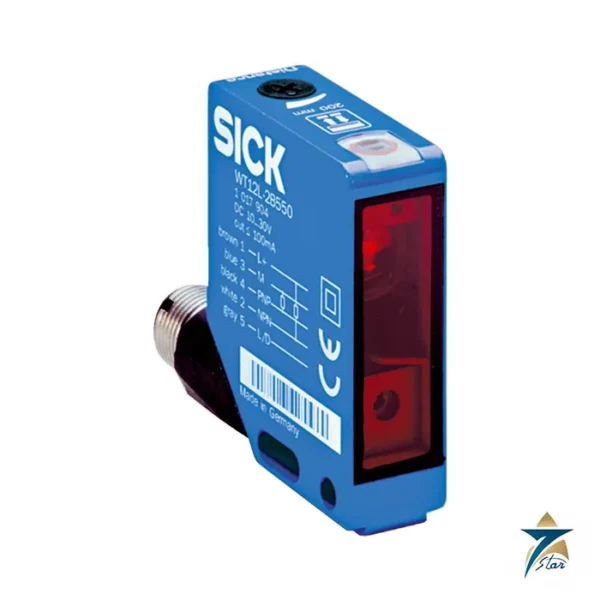
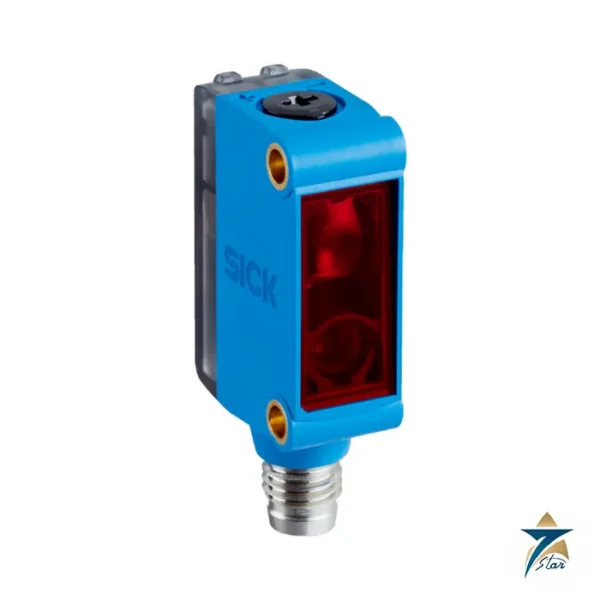
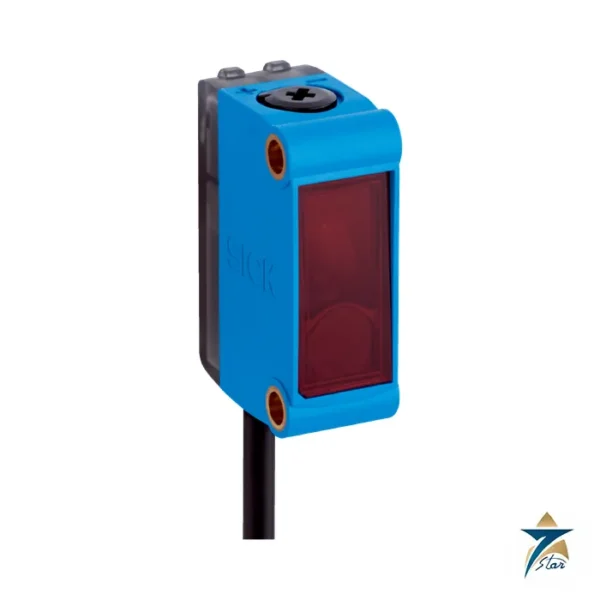
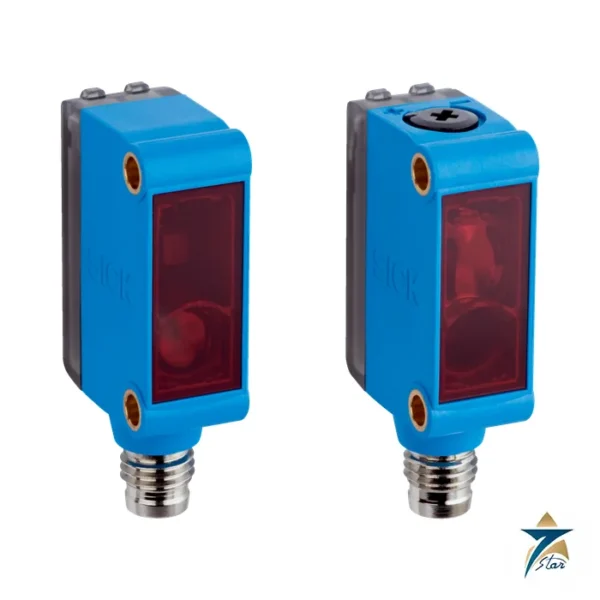
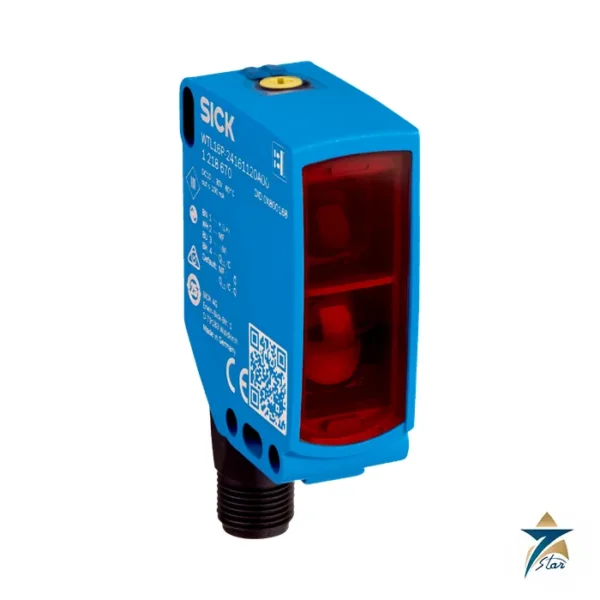
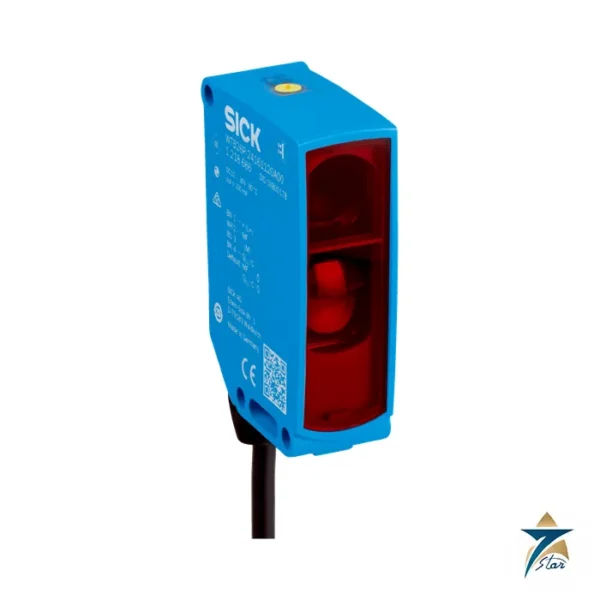
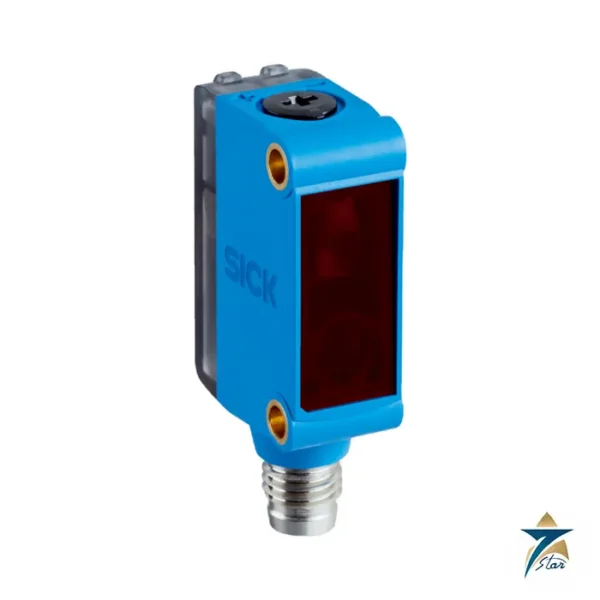
SICK WLG16P-24162120A00 W16 Retro-Reflective Sensor
Description
WLG16P-24162120A00 is a SICK W16 retro-reflective photoelectric sensor (part no. 1218661) that sends a light beam to a reflector and switches when an object interrupts it. The catalogue summary lists: sensing range min. / max.: 0 m / 5 m; functional principle: Photoelectric retro-reflective sensor; switching output: Push-pull: PNP/NPN; switching mode: Light/dark switching; connection type: Male connector M12, 4-pin.
How the WLG16P-24162120A00 works and where it fits
The beam travels to the reflector and back; the output changes when something blocks it. The reflector is part of the system.
Polarisation filters in the sensor allow shiny objects to be detected: a mirror-like surface reflects light without rotating its polarisation, so it is not mistaken for the reflector. Reflex sensors are less accurate than through-beam sensors at detecting small or transparent objects, because the light passes the object twice and the loss may be small.
Technical specifications
| Parameter | Specification |
|---|---|
| Type code | WLG16P-24162120A00 |
| Part number | 1218661 |
| Product family | W16 |
| Functional principle | Photoelectric retro-reflective sensor |
| Functional principle detail | Without reflector minimum distance (autocollimation/coaxial optics), ClearSens |
| Sensing range: Sensing range min. | 0 m |
| Sensing range: Sensing range max. | 5 m |
| Sensing range: Maximum distance range from reflector to sensor (operating reserve 1) | 0 m … 5 m |
| Sensing range: Reference reflector | Reflector P250F |
| Sensing range: Recommended sensing range for the best performance | 0 m … 5 m |
| Polarisation filter | Yes |
| Emitted beam: Light source | PinPoint LED |
| Emitted beam: Type of light | Visible red light |
| Emitted beam: Shape of light spot | Point-shaped |
| Emitted beam: Light spot size (distance) | Ø 80 mm (5 m) |
| Emitted beam: Maximum dispersion of the emitted beam around the standardized transmission axis (squint angle) | < +/- 1.0° (at TU = +23 °C) |
| Key LED figures: Normative reference | EN 62471:2008-09 | IEC 62471:2006, modified |
| Key LED figures: LED risk group marking | Free group |
| Key LED figures: Wave length | 635 nm |
| Key LED figures: Average service life | 100,000 h at Ta = +25 °C |
| Adjustment: Teach-Turn adjustment | BluePilot; Teach-in plus user mode selector |
| Adjustment: IO-Link | For configuring the sensor parameters and Smart Task functions |
| Special applications | Detecting transparent objects |
| MTTFD | 690 years |
| DCavg | 0% |
| IO-Link | ✔ , IO-Link V1.1 |
| Data transmission rate | COM2 (38,4 kBaud) |
| Process data length | 16 Bit |
| Process data structure | Bit 0 = switching signal QL1 |
| VendorID | 26 |
| Declarations and certificates in the data sheet | EU declaration of conformity; UK declaration of conformity; ACMA declaration of conformity; Moroccan declaration of conformity; China RoHS; China Compulsory Product Certification (CCC) exempt; ECOLAB certificate; cULus certificate; IO-Link certificate; Photobiological safety (DIN EN 62471) certificate; Information according to Art. 3 of Data Act (Regulation EU 2023/2854) |
Selection and installation notes for WLG16P-24162120A00
Wiring data to note: response time: ≤ 500 µs; supply: 10 V DC … 30 V DC; range: 0 m; frequency: 1,000 Hz; current: ≤ 30 mA, without load. At UB = 24 V.
Housing and environmental limits listed: weight approx. 50 g; operating temperature –40 °C … +60 °C; light source pinPoint LED; dimensions 20 mm x 55.7 mm x 42 mm; enclosure rating IP66 (EN 60529); IP67 (EN 60529); IP69 (EN 60529); wavelength 635 nm.
For installation, mount sensor and reflector rigidly, keep the optical path free of steam and dust where possible, and avoid other shiny surfaces close to the beam that could return the light by mistake.
Check the enclosure rating, the housing material and the operating temperature range in the table against the environment; reflectors and sensors for washdown or outdoor use are different items.
Related SICK products: SICK WLA16P-24162100A00 Retro-Reflective Sensor, SICK WLA26P-24162100A00 W26 IO-Link Retro-Reflective Sensor, SICK GL6G-P4211 Retro-Reflective Sensor, SICK WL4SL-3P2232 W4 Retro-Reflective Sensor, SICK WL4SLG-3P5254H W4 Retro-Reflective Sensor and SICK WL12G-3V2572 Retro-Reflective Sensor.
Documents and quotation
Attached to this page: the SICK data sheet for WLG16P-24162120A00, part no. 1218661, as published by SICK. Quotations are prepared by Seven Star LLC, an independent supplier in Muscat, once you send the part number, quantity and site through the RFQ form. Browse more in Sensors & Transmitters. Compare the complete type code with your existing unit and controller before ordering; the data sheet prevails if it differs from this page.
Datasheets & Documents
- Datasheet SICK WLG16P-24162120A00 official data sheet (part no. 1218661) Download
Reviews (0)
How would you rate this product? Cancel reply
About brand
SICK is the German maker of industrial sensors: photoelectric and proximity sensors, safety laser scanners and light curtains, encoders, distance sensors, code readers and gas analysers. Erwin Sick, an optics engineer, founded it in Munich in 1946, and in 1952 it introduced its first marketable accident-prevention light curtain, which protected press operators by stopping the machine when a hand broke the light beam. The company moved to Waldkirch in the Black Forest in 1956 and is still headquartered there. It is a privately held company, and has been an Aktiengesellschaft (AG) since 1996.
SICK company profile
| Founded | 1946, Munich, Germany, by Erwin Sick (1909–1988) |
|---|---|
| Headquarters | Waldkirch, Baden-Württemberg, Germany (since 1956) |
| Ownership | Privately held; after the founder's death in 1988 his widow Gisela Sick became the main shareholder. Legal form SICK AG since 1996 |
| Size | More than 12,000 employees and group revenue of about EUR 2.3 billion (company figures for 2023) |
| First breakthrough | Accident-prevention light curtain for presses, shown in Hanover in 1952 |
| International growth | First foreign subsidiary in France in 1972, United States in 1976; today sales and service companies worldwide |
| Product families | Photoelectric, inductive, capacitive, magnetic and ultrasonic sensors; safety laser scanners, light curtains, safety controllers and relays; encoders and motor feedback systems; distance sensors and LiDAR; barcode and 2D code readers and machine vision; gas analysers, dust and flow measurement for process and emissions monitoring |
Milestones
- 1946: Erwin Sick receives a licence to run his engineering firm in Munich.
- 1952: The first marketable accident-prevention light curtain is presented in Hanover and goes into series production.
- 1956: The company moves to Waldkirch with 25 employees.
- 1972 and 1976: Subsidiaries are founded in France and the United States.
- 1996: SICK becomes an Aktiengesellschaft.
- Today: Sensors for factory and logistics automation, machine safety and process analysis, with a large share of revenue outside Germany.
Choosing a SICK sensor
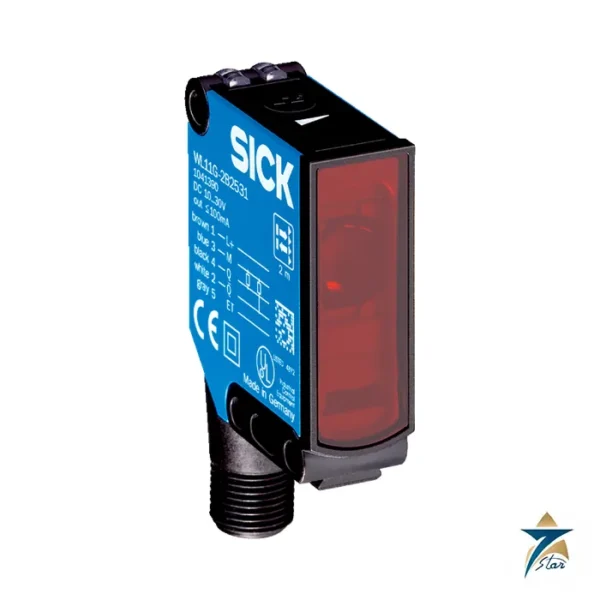
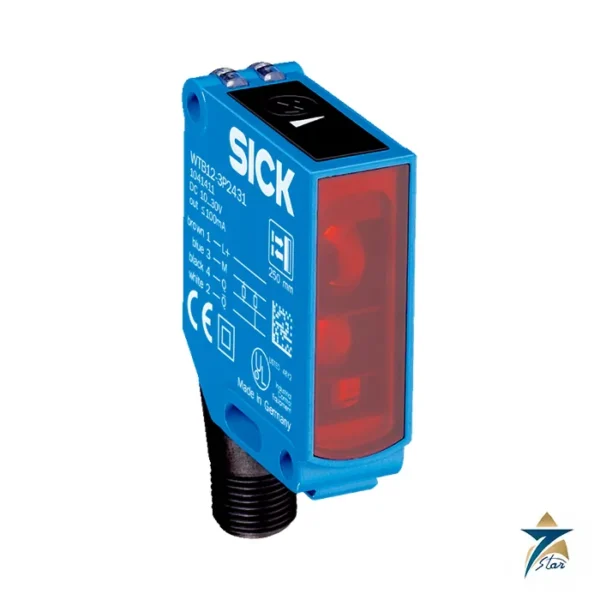
For object detection, the sensing principle comes first. A retro-reflective sensor (WL series) sends light to a reflector and switches when an object breaks the beam; it is reliable over long distances and easy to align. A sensor with background suppression (WTB series) detects an object at a set distance and ignores what is behind it, which suits conveyors with shiny or dark backgrounds. A through-beam pair (WS/WE) gives the longest range and the highest reliability in dust. For transparent bottles and film, use a model built for transparent objects (for example WL12G-3B or WL150-P420). The digits in the code also matter: "P" usually means a PNP output and "N" NPN, and the last digits set the connector or cable. For machine guarding, a safety laser scanner such as nanoScan3 or microScan3 protects an area, while a safety controller such as Flexi Soft combines several safety devices.
Where SICK products are used
In Oman and the GCC, SICK sensors are used in packaging and bottling lines, food and beverage plants, logistics and airport baggage handling, cement and steel plants, ports and cranes, automated warehouses, and on machines built by European OEMs. SICK safety scanners guard robots and automated guided vehicles, and its encoders give position feedback on motors, hoists and conveyors.
SICK products we list
| Family | Examples |
|---|---|
| Photoelectric sensors | WL12-3P2431, WTB12-3P2431, GTB6-P4211, VL18-4P3240, WL12G-3B2531, WS/WE100, KT5W contrast, W26 IO-Link |
| Proximity, cylinder and ultrasonic sensors | IME12-08NPSZC0S, IME18-05BPSZC0S, MZT8, UM18 4-20 mA, UM30, UFN3 fork |
| Machine safety | nanoScan3, microScan3, S300 Professional, Flexi Soft FX3-CPU1, FX3-XTIO, ReLy OSSD |
| Encoders and motor feedback | DFS60B, AFM60 PROFINET, AFS60 SSI, ATM60 PROFIBUS, SRS50, EFS50 |
| Distance sensors and code readers | DT50, DL50, DT35, Lector632 |
Ordering SICK products: what we need
Send the type code and the 7-digit SICK part number from the label (for example WTB12-3P2431 together with its part number). For a replacement sensor, add the output (PNP or NPN), connection (M8, M12 or cable) and sensing distance. For encoders, add the interface (incremental, SSI, PROFIBUS, PROFINET), resolution and shaft type. For safety scanners, tell us the model and whether the existing configuration needs to be kept.
Facts checked against SICK's published company history and annual figures, October 2026.
Browse SICK products by category: Sensors & Transmitters.
Related products
Frequently Asked Questions
It is a SICK retro-reflective sensor (W16), part no. 1218661. The catalogue summary reads: Sensing range min. / max.: 0 m / 5 m; Functional principle: Photoelectric retro-reflective sensor; Switching output: Push-pull: PNP/NPN; Switching mode: Light/dark switching.
Supply voltage is 10 V DC ... 30 V DC. Check the output and interface rows in the table for the signal levels.
Enclosure rating: IP66 (EN 60529); IP67 (EN 60529); IP69 (EN 60529). Ambient operating temperature: –40 °C ... +60 °C. Confirm both against the site before ordering.
Yes. The official SICK data sheet for part no. 1218661 is attached as a PDF and linked on this page; where it differs from the page text, the data sheet applies.
Compare the full type code and part number 1218661 with the device being replaced, check supply, output or interface and mounting, and send the details through the RFQ form. Seven Star LLC is an independent supplier, not a SICK partner.

Reviews
There are no reviews yet.