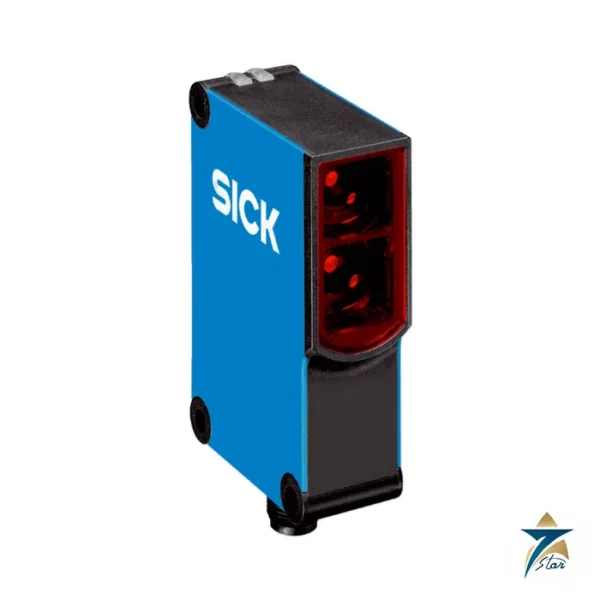
KT5 contrast sensor for registration marks, NPN output
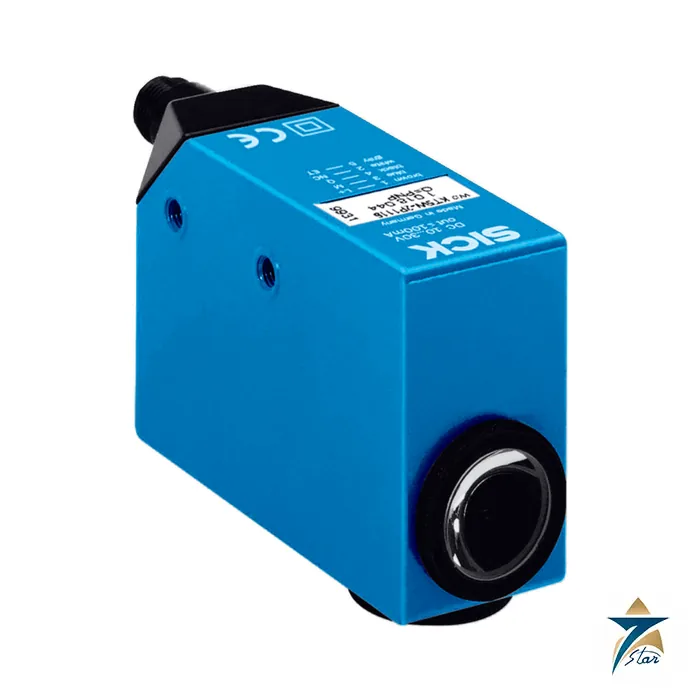
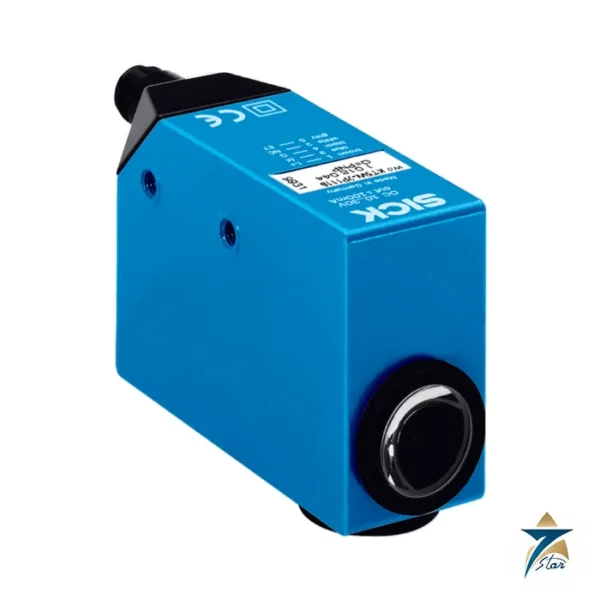
The SICK KT5W-2N1116 (part no. 1018045) is a KT5 contrast sensor with an NPN output. It uses a white RGB LED source with 470, 525 and 640 nm wavelengths and detects print marks, register marks and colour differences at a sensing distance of up to 10 mm. The 1.2 mm by 4.2 mm light spot is oriented vertically, and the 30.4 mm by 53 mm by 80 mm zinc diecast housing is rated IP67.
SICK shows this type in its catalogue archive on sick.com, so confirm availability and any replacement with SICK before ordering for new machines.
Technical specifications
| Parameter |
Specification |
| Manufacturer |
SICK |
| Type / family |
KT5W-2N1116 / KT5 |
| Part no. |
1018045 |
| Housing design |
Middle |
| Dimensions (W x H x D) |
30.4 mm x 53 mm x 80 mm |
| Light source |
LED, RGB |
| Wavelengths |
470 nm, 525 nm, 640 nm |
| Light emission |
Long and short side of housing, exchangeable |
| Light spot size / direction |
1.2 mm x 4.2 mm / vertical |
| Sensing distance |
up to 10 mm (from lens edge) |
| Adjustment / teach-in |
Teach-in button; static 2-point teach-in |
| Supply voltage |
10 V DC … 30 V DC |
| Ripple |
up to 5 Vpp |
| Current consumption |
below 80 mA |
| Switching frequency / response time |
10 kHz / 50 microseconds |
| Switching output |
NPN (HIGH approx. UV / LOW up to 2 V) |
| Output current Imax. |
100 mA |
| Teach input (ET) |
NPN: teach U below 2 V; run U = 10 V to UV |
| Retention time (ET) |
25 ms, non-volatile memory |
| Protection class |
II |
| Circuit protection |
Reverse polarity protected, Q short-circuit protected, interference pulse suppression |
| Connection |
Plug, M12, 5-pin |
| Housing material |
Zinc diecast |
| Weight |
400 g |
| Enclosure rating |
IP67 |
| Ambient temperature |
-10 °C … +55 °C operation; -25 °C … +75 °C storage |
What contrast sensors do
A contrast sensor measures the reflected light from a small spot and switches when the brightness or colour differs from the taught reference. Typical uses are printed register marks on packaging film, labels on a liner, tab and cut detection and the detection of coloured objects on a similar background. An RGB light source covers more colour pairs than a single-colour LED.
Teaching is done with the button or the teach input in two points: one on the mark, one on the background. The sensing distance of 10 mm is measured from the leading edge of the lens, and the spot is vertical, so orient the sensor so that the long side of the spot crosses the mark across its width. The light emission can be changed between long and short side of the housing, which allows two mounting directions.
NPN versus PNP version
The KT5W-2N1116 has an NPN output and is intended for controllers with sinking-type inputs. The PNP sibling KT5W-2P1116 (part no. 1018044) has identical optics and housing but a PNP output and reversed teach-input logic, so the two are not interchangeable without checking the PLC wiring. Quote the full type and part number.
Key features of the KT5W-2N1116
- RGB light source: the sensor evaluates red, green and blue light (640, 525 and 470 nm), so it can pick the colour that gives the strongest contrast between mark and background.
- Fast response: 10 kHz switching frequency and 50 µs response time support high web and packaging line speeds.
- Static 2-point teach-in: the sensor learns the mark and the background separately, which gives a reliable threshold on difficult material.
- External teach input: the teach can be triggered from a PLC, so format changes do not need someone at the sensor.
- Exchangeable light emission: light can exit from the long or short side of the housing to suit the mounting space.
- Robust housing: zinc diecast with IP67, suited to washdown and dusty production areas.
Setting up the sensor
Mount the sensor so the light spot hits the material at the stated sensing distance, measured from the lens edge. Contrast sensors work on diffuse reflection, so shiny or foil-laminated materials can produce strong specular reflections; tilting the sensor a few degrees away from perpendicular usually reduces this effect. Align the 1.2 x 4.2 mm spot with the long dimension across the direction of travel or along it according to the mark shape and the position tolerance of the web.
For the teach, first present the background and press the button, then present the mark and press again (or use the external teach input with the timing described in the operating instructions). Repeat the teach whenever the material, print colour or sensing distance changes. The taught values are stored in non-volatile memory, so they are kept after power loss.
Wiring an NPN sensor
With an NPN output, the sensor switches the load to 0 V. The load (a PLC input or a relay) is connected between the positive supply and the sensor output. This suits sinking-type controller inputs common on some Asian and older machines. If your PLC input card is designed for sourcing sensors, the PNP version described above is the correct choice. Use a shielded cable with the M12 5-pin connector on electrically noisy machines, and route it away from motor cables and drive outputs.
Applications
- Registration mark detection for cutting, sealing and printing on packaging machines.
- Label and print presence checks.
- Detecting colour differences between products or on edges of materials.
- Tube and carton orientation on filling lines in food, pharmaceutical and consumer goods plants.
Use in Oman and GCC facilities
Packaging and bottling plants in the region often deal with high ambient temperatures and condensation on chilled products. Keep the lens clean, since dust and condensation reduce the received light and therefore the contrast margin. Check the sensor during routine cleaning and re-teach if the switching becomes unstable.
What to include in an RFQ
Give the type code KT5W-2N1116 and part number 1018045, the quantity, and whether a matching M12 cable or mounting bracket is needed. As SICK shows this type in its archive, please tell us whether a successor model would be acceptable.
Documents and quotation
Download the manufacturer data sheet for KT5W-2N1116 (part no. 1018045) from this page; it is the source of every specification listed here. SICK lists this type in its catalogue archive, so lifecycle status and any named successor should be checked first. To request a price, send the type code and part number to Seven Star LLC, an independent supplier based in Muscat, together with the quantity and the site where the goods are needed. Please confirm before ordering that the version, connector and accessories (clamps, reflector or a cable with connector) match your drawings, because published data may change without notice. Related items can be found in sensors and transmitters and in the SICK WTB4-3 miniature photoelectric sensor.












Reviews
There are no reviews yet.