G10 reflex sensor for foil-wrapped products, up to 9.5 m
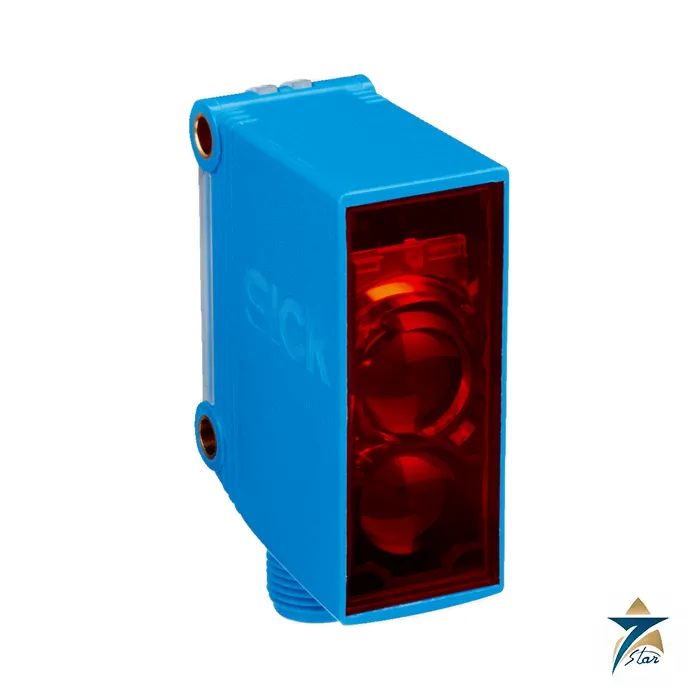
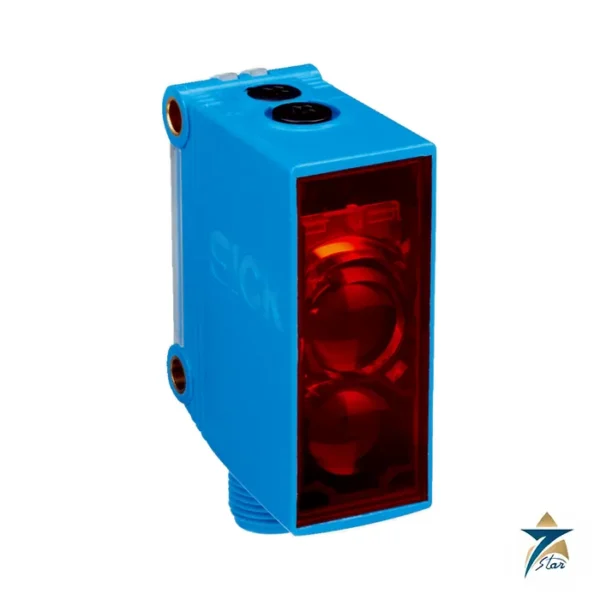
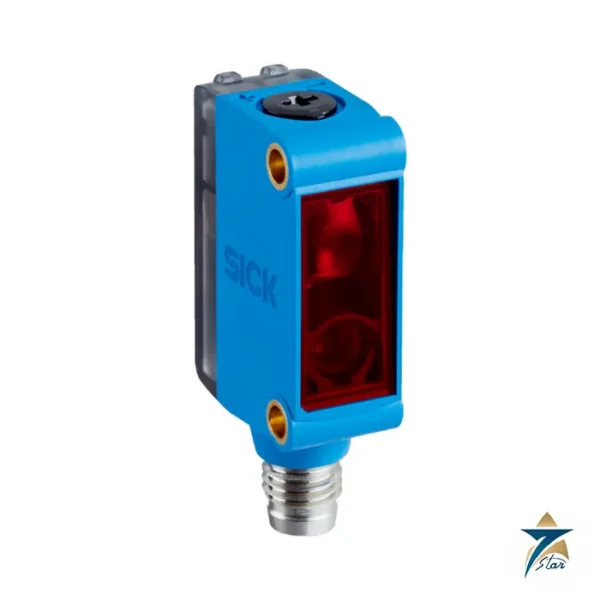
The SICK GL10-F4551 (part no. 1071153) is a G10 retro-reflective sensor developed for objects wrapped in film. SICK states a typical range of 0.3 m to 9.5 m with the PL80A reflector (maximum 0.15 m to 12 m) and 0.3 m to 8 m with a P250 reflector. A PinPoint LED gives a 58 mm spot at 5 m, and the output is PNP, complementary, with light/dark switching.
The data sheet lists high functional reliability on foil-wrapped objects and compliance with UL325 when used with the BEF-G10WSG protection hood.
Technical specifications
| Parameter |
Specification |
| Manufacturer |
SICK |
| Type / family |
GL10-F4551 / G10 |
| Part no. |
1071153 |
| Functional principle |
Photoelectric retro-reflective sensor, dual-lens system |
| Sensing range with PL80A |
0.3 m … 9.5 m typical; max. 0.15 m … 12 m |
| Sensing range with P250 |
0.3 m … 8 m typical; max. 0.15 m … 10 m |
| Polarising filter |
Yes |
| Light source / type |
PinPoint LED, visible red light, 625 nm |
| Light spot size |
58 mm diameter at 5 m |
| Special application |
Detecting objects wrapped in film |
| Adjustment |
None |
| Supply voltage UB |
10 V DC … 30 V DC |
| Ripple |
below 5 Vpp |
| Current consumption |
20 mA |
| Output |
PNP, complementary, light/dark switching |
| Output current Imax. |
100 mA |
| Response time / switching frequency |
1 ms max. / 500 Hz |
| Protection class |
III |
| Dimensions (W x H x D) |
20 mm x 50 mm x 39 mm |
| Housing material |
Plastic ABS/PMMA |
| Connection |
Male connector M12, 4-pin |
| Weight |
35 g |
| Enclosure rating |
IP67 |
| Standards |
EN 60947-5-2; UL325 with protection hood BEF-G10WSG (2071960) |
| Ambient temperature |
-30 °C … +60 °C operation; -40 °C … +70 °C storage |
| MTTFD |
2,043 years (DCavg 0 %) |
| UL file no. |
NRKH.E348498 and NRKH7.E348498 |
Beam through stretch film and shrink wrap
Pallets and cartons wrapped in clear stretch film create reflections and partial transparency that confuse ordinary sensors. This type is specified for such films, and the data sheet describes high functional reliability on foil-wrapped objects. It has no adjustment, which removes tampering and reduces commissioning time.
Mount the reflector perpendicular to the beam, keep the lens clean and respect the minimum distance of 0.15 m to 0.3 m. For automatic gate use under UL325 fit the protection hood BEF-G10WSG, which is not included in the delivery.
Ordering note
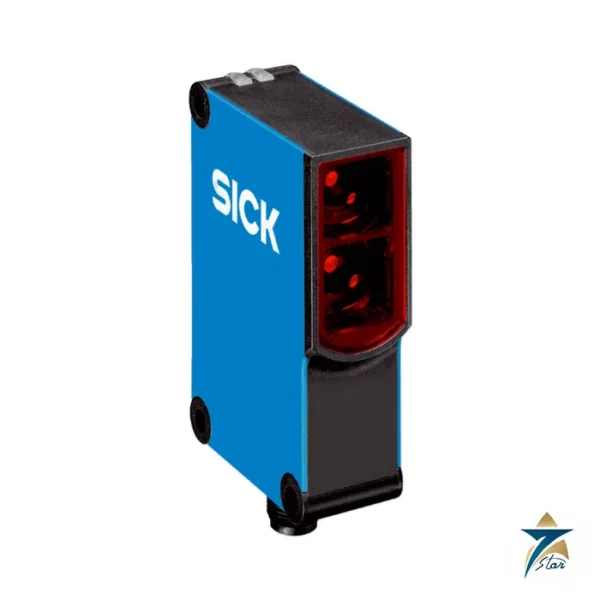
The reference is GL10-F4551 with part no. 1071153. The G10 background-suppression sibling GTB10-P4211 in this order list uses the same housing but does not need a reflector. The sensor is delivered without a reflector; order a PL80A or P250 separately.
Key features of the GL10-F4551
- Optimised for film: the optics and switching behaviour are tuned for objects wrapped in transparent stretch or shrink film, where a standard reflex sensor may miss the object or switch erratically.
- Polarising filter: together with a suitable prismatic reflector, the filter helps the sensor ignore reflections from shiny surfaces and respond only to light returned by the reflector.
- Dual-lens system: separate sender and receiver lenses support reliable detection across the specified range.
- Visible red PinPoint spot: the bright, well-defined light spot makes alignment with the reflector quick, even over long distances.
- Complementary PNP output: both light-switching and dark-switching signals are available, so the same sensor can serve presence detection and fault logic.
- Robust compact housing: IP67 rating and an M12 connector suit conveyor frames and washdown-free logistics areas.
Choosing the reflector and mounting position
The achievable range depends on the reflector. The PL80A gives the longest range listed for this sensor, while the smaller P250 suits narrower spaces at a shorter distance. Use only reflectors that are compatible with polarised retro-reflective sensors; plain reflective tape or non-prismatic reflectors can defeat the polarising filter. Place the reflector on the far side of the conveyor or gate, square to the beam, and keep the sensor beyond its minimum distance from the reflector.
Mount the beam at a height where the film-wrapped load is solid and consistent, typically through the body of the pallet load rather than at the top edge where loose film tails flutter. Angling the sensor slightly relative to the face of wrapped objects can further reduce direct mirror-like reflections from glossy film.
Wiring and integration
The four-pin M12 connector carries supply, both outputs and ground. Use a pre-assembled shielded or unshielded M12 cable to suit the panel standard, and connect the output that matches the PLC logic required. The short response time lets the sensor work on fast conveyors and in gate safety edge logic where UL325 compliance with the protection hood is specified.
Maintenance in dusty and hot environments
In warehouses and outdoor gate installations in the GCC, airborne sand settles on the lens and reflector and reduces the received signal. Include both in routine cleaning with a soft, clean cloth and avoid abrasive or solvent-based cleaners on the plastic front. Check the alignment after any impact from forklifts or pallet jacks, and inspect the cable for damage where it passes along the conveyor. The sensor has no adjustment, so after cleaning and alignment it returns to the factory behaviour without re-teaching.
Applications in Oman and the GCC
Typical uses include detecting stretch-wrapped pallets at the infeed and outfeed of wrapping machines, monitoring pallet conveyors in distribution centres and food and beverage plants, detecting shrink-wrapped bottle packs, and providing vehicle or object detection on automatic gates and barriers where the UL325 hood configuration is used.
What to include in an RFQ
- Model GL10-F4551 and part number 1071153, with quantity.
- Reflector type required (PL80A, P250 or other) and mounting brackets.
- The BEF-G10WSG protection hood if the application falls under UL325.
- Connection cable length and type for the M12 connector.
- A short description of the film and object being detected.
Documents and quotation
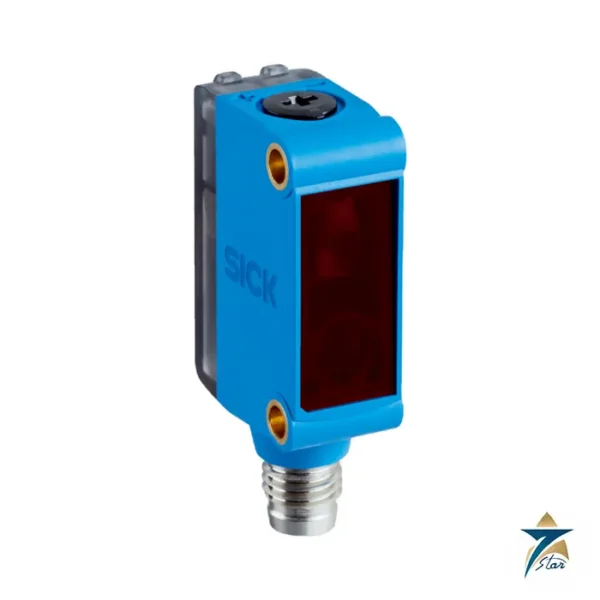
Download the manufacturer data sheet for GL10-F4551 (part no. 1071153) from this page; it is the source of every specification listed here. To request a price, send the type code and part number to Seven Star LLC, an independent supplier based in Muscat, together with the quantity and the site where the goods are needed. Please confirm before ordering that the version, connector and accessories (a mounting bracket or matching M12 cordset) match your drawings, because published data may change without notice. Related items can be found in sensors and transmitters and in the SICK WTB4-3 miniature photoelectric sensor.
Before ordering, compare the type code and part number on your existing unit or drawing with the details on this page, and confirm supply voltage, output type, connector and mounting against the data sheet. Send the nameplate details with your enquiry and we will check them against the manufacturer data before quoting.







Reviews
There are no reviews yet.