LRE01: 0.1 to 0.16 A thermal overload relay for LC1E starters
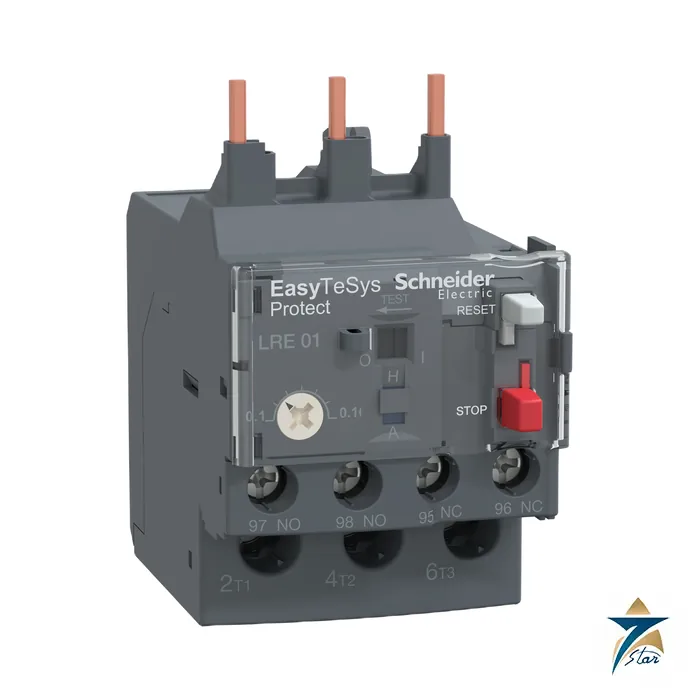
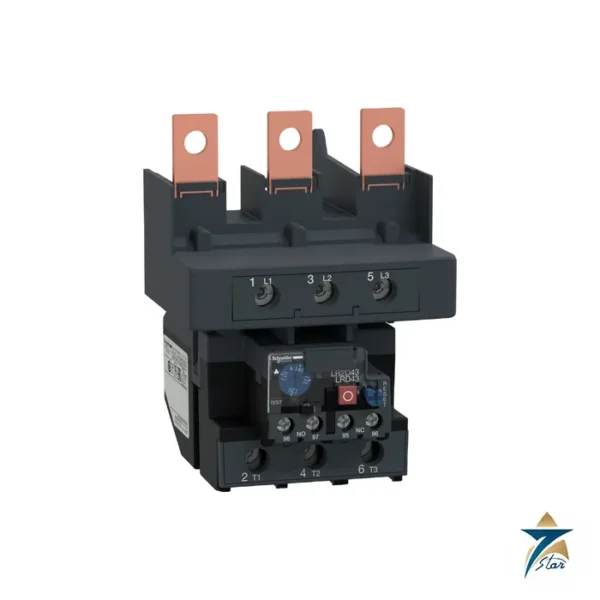
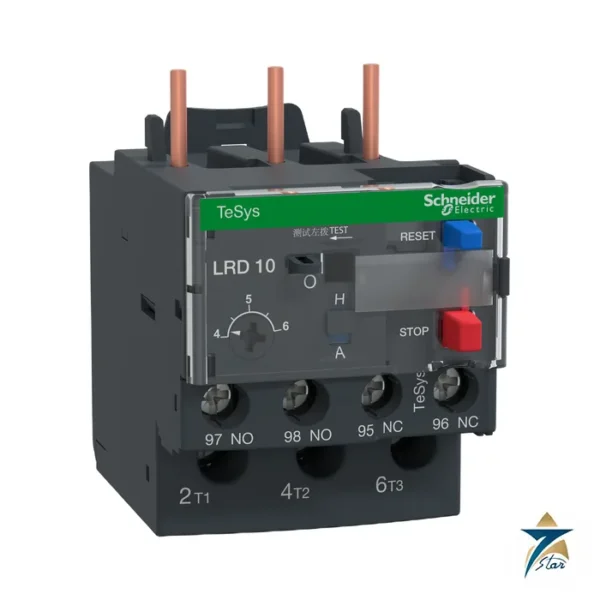
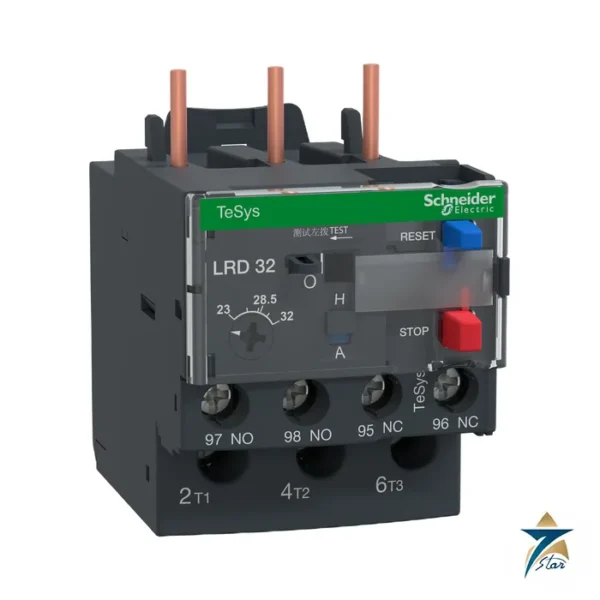
The LRE01 is a Schneider Electric product listed in its datasheet as: EasyPact TVS differential thermal overload relay 0.1…0.16 A – class 10A. It is the thermal overload part of a motor starter: it follows the current drawn by the motor and opens a signalling contact when an overload or a lost phase would otherwise overheat the windings. Seven Star LLC supplies the LRE01 in Oman and the GCC as an independent supplier based in Muscat.
The reference tells you the family and the band. LRE is the device short name given in the datasheet, the range is Easy TeSys Protect, and the title states the adjustable window, 0.1 to 0.16 A, together with trip class 10A. The two or three digits after LRE are the range code of that band. The LRE01 is built on the compact body (45 mm wide) for LC1E contactors up to the LC1E38 size. The 0.1 to 0.16 A window is the very bottom of the group. It is meant for motors whose full-load current is a fraction of an ampere, for example small dosing-pump motors, damper actuators with three-phase motors and similar auxiliaries.
LRE01 datasheet values at a glance
| Parameter |
Specification |
| Manufacturer / part number |
Schneider Electric / LRE01 |
| Description |
EasyPact TVS differential thermal overload relay 0.1…0.16 A – class 10A |
| Range |
Easy TeSys; Easy TeSys Protect |
| Relay application |
Motor protection |
| Thermal overload class |
Class 10A conforming to IEC 60947-4-1 |
| Thermal protection adjustment range |
0.1 to 0.16 A |
| Tripping threshold |
1.14 +/- 0.06 Ir conforming to IEC 60947-4-1 |
| Phase failure sensitivity |
Tripping current 130 % of Ir on two phase, the last one at 0 conforming to IEC 60947-4-1 |
| Network / frequency |
AC / 50…60 Hz |
| Rated operational voltage [Ue] |
≤ 690 V AC |
| Rated insulation voltage [Ui] |
690 V conforming to IEC 60947-4-1 |
| Auxiliary contacts |
1 NO + 1 NC |
| Signalling circuit thermal current [Ith] |
5 A for signalling circuit |
| Associated fuses |
2 A gG or 0.25 A aM (power circuit); 5 A gG (signalling circuit) |
| Product compatibility |
LC1E06 to LC1E38 |
| Mounting |
Under contactor; Plate, with specific accessories; Rail, with specific accessories |
| Power terminals |
Screw clamp, flexible cable without ferrule 1.5 to 6 mm² |
| Tightening torque |
Power circuit: 1.7 N.m – on screw clamp terminals; Signalling circuit: 1.7 N.m – on screw clamp terminals |
| Dimensions (W x H x D) |
45 mm x 44.5 mm x 70 mm |
| Net weight |
0.13 kg |
| IP degree of protection |
IP20 conforming to IEC 60529 |
| Ambient temperature, operation |
-20 to 60 °C without derating conforming to IEC 60947-4-1; -20 to 70 °C with derating |
| Ambient temperature, storage |
-60 to 80 °C |
| Product certifications |
CB Scheme; CCC; CE; EAC |
Setting the LRE01 correctly
The dial of the LRE01 spans 0.1 to 0.16 A. The datasheet states a tripping threshold of 1.14 +/- 0.06 Ir conforming to IEC 60947-4-1, so the relay is designed to act when the motor current reaches about 1.14 times the dialled value, with a tolerance of 0.06 times. At the top of the scale that is roughly 0.182 A and at the bottom roughly 0.114 A.
It is a differential relay, which matters on a three-phase motor. The datasheet gives a tripping current of 130 % of Ir on two phases while the third phase is at zero, conforming to IEC 60947-4-1; at the top of the dial 0.16 A that corresponds to about 0.208 A in each of the two live phases. A broken fuse or loose terminal therefore does not leave the motor running single-phased unnoticed.
Class 10A is the fast characteristic for motors that start quickly; the class number is the longest tripping time in seconds at 7.2 times the setting current under IEC 60947-4-1. Temperature compensation is listed over -20 to 60 °C, so the setting does not wander with panel temperature inside that band.
Contactors, mounting and size of the LRE01
The datasheet lists the compatible contactors for the LRE01 as LC1E06 to LC1E38. Mounting options are listed as under contactor; plate, with specific accessories; rail, with specific accessories. In a normal starter the relay plugs directly under the contactor, which keeps the power wiring short and gives a compact direct-on-line starter without extra links.
The body measures 45 mm wide, 44.5 mm high and 70 mm deep with a net weight of 0.13 kg; the packed unit weighs 141 g. At this scale a dial position is a matter of hundredths of an ampere, so read the nameplate carefully and do not round up. If the motor draws more than 0.16 A you simply need the next band.
Wiring the LRE01: power side and signalling side
On the power side the datasheet lists screw clamp terminals; for flexible cable without ferrule the capacity is 1.5 to 6 mm², and the recommended torque is 1.7 N.m. On the signalling side two screw clamp terminals take 1 to 2.5 mm² conductors at 1.7 N.m. Use a torque screwdriver, because heat cycling loosens starter terminals over time.
The auxiliary contact set is 1 NO + 1 NC. Wire the normally closed contact (95-96) in series with the contactor coil so a trip drops the starter, and use the normally open contact (97-98) for a fault lamp or PLC input. The datasheet gives a conventional thermal current of 5 A for signalling circuit and names a 5 A gG fuse for that circuit.
For the power circuit the datasheet names 2 A gG or 0.25 A aM fuses. That is about 12.5 times the top of the dial, a reminder that the fuse is for short circuits, while the relay deals with overloads.
Before you order the LRE01
- Motor nameplate current inside 0.1 to 0.16 A, ideally near the middle of the dial.
- Contactor in the starter must be one of LC1E06 to LC1E38.
- Class 10A: confirm that the load starts quickly enough for this characteristic.
- Upstream short-circuit device: 2 A gG or 0.25 A aM, per the datasheet.
- Space: allow 45 mm x 44.5 mm x 70 mm and 0.13 kg.
- Say whether the relay is for a new starter or replaces one that has tripped out of service.
Typical uses of the LRE01 in Oman and the GCC
Starters of this type are found in water and desalination auxiliaries, oil and gas utility skids, power station balance-of-plant and building services across Oman and the GCC. The 0.1 to 0.16 A window is the very bottom of the group.
Heat and dust are the practical enemies. The datasheet allows -20 to 60 °C without derating conforming to IEC 60947-4-1 without derating and IP20 protection, so the LRE01 belongs inside a closed, ventilated panel; in summer the inside of a sunlit enclosure can be far above the outdoor mean, so compare your measured panel temperature with that limit.
Ambient limits and certificates of the LRE01
The datasheet gives an operating range of -20 to 60 °C without derating conforming to IEC 60947-4-1; -20 to 70 °C with derating and a storage range of -60 to 80 °C, with IP20 protection, fire resistance of 850 °C and mechanical robustness of 6 Gn shocks and 3 Gn vibrations. The standards named include EN/IEC 60947-1, 60947-4-1 and 60947-5-1.
Certifications listed for this exact reference are CB Scheme; CCC; CE; EAC. Do not assume any other approval; if the project needs a specific marine or hazardous-area certificate, tell us and we will check it against the datasheet before quoting.
Information to send with an RFQ for the LRE01
- Full reference LRE01 and the quantity required
- Motor nameplate current, voltage and power
- Contactor reference the relay will be fitted to
- Delivery location and timing
- New starter, replacement or spare
Documents and quotation
A datasheet for this product is attached on this page. It lists the electrical, mechanical and environmental data summarised above, and it is the document to check against your own drawings.
Send us the part number, quantity and application and we will confirm availability and a quotation. Seven Star LLC is an independent supplier in Muscat and is not affiliated with the manufacturer.






















Reviews
There are no reviews yet.