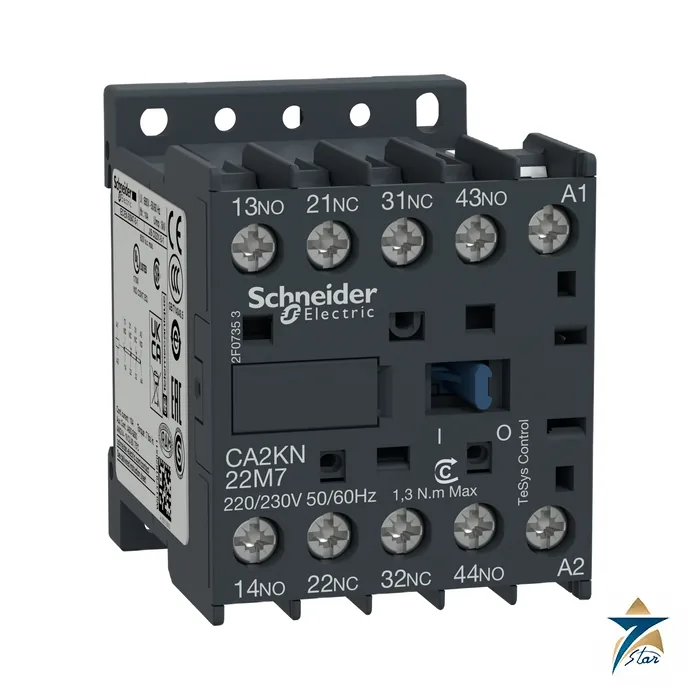
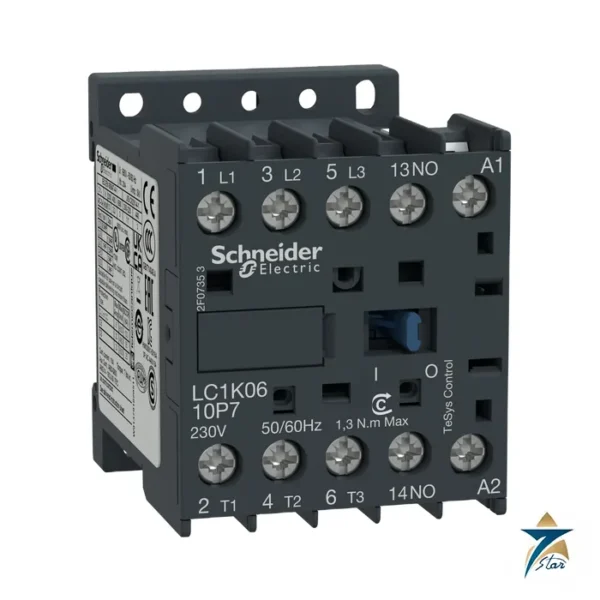
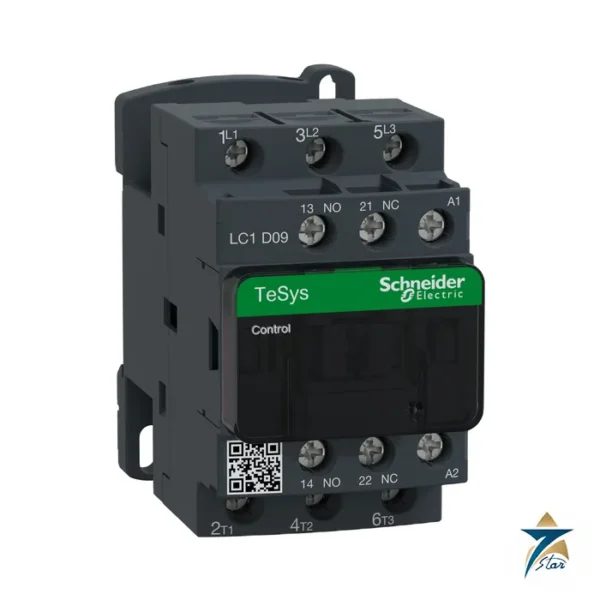
CA2KN22P7: control relay with 2 NO and 2 NC contacts and a 230 V coil
The CA2KN22P7 is a Schneider Electric TeSys K control relay listed in the datasheet as: TeSys K control relay – 2 NO + 2 NC – <= 690 V – 230 V AC coil. A 2 NO + 2 NC contact set is the most flexible arrangement of the CA2K range: two circuits that close on energising and two that open. That mix lets one relay both permit and block, which is why it appears in interlocks, in latching and seal-in circuits and in logic that needs a defined fail state. Seven Star LLC supplies the CA2KN22P7 in Oman and the GCC as an independent supplier based in Muscat.
The datasheet gives the device short name CA2K and the application as control circuit. The contact set is two normally open and two normally closed contacts, the coil is 230 V AC 50/60 Hz, and the utilisation categories are AC-15 and DC-13, the standard categories for control-circuit loads such as contactor coils and signal lamps.
Technical specifications of the CA2KN22P7
| Parameter |
Specification |
| Manufacturer / part number |
Schneider Electric / CA2KN22P7 |
| Description |
TeSys K control relay – 2 NO + 2 NC – <= 690 V – 230 V AC coil |
| Range |
TeSys |
| Product name |
TeSys CAK |
| Product or component type |
Control relay |
| Device short name |
CA2K |
| Contactor application |
Control circuit |
| Utilisation category |
AC-15; DC-13 |
| Pole contact composition |
2 NO + 2 NC |
| [Ue] rated operational voltage |
<= 690 V <= 400 Hz |
| Control circuit type |
AC at 50/60 Hz |
| [Uc] control circuit voltage |
230 V AC 50/60 Hz |
| [Ith] conventional free air thermal |
10 A (at 50 °C) |
| Irms rated making capacity |
110 A conforming to IEC 60947 |
| [Ui] rated insulation voltage |
690 V conforming to IEC 60947; 750 V conforming to VDE 0110 group C; 690 V conforming to BS 5424; 600 V conforming to CSA C22.2 No 14 |
| Mounting support |
Rail; Plate |
| Tightening torque |
1.3 N.m – on screw clamp terminals – with screwdriver flat Ø 6 mm; 1.3 N.m – on screw clamp terminals – with screwdriver Philips No 26 mm |
| Control circuit voltage limits |
Drop-out: 0.2 to 0.75 Uc (at <50 °C); Operational: 0.8 to 1.15 Uc (at <50 °C) |
| Mechanical durability |
10 Mcycles |
| Maximum operating rate |
10000 cyc/h |
| Immunity to microbreaks |
2 ms |
| Inrush power in VA |
30 VA (at 20 °C) |
| Hold-in power consumption in VA |
4.5 VA (at 20 °C) |
| Heat dissipation |
1.3 W |
| Minimum switching voltage |
17 V |
| Minimum switching current |
5 mA |
| Non overlap distance |
0.5 mm |
| Insulation resistance |
> 10 MOhm |
| Height |
58 mm |
| Width |
45 mm |
| Depth |
57 mm |
| Net weight |
0.18 kg |
| Standards |
EN/IEC 60947-5-1; GB/T 14048.5; UL 60947-5-1; CSA C22.2 No 60947-5-1; JIS C8201-5-1 |
| Product certifications |
CB Scheme; CCC; UL; CSA; EAC; CE; UKCA |
| IP degree of protection |
IP2X |
| Protective treatment |
TC conforming to IEC 60068 |
| Operating altitude |
2000 m without derating |
| Ambient air temperature, operation |
-25 to 50 °C |
| Ambient air temperature, storage |
-50 to 80 °C |
Contact set and operation of the CA2KN22P7
In a seal-in (self-holding) circuit one NO contact bridges the start button, while an NC contact in series with the stop path drops the circuit when another function demands it. With the coil off the two NC contacts are closed, so a signal such as ‘not running’ or ‘permissive healthy’ is available without any extra wiring.
Operating times in the datasheet: 10 to 20 ms coil de-energisation and NO opening; 10 to 20 ms coil energisation and NO closing; 15 to 25 ms coil de-energisation and NC closing; 5 to 15 ms coil energisation and NC opening. Non-overlap distance between NO and NC contacts: 0.5 mm. Mechanical durability: 10 Mcycles. Maximum operating rate: 10000 cyc/h.
Coil supply, contact ratings and low-level switching of the CA2KN22P7
The 230 V AC coil is the standard mains-level control voltage in the Gulf, matching the single-phase supply of a 400 V three-phase network. The coil is designed for 230 V and, with the datasheet operating limits of 0.8 to 1.15 times the rated voltage, tolerates ordinary supply variations.
The datasheet lists the coil voltage as 230 V AC 50/60 Hz. Operating limits: Drop-out: 0.2 to 0.75 Uc (at <50 °C); Operational: 0.8 to 1.15 Uc (at <50 °C). Inrush consumption: 30 VA (at 20 °C). Hold-in consumption: 4.5 VA (at 20 °C). Heat dissipation of the CA2KN22P7: 1.3 W. Immunity to micro-breaks: 2 ms.
Because the coil is 230 V, the relay can be driven from the same circuit as a mains-level pilot lamp, which makes fault tracing easier on older panels.
Conventional free-air thermal current: 10 A (at 50 °C). Rated making capacity: 110 A conforming to IEC 60947. Associated short-circuit protection: 10 A gG conforming to IEC 60947; 10 A gG conforming to VDE 0660. Minimum switching voltage: 17 V. Minimum switching current: 5 mA. Insulation resistance: > 10 MOhm. Rated operational voltage: <= 690 V <= 400 Hz.
The minimum switching figures matter when the relay is used to feed a PLC input or an electronic circuit at 24 V: contacts that normally carry amps can lose reliability at very low voltage and current, so the datasheet minimum should be respected or a different contact technology considered.
Family comparison for the CA2KN22P7
The CA2KN22U7 differs in coil 230 to 240 V AC 50/60 Hz against 230 V AC 50/60 Hz here. The CA2KN31B7 differs in contacts 3 NO + 1 NC against 2 NO + 2 NC here; coil 24 V AC 50/60 Hz against 230 V AC 50/60 Hz here.
The table lists the CA2K references of this group; contact set and coil are the only things that change, and the body, size and ratings are shared.
| Reference |
Contacts |
Coil |
Categories |
| CA2KN22P7 (this page) |
2 NO + 2 NC |
230 V AC 50/60 Hz |
AC-15; DC-13 |
| CA2KN22U7 |
2 NO + 2 NC |
230-240 V AC 50/60 Hz |
DC-13; AC-15 |
| CA2KN31B7 |
3 NO + 1 NC |
24 V AC 50/60 Hz |
AC-15; DC-13 |
| CA2KN31M7 |
3 NO + 1 NC |
220-230 V AC 50/60 Hz |
AC-15; DC-13 |
| CA2KN31U7 |
3 NO + 1 NC |
230-240 V AC 50/60 Hz |
DC-13; AC-15 |
| CA2KN40B7 |
4 NO |
24 V AC 50/60 Hz |
AC-15; DC-13 |
| CA2KN40M7 |
4 NO |
220-230 V AC 50/60 Hz |
AC-15; DC-13 |
| CA2KN40P7 |
4 NO |
230 V AC 50/60 Hz |
DC-13; AC-15 |
Selection checklist for the CA2KN22P7
Selection tip for the CA2KN22P7: the P7 suffix is the plain 230 V coil, so it fits panels fed from one phase of a 400 V network without an intermediate transformer. If an existing panel carries relays marked 220/230 V, a P7 unit can usually share the same control feeder, but a measured voltage at the coil terminals is the safer basis than the nameplate of the old relay. Because this version keeps two NC contacts, it is the usual stock choice for spares of seal-in and interlock relays, where the same part may be asked for repeatedly by different panels.
- Count the NO and NC contacts of the circuit diagram; this reference gives exactly two of each.
- If a fourth NO is needed with no NC, the 4 NO reference is simpler.
- Coil voltage: 230 V AC 50/60 Hz; operating limits 0.8 to 1.15 times the rated voltage.
- Mounting: rail or plate, body 45 mm wide x 58 mm high x 57 mm deep.
- Short-circuit protection: use the associated 10 A gG fuse noted in the datasheet.
Mounting, wiring and environment for the CA2KN22P7
The relay mounts on a rail or on a plate, measures 45 mm wide x 58 mm high x 57 mm deep and weighs 0.18 kg. Terminals are screw clamps; the datasheet gives 1.3 N.m – on screw clamp terminals – with screwdriver flat Ø 6 mm, and accepted conductors from 0.34 to 4 mm squared depending on type and number. Fit a marker beside each screw group so that the NO and NC terminals are not confused during later maintenance.
The environment is stated as -25 to 50 °C in operation and -50 to 80 °C in storage, an altitude of 2000 m without derating, protection IP2X and a flame retardance of V1 to UL 94. The mechanical robustness data in the datasheet give vibration and shock withstand figures for both the open and closed state, which is useful for relays on moving or shaking machines.
Where the CA2KN22P7 is used in Oman and the GCC
A typical home for this reference is a motor control panel, where the relay seals in a start command, drops out on a stop or trip, and repeats the ‘running’ state to a PLC. The 230 V coil allows the relay to be driven directly from a phase and neutral already present in the panel.
In Oman’s hot plant rooms the datasheet range of -25 to 50 degrees C in operation is the figure to compare with panel temperature; panels in direct sun or without ventilation should be checked, and the relay should not be mounted directly above a heat source such as a power supply or a drive.
Information to send with an RFQ for the CA2KN22P7
- Full reference (CA2KN22P7) and quantity required
- Supply and control voltage at site, with the frequency
- Existing panel, rail and neighbouring devices it must fit beside
- Delivery location and timing
- Whether it is a spare, a like-for-like replacement or a new installation
- Contact set needed: number of NO and NC contacts
Documents and quotation
A datasheet for the CA2KN22P7 is attached on this page. It lists the electrical, mechanical and environmental data summarised above, and it should be read together with the manufacturer’s installation instructions for the final design.
Send us the part number, quantity and application and we will confirm availability and a quotation. Seven Star LLC is an independent supplier in Muscat and is not affiliated with the manufacturer.





















Reviews
There are no reviews yet.