LRD01: 0.1 to 0.16 A class 10A overload relay in plain terms
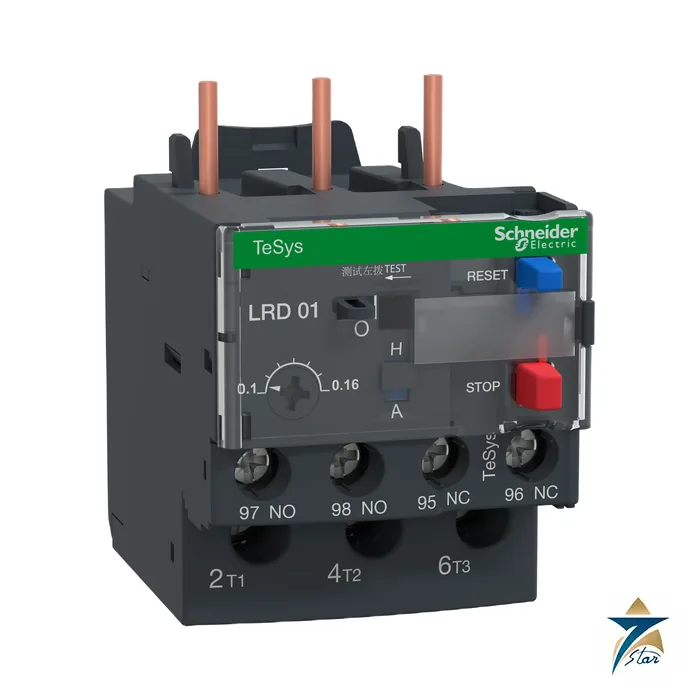
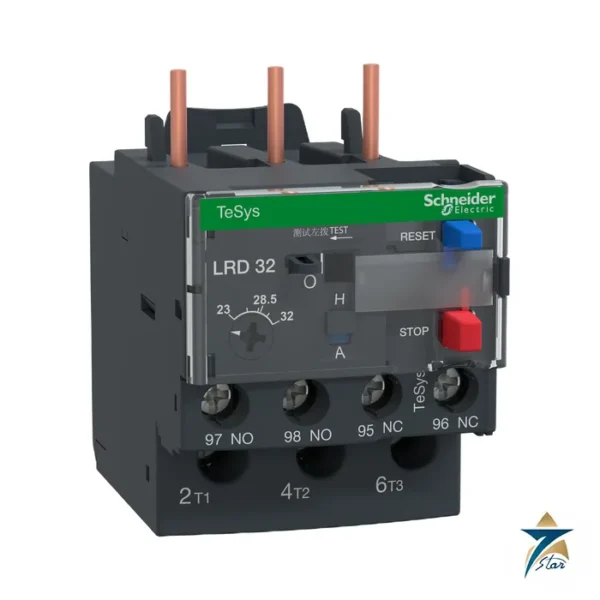
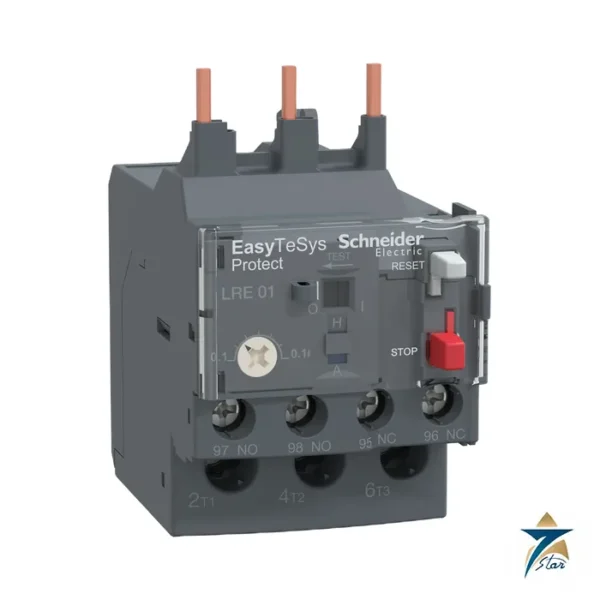
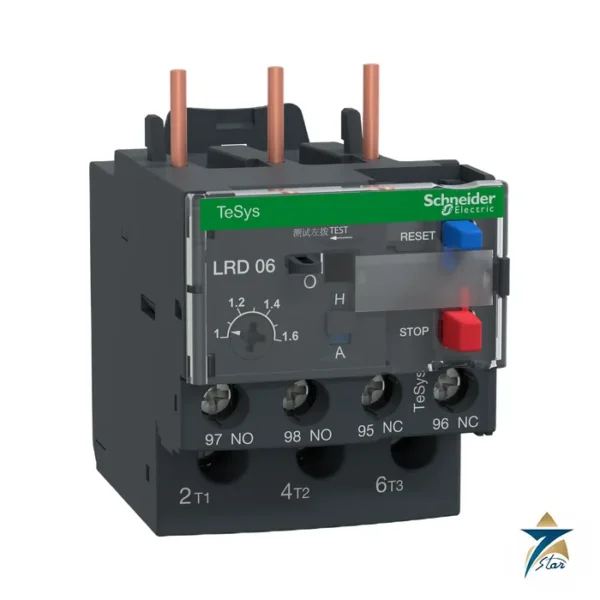
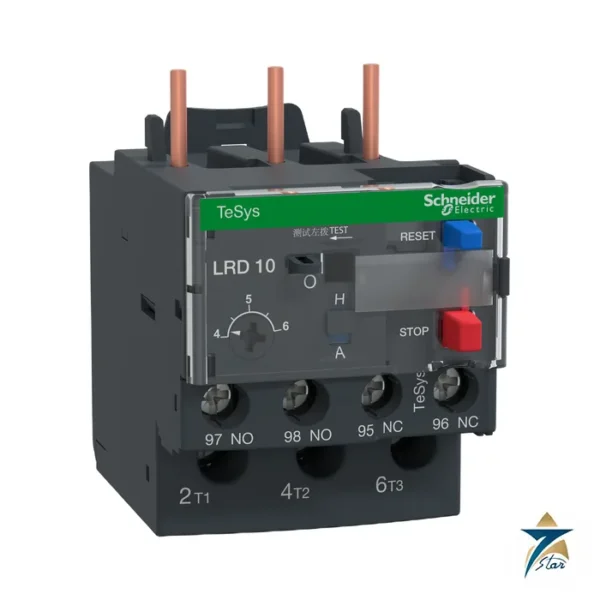
The LRD01 is a Schneider Electric product listed in the datasheet as: TeSys LRD thermal overload relays – 0.1 to 0.16 A – class 10A. In a motor starter it is the part that watches the current of the motor and opens the control circuit when an overload or a lost phase would otherwise overheat the windings. Seven Star LLC supplies the LRD01 in Oman and the GCC as an independent supplier based in Muscat.
Reading the reference: the datasheet identifies the LRD01 as part of the TeSys LRD family, and the title gives the figure that matters, namely the adjustable window of 0.1 to 0.16 A with thermal class 10A. It is built as the compact frame (45 mm wide) used with LC1D09 to LC1D38 contactors. The 0.1 to 0.16 A window is the lowest on the ladder. It fits motors that draw only a fraction of an ampere: small metering and dosing pump motors, fractional-watt fan motors, damper and louvre drives and similar auxiliaries on skids and HVAC panels.
Technical specifications of the LRD01
| Parameter |
Specification |
| Manufacturer / part number |
Schneider Electric / LRD01 |
| Description |
TeSys LRD thermal overload relays – 0.1 to 0.16 A – class 10A |
| Range |
TeSys; TeSys Deca |
| Product name |
TeSys LRD; TeSys Deca |
| Product or component type |
Differential thermal overload relay |
| Relay application |
Motor protection |
| Thermal overload class |
Class 10A conforming to IEC 60947-4-1 |
| Thermal protection adjustment range |
0.1 to 0.16 A |
| Tripping threshold |
1.14 ± 0.06 Ir conforming to IEC 60947-4-1 |
| Phase failure sensitivity |
Tripping current 130 % of Ir on two phase, the last one at 0 |
| Network type / frequency |
DC; AC / 0 to 400 Hz |
| Rated operational voltage [Ue] |
690 V AC 0 to 400 Hz for power circuit conforming to IEC 60947-4-1 |
| Rated insulation voltage [Ui] |
Power circuit: 600 V conforming to CSA; Power circuit: 600 V conforming to UL; Power circuit: 690 V conforming to IEC 60947-4-1 |
| Rated impulse withstand [Uimp] |
6 kV |
| Auxiliary contact composition |
1 NO + 1 NC |
| Signalling circuit permissible current |
3 A at 120 V AC-15 for signalling circuit; 0.22 A at 125 V DC-13 for signalling circuit |
| Associated fuse (signalling circuit) |
4 A gG for signalling circuit; 4 A BS for signalling circuit |
| Product compatibility |
LC1D09, LC1D12, LC1D18, LC1D25, LC1D32, LC1D38 |
| Mounting support |
Plate, with specific accessories; Rail, with specific accessories; Under contactor |
| Temperature compensation |
-20 to 60 °C |
| Power circuit connection |
screw clamp terminals 1 cable 1.5 to 10 mm² flexible without cable end; screw clamp terminals 1 cable 1 to 4 mm² flexible with cable end; screw clamp terminals 1 cable 1 to 6 mm² solid without cable end |
| Tightening torque |
Control circuit: 1.7 N.m – on screw clamp terminals; Power circuit: 1.7 N.m – on screw clamp terminals |
| Dimensions (W x H x D) |
45 mm x 66 mm x 70 mm |
| Net weight |
0.124 kg |
| IP degree of protection |
IP20 conforming to IEC 60529 |
| Ambient air temperature (operation) |
-20 to 60 °C without derating conforming to IEC 60947-4-1 |
| Ambient air temperature (storage) |
-60 to 70 °C |
| Flame retardance |
V1 conforming to UL 94 |
| Product certifications |
IEC; UL; CSA; CCC; EAC; BV; RINA; DNV-GL; LROS (Lloyds register of shipping); ATEX INERIS; UKCA |
How the LRD01 reacts to overload
The setting dial of the LRD01 covers 0.1 to 0.16 A. The datasheet gives the tripping threshold as 1.14 ± 0.06 Ir conforming to IEC 60947-4-1, which means the relay is built to trip when the motor current reaches about 1.14 times the dialled value, with a tolerance of 0.06 times. At the top of the scale, 1.14 times 0.16 A works out to about 0.18 A; at the bottom of the scale, 1.14 times 0.1 A is about 0.114 A.
The relay is also a differential type. For the phase failure case, the datasheet states a tripping current of 130 % of Ir on two phases while the third carries nothing, which at 0.16 A corresponds to about 0.2 A in the two live phases. This sensitivity is what protects a three-phase motor from running on two phases after a blown fuse or a loose terminal, and it is the reason the type is chosen over a simple thermal element for pumps and fans.
Class 10A is the common choice for motors that start quickly. Under IEC 60947-4-1 the class number is the longest tripping time in seconds at 7.2 times the setting current, so a class 10A relay reacts faster to a locked rotor than a class 20 relay. The relay has temperature compensation over -20 to 60 °C, so the setting does not drift within that band.
Contactors and mounting for the LRD01
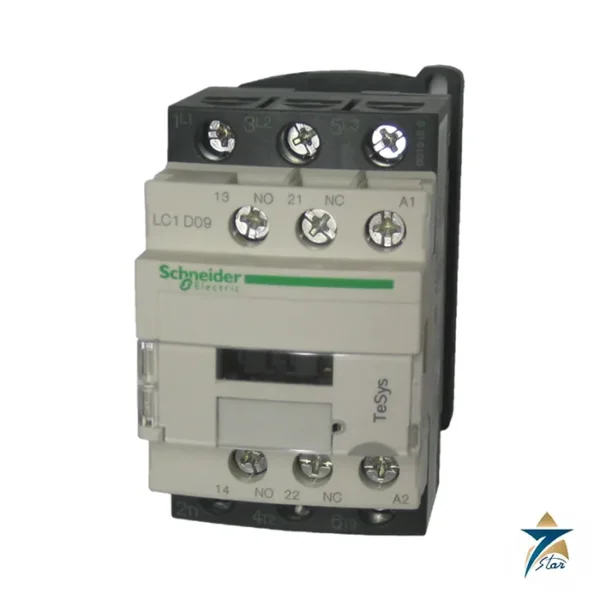
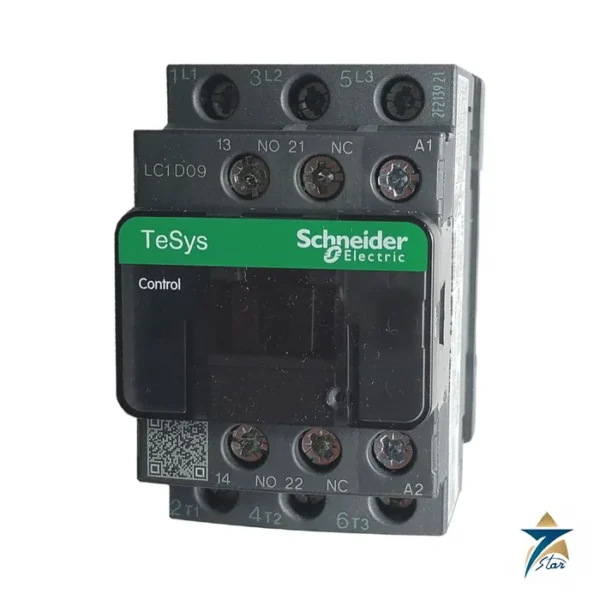
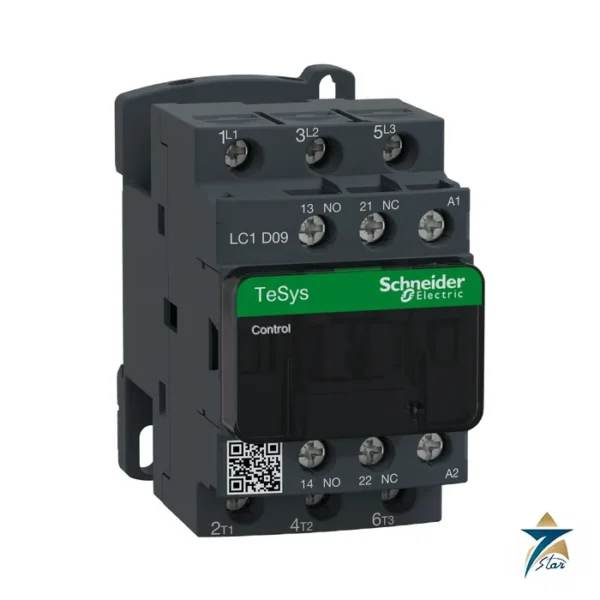
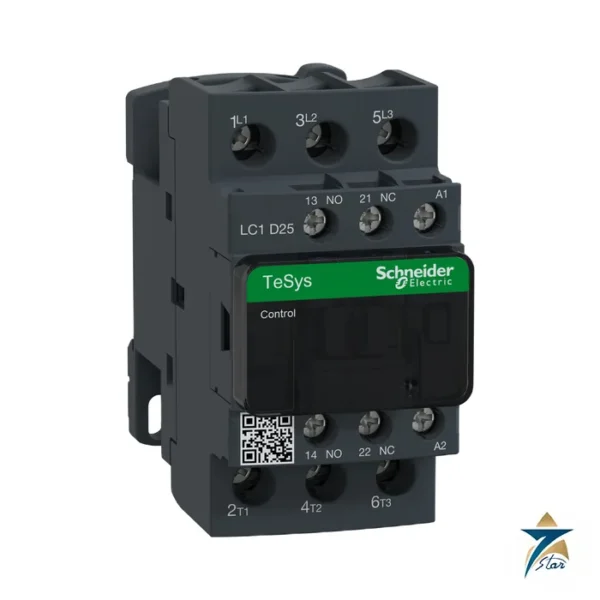
The datasheet lists the contactors compatible with the LRD01 as LC1D09, LC1D12, LC1D18, LC1D25, LC1D32, LC1D38. The mounting options are plate, with specific accessories; rail, with specific accessories; under contactor. In practice the relay plugs straight under a TeSys Deca contactor of the listed frames, so the contactor and relay together form a compact direct-on-line or reversing starter without extra wiring in the power circuit.
The relay body measures 45 mm wide, 66 mm high and 70 mm deep and weighs 0.124 kg. It belongs to the compact frame (45 mm wide) used with LC1D09 to LC1D38 contactors. Because the span is so narrow in absolute terms, a motor that draws more than 0.16 A at full load simply does not belong on this relay; trying to stretch the setting to the top and beyond only produces nuisance trips or no protection at all. Move up to the next range instead.
Wiring the LRD01: terminals and aux contact
On the power side the datasheet lists screw clamp terminals 1 cable 1.5 to 10 mm² flexible without cable end; screw clamp terminals 1 cable 1 to 4 mm² flexible with cable end; screw clamp terminals 1 cable 1 to 6 mm² solid without cable end. The tightening torque is listed as control circuit: 1.7 N.m – on screw clamp terminals; power circuit: 1.7 N.m – on screw clamp terminals. Use a torque screwdriver, because terminals on motor starters loosen over time with heat cycling and vibration.
The control side is a pair of contacts, described as 1 NO + 1 NC, with terminal marking 95 and 96 for the normally closed contact and 97 and 98 for the normally open contact. The permissible current of that signalling circuit is 3 A at 120 V AC-15 for signalling circuit; 0.22 A at 125 V DC-13 for signalling circuit, and the associated protection is 4 A gG for signalling circuit; 4 A BS for signalling circuit. Wire the normally closed contact in series with the contactor coil so that a trip drops the contactor, and use the normally open contact for a fault lamp or a PLC input.
Before ordering the LRD01
- Motor nameplate current: it must sit between 0.1 and 0.16 A, ideally in the middle of the dial.
- Contactor: the starter must use one of LC1D09, LC1D12, LC1D18, LC1D25, LC1D32, LC1D38.
- Trip class: this relay is class 10A; confirm that it suits the starting time of the load.
- Signalling circuit: the contact is rated 3 A at 120 V AC-15 for signalling circuit; 0.22 A at 125 V DC-13 for signalling circuit.
- Space: allow 45 mm x 66 mm x 70 mm and a weight of 0.124 kg.
- Status: say whether you need a spare for an existing starter or a new installation.
Typical applications of the LRD01 in Oman and the GCC
The compact frame is the workhorse of small motor control centres, local starter panels and skid-mounted packages, where many identical starters sit side by side and panel space is tight. In Oman and the GCC such starters appear in water and desalination plants, oil and gas auxiliaries, power station balance-of-plant and building services.
Heat and dust are the main enemies. Overload relays are temperature-compensated, but a hot, dusty panel still ages terminals and contacts faster, so inspect the connections of the LRD01 during planned shutdowns and keep the front cover and dial clean.
Ambient limits and certifications of the LRD01
The datasheet gives an operating ambient temperature of -20 to 60 °C without derating conforming to IEC 60947-4-1 and a storage range of -60 to 70 °C, with IP20 protection and V1 flame retardance. It states mechanical robustness as Vibrations: 6 Gn conforming to IEC 60068-2-6; Shocks: 15 Gn for 11 ms conforming to IEC 60068-2-7. On sites in Oman the actual panel temperature in summer can be well above the outdoor mean when panels are in the sun, so compare your measured cabinet temperature with the datasheet limit and add ventilation or shading where needed.
Certifications listed for the LRD01 are IEC; UL; CSA; CCC; EAC; BV; RINA; DNV-GL; LROS (Lloyds register of shipping); ATEX INERIS; UKCA. The standards named are EN/IEC 60947-4-1; EN/IEC 60947-5-1; UL 60947-4-1; UL 60947-5-1; CSA C22.2 No 60947-4-1; CSA C22.2 No 60947-5-1; GB/T 14048.4; GB/T 14048.5; EN 50495. Only rely on a certificate that is listed here for this exact reference; if a project needs a particular marine or hazardous-area approval, tell us and we will check it against the datasheet before quoting.
Information to send with an RFQ for the LRD01
- Full reference LRD01 and the quantity required
- Motor nameplate current, voltage and power
- Contactor reference the relay will be fitted to
- Required delivery location and timing
- Whether it is a spare, a replacement or a new installation
Documents and quotation
A datasheet for this product is attached on this page. It lists the electrical, mechanical and environmental data summarised above, and it is the document to check against your own drawings.
Send us the part number, quantity and application and we will confirm availability and a quotation. Seven Star LLC is an independent supplier in Muscat and is not affiliated with the manufacturer.






















Reviews
There are no reviews yet.