SAMSON Type 3756 booster valve for pneumatic actuators
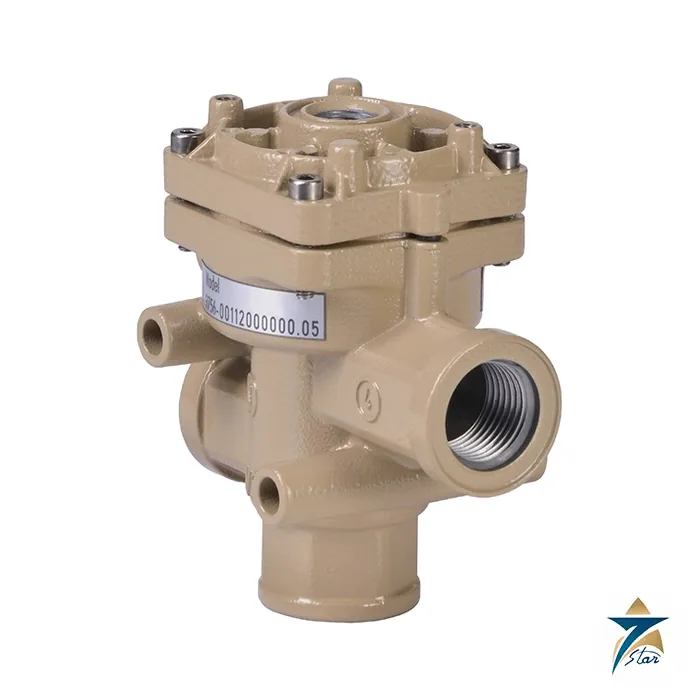
The SAMSON Type 3756 is a pneumatic booster valve. A small control pressure or a pilot solenoid switches it, and it then passes a much larger air flow to an actuator, so single- or double-acting actuators move quickly even when the control signal comes from a low-flow source. Seven Star LLC supplies the Type 3756 in Oman and the GCC as an independent supplier based in Muscat.
The type number covers a family rather than one fixed device. The datasheet lists 3/2-, 5/2-, 5/3- and 6/2-way functions, spring-return or detent mechanisms, KVS values from 1.4 to 10, aluminum or stainless steel bodies, a threaded connection for pipe mounting or a NAMUR interface per VDI/VDE 3845 for direct mounting on a rotary actuator. The maximum operating pressure is 10 bar and the ambient range reaches –45 to +80 °C.
Because the family is wide, the useful question is not whether a Type 3756 fits, but which version. The sections below show how to read the options so your RFQ names the correct build.
Reading the Type 3756 versions
- KVS 1.4, spool design: 3/2-way with exhaust air feedback, 5/2-way, 5/2-way with two detent positions, and 5/3-way with spring-centered mid-position (ports 2 and 4 closed, vented or supplied). Threaded G ¼ or ¼ NPT, or NAMUR ¼.
- KVS 2.9, spool design, NAMUR ½: 3/2-way and 5/2-way. The datasheet marks the KVS 2.9 as available on request.
- KVS 4.3, poppet design with soft seat: 3/2-way (closed or open in neutral), 5/2-way and 6/2-way, threaded G ½ or ½ NPT, and NAMUR ¼ or ½ versions with KVS 2.0 or 4.3.
- KVS 10: 3/2-way with spring return and a G 1 connection.
- KVS 1.9 redundancy valves: two-sided 3/2-way arrangement for series connection with emergency venting, or parallel connection with emergency supply, on NAMUR ½.
A 3/2-way booster drives a single-acting spring-return actuator. A 5/2 or 5/3 version drives a double-acting actuator. The spring-centered 5/3 variants decide what the actuator does when control is lost: trapped in position (ports closed), vented, or pressurized.
Type 3756 technical specifications
| Parameter |
Specification |
| Manufacturer / part number |
SAMSON AG, Type 3756 booster valve |
| Switching functions |
3/2-way, 5/2-way, 5/3-way and 6/2-way |
| Mechanism |
Spring return or detent (two-sided versions) |
| Flow coefficient |
KVS 1.4 to 10 depending on version |
| Maximum operating pressure |
10.0 bar |
| Control pressure |
1.4 to 10 bar on spool versions; 1.4 to 3 bar on direct-pneumatic poppet versions; up to 10 bar via CNOMO interface depending on the pilot valve |
| Switching points |
Returns to neutral at ≤0.2 bar; operates at ≥1.4 bar |
| Medium |
Instrument air free from corrosive substances, nitrogen, or non-corrosive gases |
| Air quality |
ISO 8573-1: particle class 4, oil class 3, dew point class 3 or 10 K below lowest ambient |
| Body material |
Powder-coated aluminum or stainless steel 1.4404 (aluminum only on some versions) |
| Seals and diaphragms |
Silicone rubber (–45 to +80 °C) or chloroprene (–20 to +80 °C) on poppet versions |
| Ambient temperature |
–45 to +80 °C (silicone) or –20 to +80 °C (chloroprene) |
| Connection |
G ¼/¼ NPT, G ½/½ NPT, G 1, or NAMUR ¼ / ½ per VDI/VDE 3845 |
| Weight (approx.) |
0.48 kg (KVS 1.4); 0.58 kg (KVS 4.3 3/2); 1.1 kg (KVS 4.3 5/2 and 6/2); 1.38 and 1.5 kg (NAMUR poppet); 1.76 kg (KVS 2.9); 2.2 kg (redundancy) |
How the Type 3756 booster works
In the spool version, a spool with metal-to-metal seat and zero overlap moves against a return spring. In the neutral position the connections 1 to 2 and 4 to 5 are open. Applying control pressure to the spool’s control side shifts it so that 1 connects to 4 and 2 connects to 3, which reverses the actuator. When the control pressure is released, the spring returns the spool.
The poppet version uses a soft-seated poppet driven by a diaphragm. With no control pressure, the spring closes the connection between ports 4 and 3. Once the control pressure rises, the diaphragm lifts the poppet and opens that path, while port 5 closes. The soft seat gives tight shut-off and a high KVS for its size, up to 4.3 in the direction 3 to 5.
Flow can be estimated from KVS: at an inlet of 2.4 bar absolute and 1.0 bar outlet, the datasheet gives Q = KVS × 36.22 in m³/h. This is a quick way to check whether a candidate valve can stroke your actuator within the required time.
Fitting the Type 3756 in an actuator package
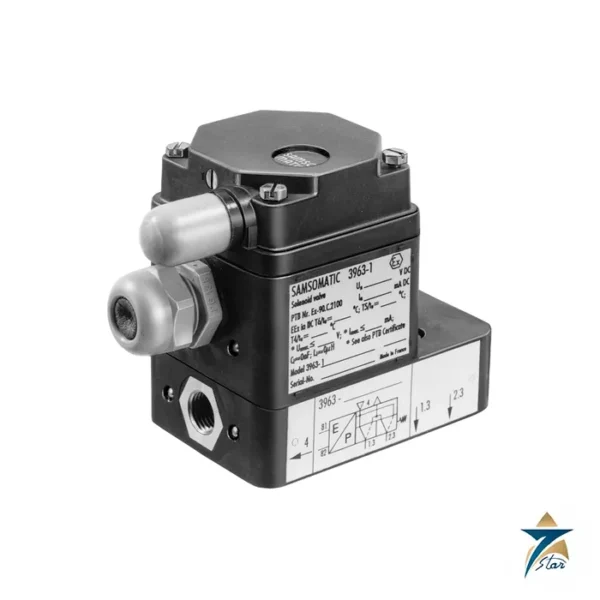
A booster valve sits between a pilot device and the actuator. The pilot may be a solenoid such as the SAMSON Type 3963 or Type 3967, which mount on the booster through a CNOMO interface, a positioner output, or a pneumatic logic signal. The Type 3756 is therefore a companion to the intrinsically safe SAMSON Type 3969 and to the positioner range rather than a stand-alone controller.
The NAMUR-interface versions bolt directly onto an actuator with a VDI/VDE 3845 face, which removes tubing and shortens the response. The threaded versions are used where the booster is installed in the pipe run next to a large piston or diaphragm actuator. Redundant 3/2 arrangements with series or parallel connection are meant for safety circuits that vent or supply the actuator even if one valve fails, and the datasheet shows SIL and TUV approvals for several versions.
Type 3756 ordering checklist
- Actuator type: single-acting spring-return (3/2) or double-acting (5/2, 5/3, 6/2).
- Required fail-safe behavior: vent, hold position, or pressurize on loss of control (selects the 5/3 mid-position).
- Actuator volume and stroke time, to size KVS from 1.4 up to 10.
- Mounting: NAMUR ¼ or ½ direct, or a threaded G ¼, G ½ or G 1 pipe connection with NPT as an option.
- Body material (aluminum or stainless steel 1.4404) and seal material, according to the ambient temperature and corrosion.
- Pilot method: direct pneumatic connection G 1/8, or a solenoid on the CNOMO interface, and the control pressure available.
- Safety approvals needed on the version (SIL or TUV), where it forms part of a safety function.
Installation and maintenance of the Type 3756
Install the booster with the supplied seals on a clean, flat NAMUR face, or screw the threaded body into the air line with thread sealant suited to compressed air. Fit a filter-regulator upstream and keep to the air quality classes in the datasheet. Oil or water carry-over is the most common reason for a sluggish or sticking spool.
After commissioning, check that the actuator moves smoothly in both directions and that the neutral-position switchover occurs around the 0.2 bar release threshold. A slow return normally points to restricted exhaust: check the silencers or filters at port 3 and 5. For booster valves in safety service, add them to the partial-stroke or full-stroke test plan together with the pilot solenoid, and keep spare seals and diaphragms for critical lines.
Typical Type 3756 applications in Oman and the GCC
Boosters are used wherever an actuator is too large for a solenoid or positioner to fill in the required time. In oil and gas facilities they speed up emergency shut-down valves on pipelines, separators and compressor stations. In power plants and desalination units they help stroke damper and large control valve actuators, and in refineries and petrochemical complexes they serve fast-acting quarter-turn valves on feed and product lines.
The –45 to +80 °C range and the stainless steel body option fit hot desert sites and coastal installations with salt-laden air. Seven Star LLC can help you choose between the aluminum and stainless bodies when the unit sits in a corrosive environment.
Type 3756 families at a glance
| Series |
Function |
KVS |
Connection |
| Spool, spring return |
3/2 or 5/2 |
1.4 |
G ¼ / ¼ NPT or NAMUR ¼ |
| Spool, detent or spring-centered |
5/2 detent; 5/3 |
1.4 |
G ¼ / ¼ NPT or NAMUR ¼ |
| Spool, large NAMUR |
3/2 or 5/2 |
2.9 (on request) |
NAMUR ½ |
| Poppet, threaded |
3/2 closed/open; 5/2; 6/2 |
4.3 |
G ½ / ½ NPT |
| Poppet, NAMUR |
3/2 |
2.0 or 4.3 |
NAMUR ¼ or ½ |
| Redundancy |
3/2 series or parallel |
1.9 |
NAMUR ½ |
| Large threaded |
3/2 |
10 |
G 1 |
Information to send with an RFQ for the Type 3756
- Switching function and mechanism (spring return, detent, spring-centered).
- Connection: NAMUR size or thread, body material and seal material.
- Actuator model, size, and required opening and closing times.
- Control pressure and supply pressure, and the pilot device if a solenoid is attached.
- Safety approvals needed and the ambient temperature range.
- Quantity and delivery location.
Documents and quotation
A SAMSON datasheet (T 3756) is attached on this page with the full technical data, valve diagrams and the article code information.
Send the actuator details and the options above to Seven Star LLC and we will confirm the exact variant and quote it.
Other Models in the Samson Solenoid Valves Range
Seven Star LLC supplies models from the Samson Solenoid Valves range in Oman and the GCC. Compare the related models below and request a quote for the one that matches your application.




























Reviews
There are no reviews yet.