Fluke 1664 FC multifunction installation tester for IEC 60364 inspection and EV charger RCD tests
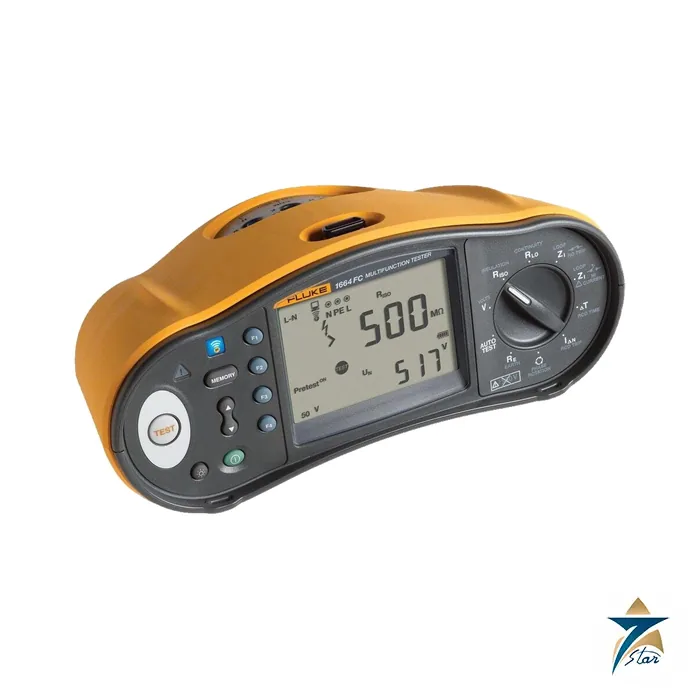
The Fluke 1664 FC is a handheld multifunction installation tester that checks the safety of low-voltage fixed wiring: continuity, insulation resistance, loop and line impedance, RCD trip time and trip current, earth resistance and phase sequence. The FC suffix means it supports the Fluke Connect wireless system, and the 1664 FC is the higher model of the 1660 series, with RCD type B and EV charger RDC-DD testing that the 1663 does not list. Seven Star LLC supplies the 1664 FC in Oman and the GCC as an independent supplier in Muscat, and this page sets out the specified functions and what to confirm when you request a quotation.
What the 1664 FC tests and how Auto Test helps
The manufacturer states that the tester checks to all local regulations and that Auto Test runs up to seven installation tests in one sequence from a single connection, which reduces manual reconnections and the chance of connection errors. A special Insulation Pre-test detects when an appliance is plugged into the installation and stops the insulation test with a visual warning, which protects customer equipment from the test voltage. Other listed functions are a high-current loop mode for fast measurement, a Z-max memory that keeps the highest loop value, a zero adapter that compensates lead and mains cord resistance, ring testing with soft-key selection of input sockets, voltage measurement between L-N, L-PE and N-PE through the mains cord, detection of raised earth voltage above 50 V on a touchpad, and continuity test currents suitable for measuring motor windings.
Technical specifications of the 1664 FC
| Parameter |
Specification |
| Manufacturer / part number |
Fluke / 1664 FC |
| AC voltage |
Range 500 V, resolution 0.1 V, accuracy 0.8 % + 3 (45 … 66 Hz), input impedance 360 kΩ, overload 660 V rms |
| Continuity (RLO) |
20 / 200 / 2000 Ω autoranging; open-circuit voltage above 4 V |
| Insulation resistance |
Test voltages 50, 100, 250, 500, 1000 V; up to 1000 MΩ at 1000 V; 1 mA test current |
| Loop and line impedance (ZI) |
10 Ω (high-current mΩ mode) / 20 / 200 / 2000 Ω; resolution down to 0.001 Ω |
| Prospective fault current |
1000 A / 10 kA (50 kA) |
| RCD types tested |
A, AC, B and S (model 1664 FC) |
| RCD trip time current settings |
10, 30, 100, 300, 500, 1000 mA and VAR; multiplier x1/2, x1, x5; VAR mode type B at 6, 60, 200 mA |
| EV / RDC-DD test |
6 mA for 10 s, 60 mA for 0.3 s, 200 mA for 0.1 s (IEC 62955) |
| RCD ramp test |
30 … 110 % of rated current, step 10 %, accuracy ±5 % |
| Earth resistance (RE) |
200 / 2000 Ω, 128 Hz, 25 V output |
| Safety |
EN/IEC 61010-1 and 61010-2-034; CAT III 500 V; CAT IV 300 V |
| Standards of performance |
EN 61557-1 to -7 and EN 61557-10 |
| Sealing |
IP40 |
| Power / weight |
6 x AA batteries / 1.3 kg including batteries |
| Dimensions |
10 x 25 x 12.5 cm |
RCD testing and the EV charging station functions
Residual current devices are tested for trip time at several fractions and multiples of the rated residual current and for trip current with a rising ramp. The 1664 FC measures trip current and trip time in parallel for RCD types AC and A. For smooth-DC types, the VAR mode at RCD type B generates the test currents for RCD type A-EV or RDC-DD devices per IEC 62955 at 6 mA, 60 mA and 200 mA, which is relevant for EV charging station protection. The data sheet lists accuracy for the trip current ramp of ±5 percent and the specified trip current windows per EN 61008-1, for example 50 to 100 percent for type AC and 50 to 200 percent for type B.
Fluke Connect, memory and operation
A rotary dial indicates the selected function without multi-level menus, and the large backlit display has a wide viewing angle. The tester has a three-layer memory. With Fluke Connect, results can be sent to a smartphone, saved to the cloud and shared during a video call, although the system may not be available in every country, and a unit used purely standalone is still a complete tester. A padded neck strap frees both hands.
Selection and ordering checklist for the 1664 FC
- 1663 or 1664 FC: choose the 1664 FC if you need RCD type B, RDC-DD tests for EV chargers or wireless reporting.
- The regulations to be tested against, for example a national wiring code based on IEC 60364.
- Insulation test voltage levels (up to 1000 V) and the capacity of insulation range needed.
- Accessories: test leads, zero adapter, probes, carrying case, as listed on the model page.
- Whether Fluke Connect wireless sharing is available and wanted in the country of use.
- Calibration certificate and traceability requirement.
Use, safety and maintenance
Always verify the tester on a known source before and after a series of measurements, and check the leads for damage. Observe the measurement category: CAT III 500 V and CAT IV 300 V are stated, so the 1664 FC is intended for the installation and not for the utility service entrance at higher voltage. De-energise and isolate circuits for continuity and insulation tests, switch off connected appliances or rely on the Insulation Pre-test warning, and zero the leads before low-resistance work. Replace the six AA cells when the battery indicator appears, and recalibrate on the schedule set by your quality system.
Typical applications in Oman and the GCC
Installation testers are used when commissioning and periodically inspecting low-voltage distribution boards, final circuits, lighting and small power in industrial buildings, camps, offices and commercial sites, and for acceptance checks of new EV charging points. The ability to test RCDs and measure loop impedance supports protective device verification in plants where earth fault protection must be proven to the project specification.
Information to send with an RFQ for the 1664 FC
- Model: 1664 FC or 1663 for comparison, with kit contents
- Standard and inspection scope
- Need for EV charger RCD tests (type B, RDC-DD)
- Calibration certificate requirement
- Quantity and delivery site
Documents and quotation
The Fluke 1660 series brochure is attached on this page. It gives an overview of the functions; the full specification table is summarised above.
Send the model and the application and Seven Star LLC will confirm availability and prepare a quotation.























Reviews
There are no reviews yet.