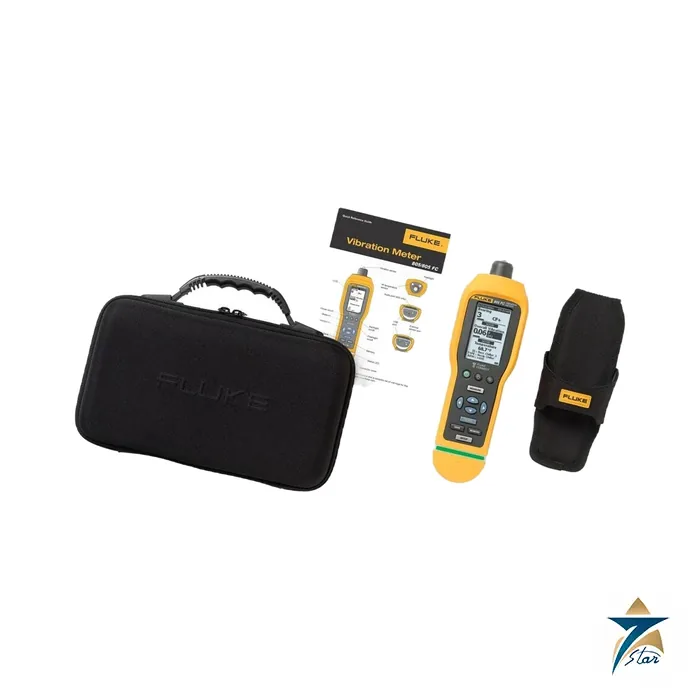
The Fluke 805 FC is a handheld vibration meter for frontline maintenance teams who need a quick, repeatable go or no-go reading on rotating machines. It measures overall vibration and bearing condition, reads temperature with a built-in infrared sensor and sends results to the Fluke Connect app by wireless link.
A pocket-size vibration screening meter with wireless data
Fluke describes the 805 FC as a vibration screening device with a sensor designed to minimise reading variation caused by angle or contact pressure. A coloured light and on-screen comments show how much pressure to apply, so different technicians get comparable readings on the same bearing housing.
Overall vibration is measured from 10 Hz to 1,000 Hz in acceleration, velocity or displacement units. Bearing condition comes from Crest Factor+, a Fluke algorithm that uses direct sensor-tip measurements between 4,000 Hz and 20,000 Hz, and a four-level severity scale reports the result as Good, Satisfactory, Unsatisfactory or Unacceptable.
Technical specifications
| Parameter |
Specification |
| Model / part no. |
Fluke 805 FC / 4489229 |
| Low frequency range (overall) |
10 Hz to 1,000 Hz |
| High frequency range (CF+) |
4,000 Hz to 20,000 Hz |
| Severity levels |
Good, Satisfactory, Unsatisfactory, Unacceptable |
| Vibration limit |
50 g peak (100 g peak-peak) |
| A/D converter / SNR |
16-bit / 80 dB |
| Sensor sensitivity |
100 mV/g +/-10 % |
| Measurement range |
0.01 g to 50 g, resolution 0.01 g |
| Accuracy |
At 100 Hz, +/-5 % of measured value |
| Amplitude units |
g, m/s2; in/s, mm/s; mils, mm |
| IR temperature |
-20 to 200 C (-4 to 392 F), +/-2 C, fixed focus about 3.8 cm |
| Memory |
Up to 3,500 measurements |
| External sensor |
SMB connector; optional, supported but not supplied |
| Connectors / interface |
USB mini-B 7-pin, USB 2.0; Fluke Connect wireless |
| Power |
2 AA lithium iron disulfide batteries, about 250 measurements |
| Operating temperature / IP |
-20 to 50 C / IP54 |
| Drop test |
1 m |
| Size / weight |
24.1 x 7.1 x 5.8 cm / 0.40 kg |
| Supplied with |
USB cable, storage case, belt holster, quick reference guide, two AA batteries |
Where it fits a maintenance routine
The meter is intended for routes of motors, fans, pumps, compressors, gearboxes and cooling tower drives. Machine profiles are created in the Fluke Connect app and pushed to the meter, so a technician can follow a route and compare readings with ISO 10816 severity scales. Up to 3,500 measurements are stored on board, and results can also be exported by USB for trending in the Excel templates Fluke provides.
It is a screening tool, not a full analyser: it gives severity and a bearing indicator rather than a spectrum. For hard-to-reach points an external accelerometer can be connected to the SMB jack, but Fluke supports external sensors without supplying them. The Fluke Connect app and the Excel templates are used to keep a trend for each machine, because one reading is less useful than a history of readings taken at the same point.
Setting up a vibration screening route
Before the first round, list the machines that matter most to production and safety, and give each one a clear name and a fixed set of measurement points. Mark the points on the bearing housings so that every technician measures at the same place and in the same direction each time; trend data is only useful when the location stays the same. Create the machine profiles in the Fluke Connect app with the correct machine type and speed information, then push them to the meter so the route is ready before the technician walks out to the plant.
Taking consistent readings
Take readings with the machine at its normal load and speed, because a pump running on recirculation or a fan at low demand can show very different values from full duty. Hold the meter steadily on the measuring point and follow the pressure guidance on the display until the reading is accepted. Measure the temperature of the same housing during the same visit, as a rising temperature together with a worsening bearing indicator gives a stronger reason to plan an inspection than either value alone.
Turning readings into maintenance decisions
A single Unsatisfactory or Unacceptable result should lead to a repeat measurement and, where the result is confirmed, to a closer look by a vibration analyst or the maintenance planner. Use the stored history to see whether the overall level or the bearing indicator is climbing slowly or has jumped suddenly, since a sudden change often follows a recent repair, alignment work or a change in operating conditions. Share the exported results with the reliability or production team so that repairs can be timed for planned stops rather than after a failure.
Care of the meter
Keep the sensor tip clean and free of damage, store the meter in its case between rounds, and replace the batteries before a long route rather than during it. Follow the calibration interval set by your quality system and record each calibration with the meter serial number.
Using the 805 FC in Oman and GCC plants
Outdoor pump stations, cooling tower decks and rooftop fans in Oman and across the Gulf can be very hot in summer, and the meter is specified for operation up to 50 °C. Avoid leaving it in a parked vehicle or in direct sun between measurements, and allow it to settle to ambient conditions before use when moving between air-conditioned rooms and hot plant areas. Its IP54 rating gives a degree of protection against dust and splashing water, but wipe off fine sand and moisture after outdoor rounds and keep the case closed during dust storms. Scheduling routes in the cooler hours of the day also makes it easier for technicians to take careful, repeatable readings.
Documents and quotation
The linked PDF is the Fluke 805 and 805 FC users manual. The 805 FC page carries a data sheet link, but the data sheet we reviewed describes the earlier 805, so the manual is the document we attach. The photograph is the Fluke product image and shows the meter with its kit. Please confirm whether you need the 805 FC with wireless transfer or the plain 805, the external sensor you may want, and calibration requirements before ordering; Fluke notes factory calibration is required. Send us the model, quantity and delivery location and we will prepare a quotation; Seven Star LLC supplies from Muscat as an independent supplier. See our Portable Test and Measurement range and the Fluke 810 handheld vibration tester for related instruments.



Reviews
There are no reviews yet.