Brand:

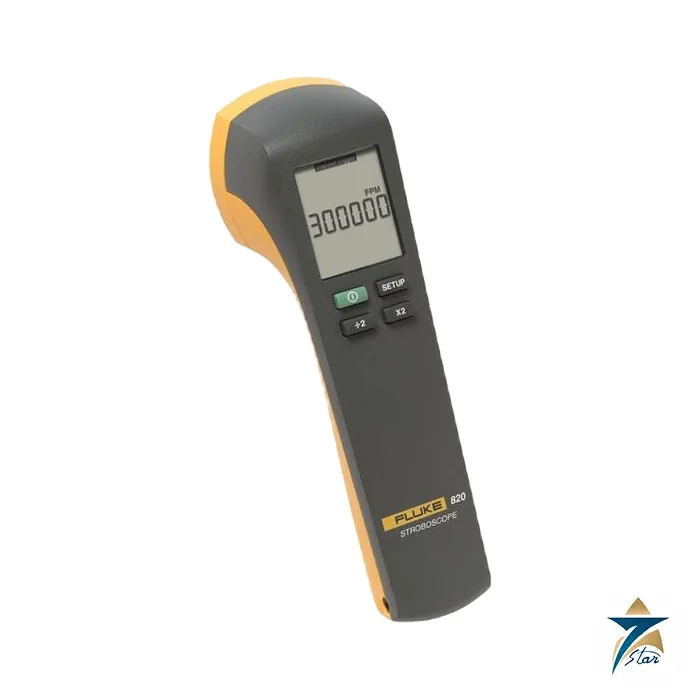
Fluke 820-2 LED Stroboscope

Description

The Fluke 820-2 is a compact LED stroboscope that makes rotating machinery appear to stand still, so that speed, slippage and wear can be seen without touching the machine. It replaces the xenon tube of older strobes with a solid-state LED array and a simple push-button interface.

Stop-motion inspection without stopping the machine

A stroboscope flashes at an adjustable rate. When the flash rate matches the rotation rate, a shaft, coupling, belt or fan blade appears stationary. The 820-2 covers 30 to 300,000 flashes per minute, or 0.5 to 5,000 Hz, so it works on slow conveyors and on high-speed spindles alike.

Fluke states a quartz-controlled accuracy of 0.02 percent, plus or minus one digit, and the multi-line LCD shows the set rate in FPM or Hz. The 2x and divide-by-2 buttons make it quick to confirm the true speed and avoid reading a harmonic.

Technical specifications

Parameter Specification
Model / part no. Fluke 820-2 / 4550041
Light source High-intensity 7-LED array, about 6500 K
Flash rate 30 to 300,000 FPM (0.5 to 5000 Hz)
Accuracy 0.02 % (+/-1 digit), quartz controlled
Resolution 0.1 for 30 to 999 FPM; 1 for 1000 to 300,000 FPM; 0.1 for 0.5 to 999 Hz; 1 for 1000 to 5000 Hz
Light output 4,800 lx at 6,000 FPM, 30 cm
Flash duration and delay Adjustable, in microseconds or degrees
Frequency setting FPM or Hz
External trigger High level 3 V to 32 V, minimum pulse width 50 microseconds
Batteries AA, quantity 3 (users manual); auto-off after 15 minutes
Size 5.71 x 6.09 x 19.05 cm
Weight 0.24 kg
Operating temperature 0 to +45 C
Impact resistance 1 m drop
Approvals CE; EN61326-1:2006
Supplied with Protective case and external trigger connector

Typical uses in plant maintenance

Maintenance teams use a strobe to check the running speed of motors, fans, pumps and belt drives, to look at gear teeth and keyways with advance or retard flash timing, to inspect couplings, chains and belts for slippage, and to read part markings on moving parts. Adjustable flash duration sharpens the image when surfaces move quickly; a shorter flash gives less blur.

The light is solid-state, has no filament or glass tube, and was drop tested to 1 metre. An external trigger input lets a machine signal control the flash. Treat the strobe as an observation tool: strobing a rotating part can make it look stopped, so keep guards in place and follow site lockout rules.

To use it, enter the expected speed, point the light at the target and trim the rate with the up and down buttons until the mark looks still. If it appears still at the entered rate and again at half the rate, the true speed is the higher figure, which is where the divide-by-2 and 2x keys help. The strobe is powered by AA batteries and switches itself off after 15 minutes to save them.

Documents and quotation

The linked PDF is the 820-2 users manual dated September 2014. Fluke’s data sheet link covers the earlier 820, so the manual is the document we attach for the 820-2. Before ordering, confirm the speed range you need, whether you need the 7-LED output at your working distance, and the battery type you will stock. Send us the model, quantity and delivery location and we will prepare a quotation; Seven Star LLC supplies from Muscat as an independent supplier. See our Portable Test and Measurement range and the Fluke 810 handheld vibration tester for related instruments.

Datasheets & Documents
  • PDF Datasheet Fluke 820-2 Stroboscope users manual, September 2014 (PDF) Download
Reviews (0)

Reviews

There are no reviews yet.

How would you rate this product?

It takes about 10 seconds — just tap a star. Your email is never published.

About brand

Fluke is the American maker of handheld electronic test tools: digital multimeters, clamp meters, insulation testers, process calibrators, thermometers, vibration meters and power quality analysers. John Fluke founded the John Fluke Engineering Company in Springdale, Connecticut, in June 1948 and moved it to Seattle in 1952. Fluke is headquartered in Everett, Washington, was acquired by Danaher in 1998 and has been part of Fortive since Fortive's spin-off from Danaher in 2016.

Seven Star LLC lists Fluke process calibrators, electrical test tools and bench calibrators, and sources them for maintenance teams and calibration laboratories in Oman.

Fluke company profile

Founded June 1948, Springdale, Connecticut, USA, as the John Fluke Engineering Company
Founder John M. Fluke Sr.
Headquarters Everett, Washington, USA (moved to the Seattle area in 1952)
Ownership Danaher from 1998; part of Fortive (NYSE: FTV) since July 2016
Product families Digital multimeters and clamp meters, insulation resistance testers, process and loop calibrators, infrared thermometers and thermal imagers, vibration meters, power quality analysers, Fluke Calibration laboratory standards

Milestones

  • 1948: John Fluke starts the company in Springdale, Connecticut.
  • 1952: The company moves to Seattle
  • 1987: A joint venture with Philips leads to the ScopeMeter handheld oscilloscope.
  • 1998: Danaher acquires Fluke.
  • 2016: Fluke becomes part of Fortive, spun off from Danaher in July.

Fluke calibrators and test tools listed

The main Fluke products on this page fall into three groups, besides other test tools such as further multimeters, a thermometer, an anemometer, a vibration tester and a portable appliance tester:

  • Process tools: the 754 documenting process calibrator with HART, 789 ProcessMeter, 721 dual sensor pressure calibrator and 729 automatic pressure calibrator
  • Electrical test: the 376 FC true-RMS clamp meter with iFlex probe and the 1587 FC insulation multimeter
  • Fluke Calibration bench standards: 5522A, 5502A, 5500A and 5080A multi-product calibrators, the 5720A multifunction calibrator, 8508A reference multimeter, 6100A electrical power standard and 9640A RF reference source

Several of the bench models belong to earlier generations. When a model is no longer produced, we check the manufacturer's documentation and propose the successor it names.

Where Fluke instruments are used

Fluke process calibrators are used for loop checks, transmitter calibration and valve tests in oil and gas, power and water plants. Clamp meters and insulation testers serve electrical maintenance on motors, switchgear and cables. The bench calibrators and reference multimeters are the working standards of electrical calibration laboratories in the GCC, where they calibrate multimeters, clamp meters, process tools and power analyzers.

Fluke products we list

Family Examples
Portable Test & Measurement 117 Electrician’s True-rms Multimeter with, 1507 Insulation Resistance Tester, 1550C 5 kV Insulation Resistance Tester, 1587 FC Insulation Multimeter, 376 FC True-RMS AC/DC Clamp Meter with iFlex, 5080A Multi-Product Calibrator, 5500A Multi-Product Calibrator, 5502A Multi-Product Calibrator and 17 more
Lubrication & Bearing Maintenance 805 FC Vibration Meter

Ordering Fluke instruments: what we need

Send the exact model with its suffix, since versions differ. A Fluke 721, for example, is defined by its two pressure ranges, and a 729 by its maximum pressure. For bench calibrators, list the options you need, such as oscilloscope calibration or power quality options, the line voltage, and the type of calibration certificate you require from the manufacturer. For Fluke multimeters and clamp meters, add the kit contents wanted, such as probes, leads or cases.

Facts checked against published histories of Fluke Corporation and Fortive, October 2026.

Frequently Asked Questions

What flash range does the Fluke 820-2 cover?
30 to 300,000 FPM, equal to 0.5 to 5,000 Hz.
How accurate is it?
Fluke states 0.02 percent with plus or minus one digit, quartz controlled.
Does it need reflective tape?
No, it checks rotating speed without contact or reflective tape.
Can the flash be triggered externally?
Yes, via an external trigger connector with a 3 V to 32 V high level.
What is supplied?
A protective case and the external trigger connector are listed.