Fluke 435-II three-phase power quality and energy analyzer, IEC 61000-4-30 Class A
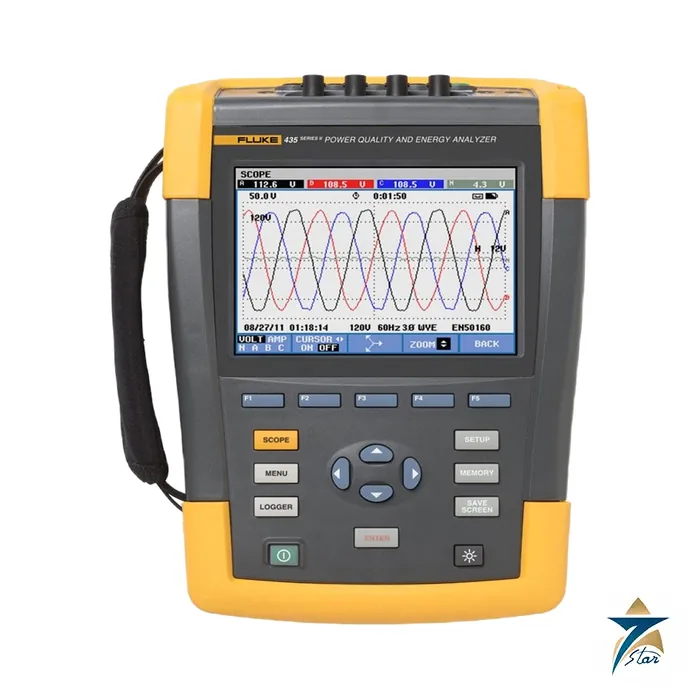
The Fluke 435-II is a handheld three-phase power quality and energy analyzer that measures to IEC 61000-4-30 Class A and adds transient capture, flicker, mains signalling and PowerWave recording to the functions found on the entry model of the 430 Series II. It sits in the middle of the series: the 434-II is the Class S model, the 435-II is Class A, and the 437-II is Class A with 400 Hz support. Seven Star LLC supplies the 435-II in Oman and the GCC as an independent supplier in Muscat, and this page lists the functions and the specification points that matter when you request a quotation.
How the 435-II differs from 434-II and 437-II
According to the selection table in the data sheet, all three models offer volts, amps and hertz, dips and swells, harmonics, power and energy, the energy loss calculator, unbalance, monitor mode, inrush and power inverter efficiency. The 435-II and 437-II add event waveform capture, flicker, transients, mains signalling and PowerWave. The 437-II alone adds 400 Hz measurement for avionic and military supply systems and ships with a hard case with rollers, while the 434-II and 435-II come with the C1740 soft case. The 435-II also has better voltage accuracy than the 434-II: ±0.1 percent of nominal voltage compared with ±0.5 percent.
Technical specifications of the 435-II
| Parameter |
Specification |
| Manufacturer / part number |
Fluke / 435-II |
| Standard compliance |
IEC 61000-4-30 Class A |
| Voltage inputs |
4 inputs (3 phase + neutral), dc-coupled, up to 1000 Vrms, nominal range 1 … 1000 V; 6 kV peak in transient mode |
| Current inputs |
4 inputs, 0.5 … 600 A or 5 … 6000 A with the included i430-Flex thin flexible probes; mV-output clamps and CTs supported |
| Sampling |
16-bit, 200 kS/s on each of 8 channels simultaneously |
| Bandwidth |
Above 10 kHz; up to 100 kHz in transient mode |
| Voltage accuracy |
±0.1 % of nominal voltage |
| Current accuracy |
±0.5 % ± 5 counts (excluding clamp accuracy) |
| Frequency |
50 Hz and 60 Hz nominal, resolution 0.001 Hz, ±0.01 Hz |
| Harmonics |
DC, 1st … 50th; interharmonics |
| Power and energy |
Watts, VA, var, PF, DPF, energy loss with user-set cost per kWh |
| Logger |
Up to 150 PQ parameters on 4 phases; memory for up to 600 parameters at user intervals per the family description |
| Monitor |
EN 50160 parameters on one screen with IEC 61000-4-30 flagging |
| Transients |
Waveform capture on 4 voltage and 4 current channels, triggers on Vrms½, Arms½, Pinst |
| Safety |
600 V CAT IV / 1000 V CAT III |
| Battery |
Li-ion BP290, up to 8 hours operating time |
| Storage |
SD card, 8 GB supplied (maximum 32 GB) |
| Included accessories |
TL430 test lead set, 4 x i430 thin flexible current probes, BP290 battery, BC430 power adapter, USB cable, PowerLog software |
Measurement modes of the 435-II
- Scope, phasor and meter views: four voltage and four current waveforms, vector diagram and tabulated readings, with trend graphs and cursors.
- Dips and swells: Vrms half-cycle, Arms half-cycle and instantaneous power with programmable thresholds.
- Harmonics: harmonic volts, THD, harmonic amps, K-factor and harmonic watts to the 50th.
- Unbalance: negative and zero sequence percentages and phase angles.
- Inrush: inrush current and duration for motor starts.
- Monitor: parameters measured simultaneously according to EN 50160, with flagging under IEC 61000-4-30.
- Flicker, transients, mains signalling and PowerWave: available on the 435-II and 437-II only.
Energy loss calculator and power inverter efficiency
The patented Unified Power Measurement method separates classical active and reactive power from unbalance and harmonic power and quantifies the loss caused by reactive power, unbalance, harmonics and neutral current. Together with the user-entered cost per kWh, the calculator reports the cost of wasted energy, which helps justify a harmonic filter, a power factor correction bank or load rebalancing. Optional dc clamps allow the analyzer to measure ac output power and dc input power at the same time to calculate inverter efficiency, relevant for solar and UPS systems.
Selection and ordering checklist for the 435-II
- Class: Class A required (435-II or 437-II) or Class S sufficient (434-II).
- Need for transient capture up to 6 kV, flicker or mains signalling.
- Probe range: the included i430-Flex probes cover 0.5 … 600 A and 5 … 6000 A; additional ac or dc clamps are optional.
- Supply frequency: 50 or 60 Hz (435-II) or 400 Hz (437-II).
- Software and reporting, and the memory card needed for long studies.
- Calibration certificate and traceability requirement.
Connecting and commissioning the analyzer
Connect the voltage leads and current probes, enter the nominal voltage and system type, and check phase relationships on the phasor screen before logging. Set thresholds for dips, swells and inrush according to the study, and start logging so that trends and events are recorded together. The analyzer is rated for 600 V CAT IV and 1000 V CAT III, but the rating depends on the use of the correct probes and leads and on the site safety rules. Keep the Li-ion battery charged for long unattended studies or power the instrument from the adapter.
Typical applications in Oman and the GCC
The 435-II is used for troubleshooting nuisance trips, motor-start sags, harmonic heating and capacitor bank resonance in plants with many drives, for supply quality acceptance tests on generators and transformers, for checks after UPS or generator transfers and for solar plant commissioning. Facilities with high cooling loads, long cable runs and weak local grids benefit from the Class A measurements when a dispute about supply quality must be documented.
Information to send with an RFQ for the 435-II
- Model: 435-II (or 434-II or 437-II), kit and probe size
- System voltage and frequency
- Study type (power quality, energy loss, transients)
- Calibration certificate requirement
- Quantity and delivery site
Documents and quotation
The Fluke 430 Series II technical data sheet is attached on this page. It includes the selection table and the complete accuracy tables.
Send the model and the application and Seven Star LLC will confirm availability and prepare a quotation.























Reviews
There are no reviews yet.