Endress+Hauser PMC11 Cerabar ceramic gauge pressure transducer
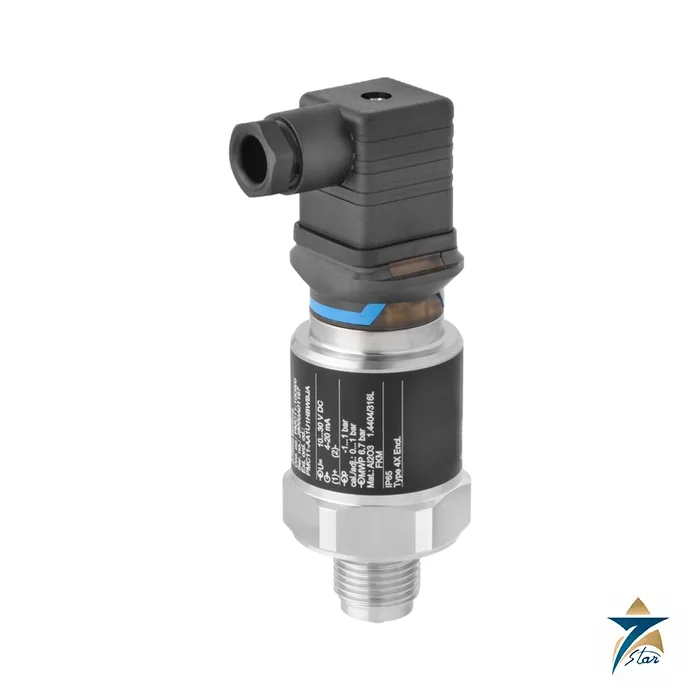
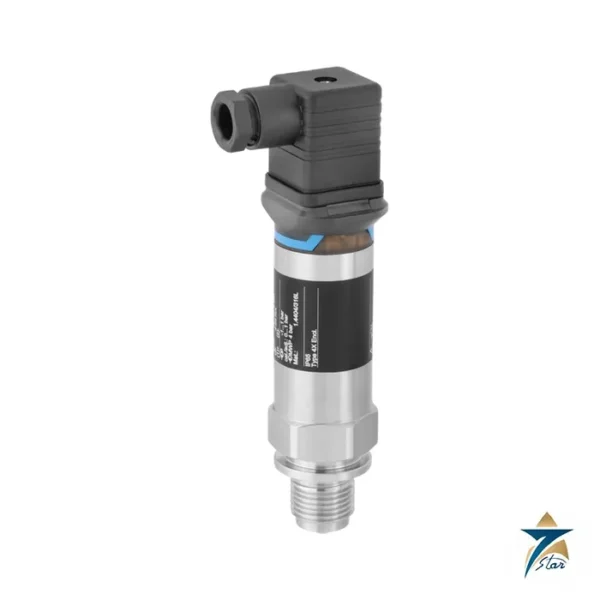
The Endress+Hauser PMC11 is the entry model of the Cerabar transducer line for gauge pressure. It pairs a capacitive sensor with a ceramic process diaphragm and a 316L stainless steel body, and it outputs either a two-wire 4–20 mA signal or a three-wire 0–10 V signal. Seven Star LLC, an independent supplier in Muscat, supplies the PMC11 in Oman and the GCC for pumps, compressors, skids, hydraulic and utility systems that need a compact, economical pressure signal.
The part number is short, so the ordering detail sits in the configuration codes rather than in the model name. The datasheet decodes them as follows: the model fixes the sensor type (ceramic) and the measuring principle (gauge only); the “Sensor range” code selects the cell (for example 1H for 1 bar, 1P for 10 bar, 1S for 40 bar); the “Output” code selects 4–20 mA or 0–10 V; and the “Electrical connection” code selects the M12 plug (L), the ISO 4400 M16 valve plug (U) or the ISO 4400 NPT ½ valve plug (V). Process connection codes cover ISO 228, ASME and DIN 13 threads.
PMC11 technical specifications
| Parameter |
Specification |
| Manufacturer / part number |
Endress+Hauser Cerabar PMC11 |
| Measuring principle |
Gauge pressure, capacitive ceramic sensor (oil-free) |
| Measuring cells |
400 mbar, 1, 2, 4, 6, 10, 16, 25 and 40 bar (6 to 600 psi) |
| Measuring range |
–400 to +400 mbar up to –1 to +40 bar (–6 to +6 psi up to –15 to +600 psi) |
| Reference accuracy |
Up to ±0.5 % of calibrated span (non-linearity ±0.1 %, non-repeatability ±0.1 %) |
| Output |
4–20 mA (2-wire) or 0–10 V (3-wire) |
| Supply voltage |
10–30 V DC (4–20 mA); 12–30 V DC (0–10 V) |
| Process temperature |
–25 to +85 °C (–13 to +185 °F) |
| Ambient temperature |
–40 to +70 °C (–40 to +158 °F) |
| Maximum working pressure |
Up to 40 bar (600 psi) depending on cell |
| Over pressure limit |
Up to 60 bar (900 psi) depending on cell |
| Wetted materials |
316L process connection; Al2O3 ceramic diaphragm, 99.9 % pure |
| Housing |
316L (1.4404) |
| Electrical connection |
M12 plug or ISO 4400 valve plug, IP65 / NEMA Type 4X |
| Process connections |
Thread ISO 228, ASME NPT, DIN 13 |
How the PMC11 ceramic sensor works
Process pressure acts directly on a thin disc of ultrapure aluminium oxide ceramic. As the disc flexes, the gap between electrodes on the ceramic substrate and on the disc changes, and the transducer converts the resulting capacitance shift into the output signal. Because there is no fill oil behind the diaphragm, there is no oil to leak into the process and no oil expansion to influence the reading. The thickness of the ceramic sets the measuring range.
The datasheet highlights two practical strengths of this construction: overload resistance of up to 40 times the nominal pressure, and very high chemical durability from the 99.9 % ceramic. The gauge sensor references the atmosphere through a pressure compensation path, which is why the installation advice on this page about moisture and cable orientation matters.
Where the PMC11 fits in the measuring system
A PMC11 loop normally consists of the transducer, a PLC or controller input, and, where needed, a loop indicator or signal conditioner of the RN221N or RMA42 type mentioned in the datasheet. It is intended as a cost-effective point measurement, not as a smart transmitter: there is no on-device display or configuration menu, and the turn down is fixed at the factory.
Within the same family, the PMC21 adds absolute-pressure cells, 0.3 % accuracy, cable and IO-Link connection options and optional approvals. The PMP11 and PMP21 use a metallic 316L diaphragm instead of ceramic and reach higher ranges. If your duty needs more than 40 bar, an absolute reference or hazardous-area approval, one of those siblings is the better fit than the PMC11.
Selecting the PMC11: ordering checklist
- Choose the cell so that the normal operating pressure sits in the middle of the span; remember the 6, 16 and 25 bar cells are limited to lower turn down than the others.
- Confirm the over pressure limit and maximum working pressure of the cell against the worst-case surge, not just normal pressure.
- Pick 4–20 mA for long cable runs and standard PLC cards; pick 0–10 V only if the controller input requires it and the cable is short.
- Select the electrical connection (M12, M16 valve plug or NPT ½ valve plug) to match the cable or conduit you already have.
- Check the process thread: ISO 228 G, ASME NPT or DIN 13, with the correct seal.
- Decide whether you need a calibration certificate or oil-and-grease cleaning, the two options listed for this model.
- If an intrinsically safe loop, marine class or oxygen duty is involved, move to the PMC21 instead.
PMC11 installation, commissioning and maintenance
Mount the transducer so that its calibration orientation is respected. In the datasheet the reference position is a horizontal diaphragm axis. If the diaphragm points upward the zero can shift by up to +0.3 mbar below 1 bar or +3 mbar at 1 bar and above; pointing downward gives the same shift in the negative direction. On low-pressure cells this is visible, so choose the orientation deliberately.
- Gases: fit a shut-off device above the tapping point so condensate drains back to the process.
- Steam and vapors: use a siphon and mount level with the tapping point so the transducer stays near ambient temperature.
- Liquids: mount level with the tapping point; for level duty install below the lowest measuring point and away from filling curtains, outlets and pump suction.
- Cables: let the cable or plug point downward to keep moisture out of the pressure compensation path.
Commissioning is a loop check: verify the supply is within 10–30 V DC and that the load stays below (supply – 6.5 V) / 22 mA. Failure is signalled per NAMUR NE 43, with a factory maximum alarm above 21 mA. Maintenance is limited to periodic zero checks against a reference and inspection of the plug seal and thread seal. We recommend keeping one spare per critical loop.
Typical PMC11 applications in Oman and the GCC
In the region the PMC11 is typically chosen for utility and OEM duties where the medium is clean enough for a ceramic face and the pressure is below 40 bar. Examples are chilled-water and cooling-water headers at gas-processing sites, instrument air and nitrogen systems, lube and hydraulic oil pressure on compressor skids, filter differential monitoring, and booster-pump discharge on desalination and water-network packages. The 316L body and sealed plug handle coastal humidity and dust well when cables are routed downward. Where ambient temperature approaches the +70 °C limit on an exposed skid, shade the unit or relocate it with a short impulse line.
PMC11 compared with sibling Cerabar models
| Model |
Sensor |
Measuring principle |
Accuracy |
Upper range |
| PMC11 |
Ceramic |
Gauge |
up to 0.5 % |
40 bar |
| PMC21 |
Ceramic |
Gauge and absolute |
up to 0.3 % |
40 bar |
| PMP11 |
Metal 316L |
Gauge |
up to 0.5 % |
40 bar |
| PMP21 |
Metal 316L |
Gauge and absolute |
up to 0.3 % |
400 bar |
Information to send with an RFQ for the PMC11
- Full part number or order code, or the nameplate photo of the device being replaced.
- Measuring range and unit, and whether the output must be inverted.
- Output (4–20 mA or 0–10 V) and electrical connection type.
- Process thread and sealing requirement.
- Medium, maximum temperature and expected pressure surges.
- Quantity, delivery site and any certificate required.
Documents and quotation
The manufacturer technical information covering the PMC11 is attached to this page. Read it together with your project specification before ordering, because the configuration codes and options determine the final device.
Send the part number, range and connection details and Seven Star LLC will confirm availability and prepare a quotation for delivery in Muscat and across the GCC.
Other Models in the Eh Cerabar Pmp Pmc Range
Seven Star LLC supplies models from the Eh Cerabar Pmp Pmc range in Oman and the GCC. Compare the related models below and request a quote for the one that matches your application.




















Reviews
There are no reviews yet.