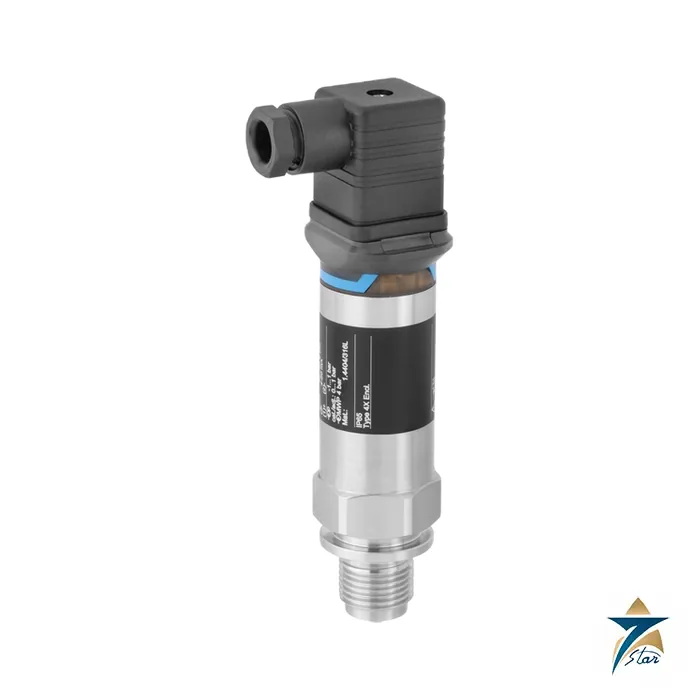
Endress+Hauser PMP11 Cerabar compact gauge pressure transducer
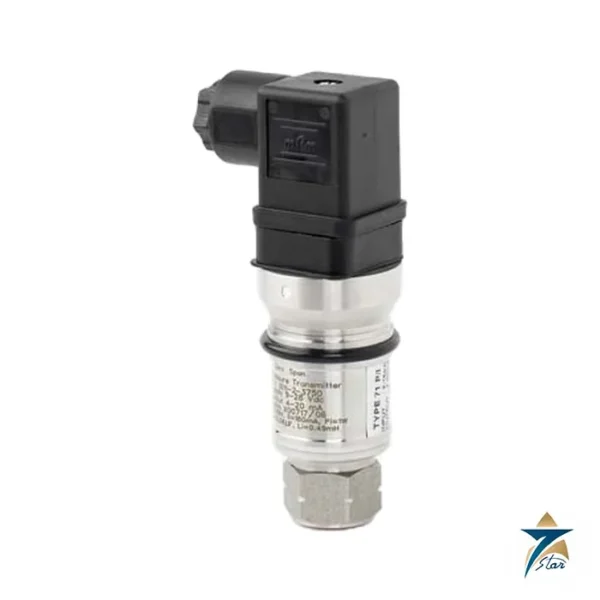
The Endress+Hauser PMP11 is a compact gauge pressure transducer from the Cerabar line. Its metal process diaphragm and fully welded sensor handle higher pressures than the ceramic sibling PMC11, and the 316L body with a valve plug or M12 connector and the 4 to 20 mA or 0 to 10 V output make it a plain, low-cost way to bring a pressure signal from pipework, pumps, compressors and skids into a PLC. It is a transducer, not a smart transmitter: there is no fieldbus and no on-board display (a plug-on PHX20 display is optional), and the turn down is set at the factory.
Seven Star LLC supplies the PMP11 in Oman and the GCC as an independent supplier in Muscat. The page below covers the decoding of the range, the main specifications and what we need to quote the right version.
PMP11 technical specifications
| Parameter |
Specification |
| Manufacturer / part number |
Endress+Hauser / PMP11 (Cerabar) |
| Measuring principle |
Gauge pressure, piezoresistive silicon sensor behind a metal diaphragm with oil fill |
| Measuring ranges (URL) |
400 mbar, 1, 2, 4, 6, 10, 16, 25 or 40 bar (6 to 600 psi); lower range limit –0.4 or –1 bar |
| Overpressure limit (OPL) |
1.6 bar for 400 mbar up to 160 bar for 40 bar; vacuum resistance 0.01 bar abs. |
| Maximum working pressure (MWP) |
1 bar to 100 bar depending on the range |
| Reference accuracy |
±0.5 % of the calibrated span (non-linearity ±0.1 %, non-repeatability ±0.1 %) |
| Turn down |
1:1 on 400 mbar; up to 2.5:1 on 1, 6 and 16 bar; up to 5:1 on 2, 4, 10 and 25 bar and above; set at the factory |
| Process temperature |
–25 to +85 °C |
| Ambient temperature |
–40 to +70 °C; storage –40 to +85 °C |
| Output |
4 to 20 mA, 2-wire (3.8 to 20.5 mA signal range) or 0 to 10 V, 3-wire |
| Supply voltage |
10 to 30 V DC for 4 to 20 mA; 12 to 30 V DC for 0 to 10 V |
| Dynamic behaviour |
Dead time 6 ms, T63 10 ms, T90 15 ms; switch-on time up to 2 s |
| Materials |
316L housing and process connection; 316L (1.4435) process diaphragm; PAO synthetic food-grade fill oil |
| Electrical connection |
M12 plug, or ISO 4400 valve plug with M16 or NPT ½ entry; IP65 NEMA 4X |
The figures are taken from the Endress+Hauser technical information for the Cerabar PMC11, PMC21, PMP11 and PMP21. The PMP11 is the gauge pressure, 316L-diaphragm, entry-level version of that group.
How the PMP11 measures pressure
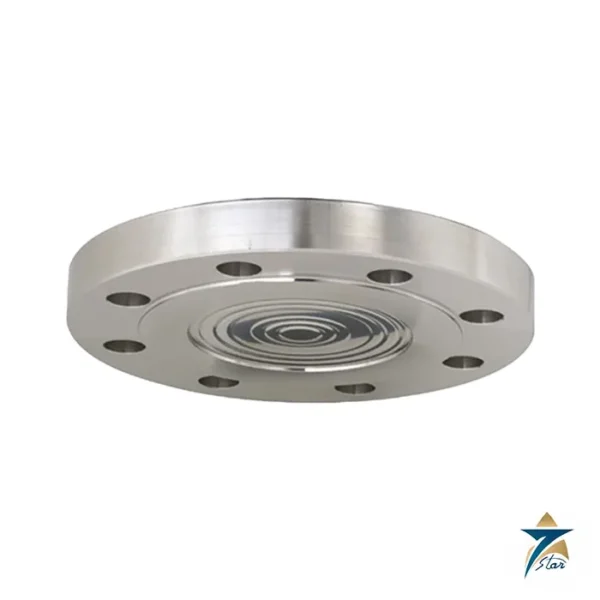
The process pressure deflects a thin 316L diaphragm of 17.2 mm diameter, and a small channel of oil transfers the force to a silicon measuring element. A Wheatstone bridge on the element changes its output voltage with pressure, and the electronics condition that into the analog output. The sensor is fully welded, which is why a metal-diaphragm device is the one to use at higher process pressures than the ceramic types, and why the diaphragm can be mounted flush with the process wall for viscous or sticky media.
The device has reverse polarity, HF and overvoltage-peak protection, and it will continue to work without damage up to 34 V DC. If the supply falls below the minimum, it shuts down in a defined manner. The alarm output is set to a maximum alarm above 21 mA as factory setting, in line with NAMUR NE 43.
PMP11 process connections and range codes
The PMP11 is offered with internal-diaphragm threads and a flush-mount thread. Internal connections include G ¼ A to EN 837, G ¼ female, G ½ A to EN 837 and a G ½ A with an 11.4 mm bore, ASME ¼ and ½ MNPT versions (some with CRN approval) and a DIN 13 M20 × 1.5 thread with a 3 mm bore. The flush versions use a G ½ A thread to DIN 3852 shape E with a pre-mounted FKM form seal, or a flush G ½ A with an O-ring seal. The sensor range is chosen from the code letters: 1F for 400 mbar, 1H for 1 bar, 1K for 2 bar, 1M for 4 bar, 1N for 6 bar, 1P for 10 bar, 1Q for 16 bar, 1R for 25 bar and 1S for 40 bar. The weight is only about 0.12 to 0.27 kg including the connection.
Where the PMP11 fits and related Cerabar and Deltapilot models
The PMP11 is one of four siblings. The PMC11 uses a robust ceramic diaphragm in a 316L body, with lower overpressure limits, while the PMP21 and PMC21 add absolute-pressure versions, IO-Link, cable outputs, hazardous-area and marine approvals and higher accuracy of 0.3 %. The datasheet lists calibration certificate and oil-and-grease cleaning as the only options for the PMP11, and the hazardous-area approvals appear as options for the PMC21 and PMP21 only. If you need Ex or marine approval, ask about the PMP21, not the PMP11. For level in tanks, the Deltapilot M, such as the FMB50, is the dedicated family.
Selecting and ordering a PMP11
- Range: take the maximum working pressure and choose a range at least 25 to 30 % above it. The PMP11 turns down at most 5:1, and many ranges only 2.5:1.
- Overpressure and surges: check the OPL against pump starts and water hammer; for example, the 10 bar range has OPL 40 bar and the 25 bar range OPL 100 bar.
- Output: 4 to 20 mA for long cable runs and noisy plants; 0 to 10 V when the PLC input is a voltage and the run is short.
- Connection: match the thread (G, NPT, DIN 13) and decide whether a flush diaphragm is needed for viscous or sticky media.
- Electrical connection: M12 plug (code L), M16 valve plug (U) or NPT ½ valve plug (V). An optional plug-on display PHX20 fits the valve plug versions.
- Media: 316L diaphragm and body suits most water, air, oil and many chemicals; ask if seawater, chlorides or acids are present.
PMP11 installation, commissioning and maintenance
Any mounting orientation works, but the zero point shifts by up to +4 mbar with the diaphragm pointing up and –4 mbar pointing down, relative to the horizontal calibration position. That matters most on the 400 mbar range. Point the cable or connector downwards to keep rain and condensation out. For gas, mount above the tapping point so condensate drains away; for steam, fit a siphon and a shutoff valve; for liquids, install the valve level with the tapping point. For tank level, install below the lowest measuring point and away from fill curtains, pump suction and agitator pulses.
The turn down is preset at the factory and cannot be changed, so verify the loop with a calibrator against the ordered range. Annual long-term stability is ±0.2 % of the upper range limit, and ±0.45 % over 8 years. Replace the transducer if it drifts out of tolerance, and keep the old nameplate details so the replacement has the same range, thread and output.
Typical PMP11 applications in Oman and the GCC
In Oman and the GCC the PMP11 is used on pump discharge and suction lines, filtration skids, compressed-air systems, hydraulic and lubrication units, boiler feed and cooling-water circuits, and package equipment in oil and gas, power and water plants. The IP65 rating suits indoor and sheltered skids, so use a sunshade or enclosure for outdoor mounting in strong sun and dust, and take care with the process temperature limit of 85 °C near hot lines.
Information to send with a PMP11 RFQ
- Part number PMP11 and the order code of any unit to be matched.
- Pressure range or normal and maximum pressures, and any surge or vacuum conditions.
- Medium and temperature, and whether a flush diaphragm is needed.
- Process thread and size, output (4 to 20 mA or 0 to 10 V) and electrical connection.
- Calibration certificate or oil-and-grease-free cleaning requirement, and quantity.
Documents and quotation
A copy of the Endress+Hauser technical information for the Cerabar PMC11, PMC21, PMP11 and PMP21 is attached on this page, with the PMP11 range tables and connections.
Send us the PMP11 information above and Seven Star LLC will prepare a quotation for Oman and the GCC.



















Reviews
There are no reviews yet.