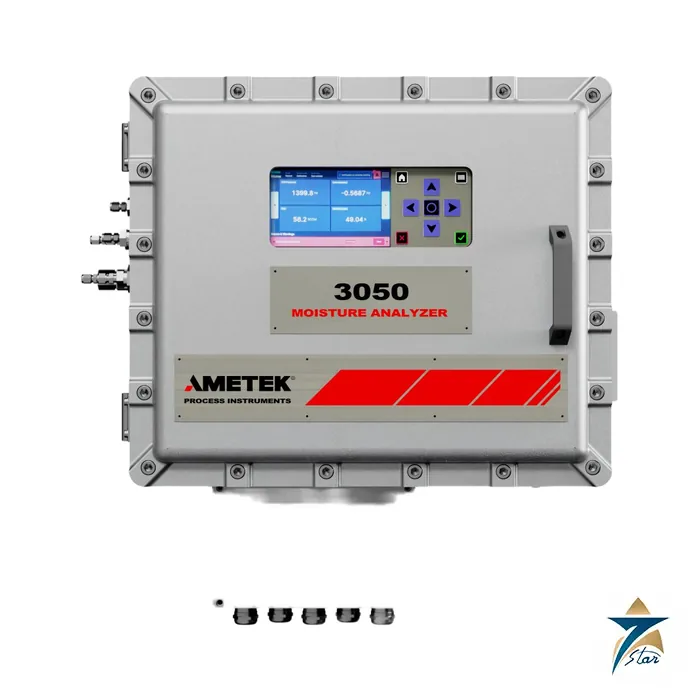
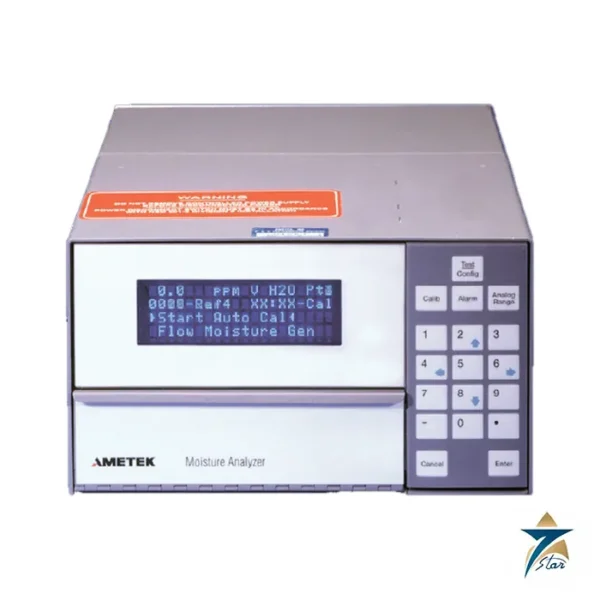
AMETEK 3050 Series QCM trace moisture analyzers
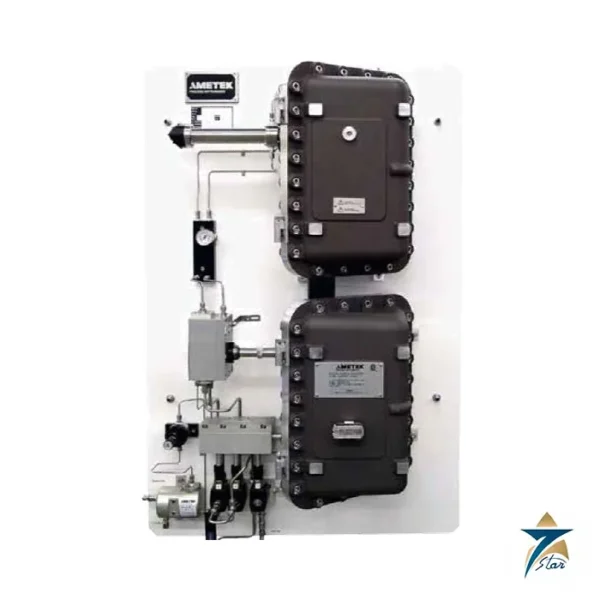
The AMETEK 3050 Series is a family of online trace moisture analyzers based on quartz crystal microbalance (QCM) sensing. A vibrating quartz crystal responds to water vapour in the sample gas, and the analyzer converts that signal into a moisture reading in ppmv, with lower detection limits reaching 0.01 ppmv on the most sensitive variant. It is aimed at natural gas, hydrocarbon process gas and industrial gas streams where a dryer breakthrough or a specification excursion must be seen quickly. Seven Star LLC supplies the 3050 Series in Oman and the GCC as an independent supplier in Muscat.
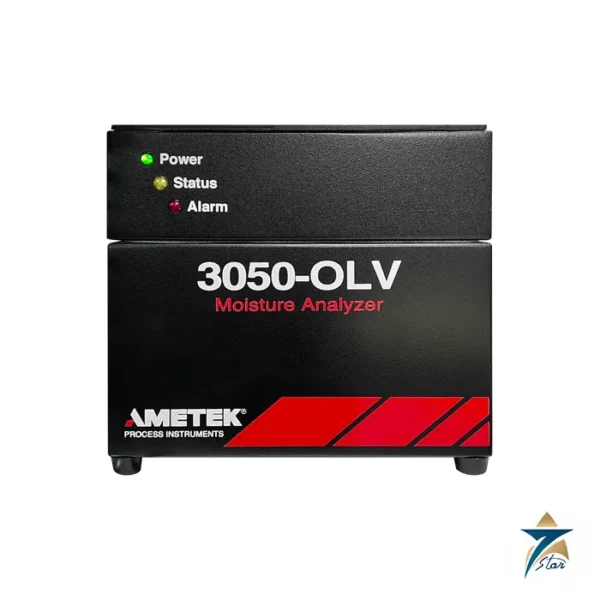
3050 Series is a series name. The manufacturer datasheet separates four performance columns, labelled OLV, SLR, DO and TE, which differ in calibrated range, accuracy and detection limit. Which one you need depends on the lowest moisture level you must measure, so the first job in any enquiry is to define the range and the application.
3050 Series performance variants decoded
| Variant |
Calibrated range |
Accuracy |
Limit of detection |
Dual moisture generator points |
Zero-gas module |
| OLV |
0.1 to 2500 ppmv |
±0.1 ppmv or ±10 % of reading, whichever is greater |
0.1 ppmv |
25 and 75 ppmv |
None |
| SLR |
0.1 to 100 ppmv |
±0.03 ppmv or ±10 % of reading, whichever is greater |
0.1 ppmv |
0.5 and 1.0 ppmv |
Included |
| DO |
0.02 to 100 ppmv |
±0.02 ppmv or ±10 % of reading, whichever is greater |
0.02 ppmv |
0.5 and 1.0 ppmv |
Included |
| TE |
0.01 to 100 ppmv |
±0.01 ppmv or ±10 % of reading, whichever is greater |
0.01 ppmv |
0.5 and 1.0 ppmv |
Included |
Read the table as a choice between breadth and depth. The OLV covers the widest span, up to 2500 ppmv, which suits general pipeline gas. The SLR, DO and TE are tuned for low-ppmv work and carry a zero-gas module so the instrument can check its own baseline. Their verification points of 0.5 and 1.0 ppmv sit within that low-ppmv range.
3050 Series technical specifications
| Parameter |
Specification |
| Manufacturer / part number |
AMETEK Process Instruments / 3050 Series (OLV, SLR, DO, TE) |
| Technology |
Quartz crystal microbalance (QCM) |
| Reference gas |
Produced continuously from the sample gas through a reference dryer with over 5,000,000 ppm-hour capacity |
| Online verification |
Internal NIST-traceable moisture source for on-demand verification without removing the analyzer |
| Calibration |
No routine factory calibration required, owing to the stability of the QCM sensor |
| User interface |
Integrated display with optical keypad |
| Communications |
RS485 2-wire Modbus RTU; Ethernet 10/100 Mbps or 1 Gbps with web interface and Modbus TCP; USB |
| Inputs |
Two remote isolated digital inputs (contact closure); one isolated analog input, selectable 1–5 V or 4–20 mA, for process pressure |
| Outputs |
Two isolated 16-bit 4–20 mA analog outputs |
| Alarms |
Four contact closures: service, data valid, concentration and one user-configurable |
| Inlet pressure |
1.3 to 3.3 bar g (20 to 50 psig); up to 200 bar g (3000 psig) with optional pressure reducer |
| Exhaust pressure |
0 to 1 bar g (0 to 15 psig) |
| Sample gas temperature |
0 to 100 °C (32 to 212 °F) |
| Gas flow |
About 200 sccm, plus about 1.0 slpm bypass for faster response |
| Instrument air |
Required for the SLR, DO and TE versions (ANSI/ISA 7.0.01-1996) |
| Readout units |
ppmv, ppmw, lb/mmscf, mg/Nm³ and dew point in °C or °F |
| Ambient temperature |
-20 to +50 °C; up to +60 °C with the high temperature option |
| Power |
120 V AC or 230 V AC, ±10 %, 50/60 Hz, 100 W maximum |
| Enclosure / approvals |
IP65; ATEX / IECEx Zone 1 |
How QCM moisture measurement works in the 3050 Series
In a QCM sensor a quartz crystal is made to vibrate at a stable frequency, and moisture picked up by the crystal changes that frequency in a way that can be converted into a concentration. The 3050 also produces a reference gas continuously from the sample itself by passing it through a reference dryer, which gives the analyzer a dry baseline to work against. The manufacturer notes that the sensor is unaffected by process gas temperature and does not need to reach equilibrium, which is why it follows both rising and falling moisture rather than lagging on the drydown.
The unusual feature of the 3050 Series is its on-board verification. A dual-concentration permeation device injects two known moisture levels, on a schedule or on demand, and the analyzer compares what its sensor reports with what it should read. For a custody-transfer or product-quality station, this gives documented evidence that the analyzer is still measuring correctly, without sending it away for factory recalibration.
Where the 3050 Series fits in the plant
AMETEK lists these applications for the series: natural gas quality in pipelines and custody transfer stations, natural gas processing and dehydration, feedstock gas quality, molecular sieve dryer efficiency, cryo-recovery turbo expander inlet and outlet, and hydrogen recycle gas in continuous catalytic reactors. The key markets named are petrochemical, natural gas, refinery, chemical and industrial gas.
The analyzer sits in a sample system: a tap off the process line, pressure reduction, filtration and a bypass flow so the sample reaches the analyzer fast. The datasheet gives the analyzer-side requirements (1.3 to 3.3 bar g inlet, about 200 sccm through the sensor and about 1.0 slpm bypass), and the sample system design must deliver those conditions. Separate sample system manual supplements exist for general-purpose, Division 2 and Zone 1 / Division 1 layouts, so the area classification should be fixed early.
Selection and ordering checklist for the 3050 Series
- Lowest moisture value you must see: this decides between OLV and the SLR, DO or TE columns.
- Highest expected moisture: OLV is calibrated to 2500 ppmv, the others to 100 ppmv.
- Process gas composition, including H2S and CO2 content; the datasheet states operation with up to 30 % hydrogen sulfide or 100 % carbon dioxide.
- Sample pressure and whether the optional pressure reducer is needed for lines above 3.3 bar g.
- Instrument air availability, required for SLR, DO and TE.
- Hazardous area: the datasheet lists ATEX/IECEx Zone 1; confirm the certificate scope for your configuration.
- Output and communication needs: 4–20 mA, Modbus RTU or TCP, Ethernet speed.
- Ambient temperature: standard to 50 °C, with a 60 °C high-temperature option.
Installation, commissioning and maintenance
Install the analyzer as close to the sample tap as practical and keep sample tubing short, because water vapour adsorbs on tubing walls and slows the response at low ppm. Electropolished or otherwise suitable stainless steel tubing is the usual practice, and the sample system should be leak-tested before gas is introduced. After power-up, let the analyzer stabilise on dry gas, run the internal verification and record the baseline for the commissioning file.
In service, the datasheet cites a consumable service life above three years, so plan the replacement of the consumable items and keep the verification log current. The integrated display and optical keypad allow configuration and alarm review at the analyzer without a hot-work permit, according to the manufacturer. A web interface over Ethernet is available for remote access.
Typical applications for the 3050 Series in Oman and the GCC
Gas processing and transmission is the most direct fit in this region: dehydration units, molecular sieve beds and export gas points all need a moisture figure that is trusted. Refinery hydrogen systems and petrochemical feed gases use the same measurement for catalyst and equipment protection. In hot, dusty sites the IP65 enclosure and the 50 °C ambient rating (60 °C optional) matter, and a shaded or ventilated installation helps keep the sample lines at a stable temperature.
Information to send with a 3050 Series RFQ
- Required variant or the moisture range, for example 0 to 100 ppmv or 0 to 2500 ppmv.
- Gas composition, pressure and temperature at the sample point.
- Area classification and certificate requirement.
- Power supply voltage and available instrument air.
- Output signals and the control system protocol.
- Ambient temperature and whether the high-temperature option is needed.
- Delivery location and the project tag or tender reference.
Documents and quotation
A datasheet for the 3050 Series is attached on this page. For ordering, send the variant, range and certification needs and we will return a quotation and delivery information.
Seven Star LLC is an independent supplier in Muscat and is not an official representative of AMETEK.

























Reviews
There are no reviews yet.