
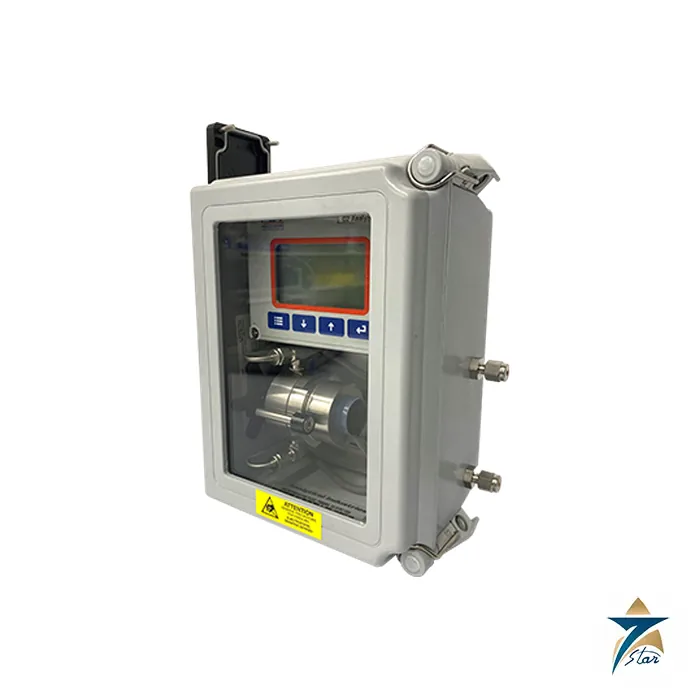
The AII GPR-1500 is a single-channel, loop-powered trace oxygen transmitter from Analytical Industries Inc. (AII), the Pomona, California manufacturer of electrochemical oxygen sensors and gas analyzers that now operates as a DwyerOmega brand. Designed for precise parts-per-million oxygen analysis in clean industrial gases, the AII GPR-1500 covers full-scale ranges from 0–10 ppmV up to 0–1 % O2, with a lower detection limit of 0.05 ppmV and a displayed resolution of 0.01 ppmV. It belongs to the GPR-x500 family, which shares one operator interface with the percent-level GPR-2500 and with the portable analyzers in the AII range, so technicians who learn one instrument can move between them without retraining.
Seven Star LLC supplies the AII GPR-1500 to process plants, gas producers and engineering contractors across the Sultanate of Oman and the wider GCC, with engineering support in Muscat. Our team helps buyers choose the right sensor variant, measurement range and area classification before the order is placed, so the transmitter arrives ready for the nitrogen package, inerting skid or purity monitoring point it is meant to serve, whether that is in Muscat, Sohar, Duqm or Salalah.
As general engineering background, an electrochemical (galvanic) oxygen sensor works like a small fuel cell. Oxygen in the sample diffuses through a membrane to a cathode, where it is reduced; a consumable anode inside the cell is oxidised at the same time, and the resulting current is directly proportional to the partial pressure of oxygen at the sensing face. Because the cell generates its own signal, no heated element, pump or reference gas is needed, and the output is close to zero when no oxygen is present, which is what makes this technology well suited to trace measurement in nitrogen, argon and other inert streams.
In the AII GPR-1500, AII pairs this principle with its own long-life ppm sensors that the company has refined over more than three decades. The datasheet lists the GPR-12-333 family (including the -LD and -H variants) and the XLT-12-333 family for colder sites, and sensor options allow oxygen to be measured in backgrounds such as helium, hydrogen or carbon dioxide. Gas temperature compensation is built in, a span check can be carried out with an air or span gas up to 0–25 % (a calibration-only range), and the response time to 90 % of a step change is stated as under two minutes for the ppm sensor.
The transmitter is housed in a wall-mounted enclosure of fibreglass and painted aluminium rated NEMA 3R, with an LCD readout and a simple keypad visible through the window. Sample gas is connected at the side fittings and should be supplied at 5–30 psi (about 0.4–2.1 bar) with a flow of 1–2 SCFH (0.5–1 L/min), as specified by the manufacturer. The sensor sits in a dedicated flow housing behind the window, so a replacement can be fitted in minutes without disturbing the wiring.
Electrically, the AII GPR-1500 is a two-wire, loop-powered device: an 18–24 V DC supply drives the 4–20 mA output, and maximum consumption is only 1.8 W. That low power budget is what allows the hazardous-area version to carry intrinsic-safety approvals for Zone 0, while the general-purpose version simply connects to a standard PLC, DCS or SCADA analog input. Compliance listed in the datasheet includes the EMC Directive 2014/30/EU (EN 50270:2015 and EN 61000-4-2:2009) and UL/IEC/EN 61010-1.
The main reasons engineers specify the AII GPR-1500 for trace oxygen duty are summarised below.
In the Gulf region the AII GPR-1500 is a natural fit for nitrogen generators and PSA packages at refineries, gas plants and LNG facilities, where the purity of the nitrogen used for purging and blanketing must be proved continuously. The manufacturer also lists inertization and blanketing gases, natural gas quality, oxygen in pharmaceutical reactors and centrifuges, steel production and heat-treatment furnaces, solder re-flow lines and feed-gas purity for food and beverage packaging. Those last applications match the growing food processing and packaging investment in the Sohar and Salalah free zones, where modified-atmosphere packaging lines depend on low residual oxygen.
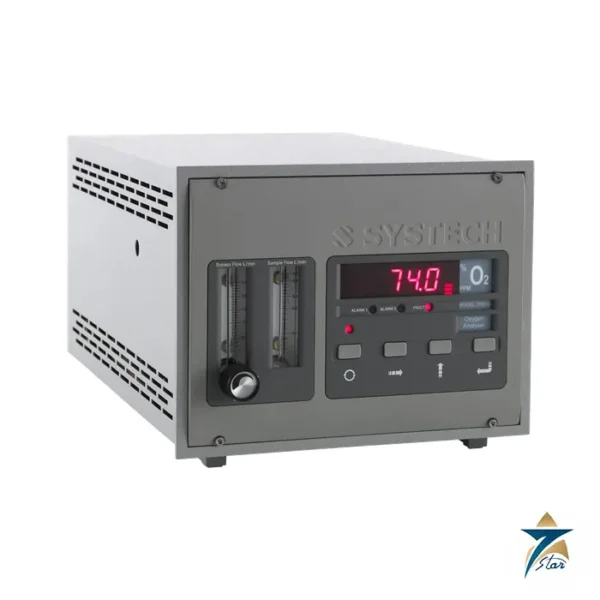
Specialty gas fillers, glove-box operators and laboratories are another strong match, because the 0–10 ppmV range and the low detection limit suit high-purity argon and nitrogen checks. Seven Star LLC supplies the AII GPR-1500 with sensor variants, spare sensors and calibration accessories for these users throughout Oman and the GCC, and our Muscat engineers can advise on sample conditioning when the gas carries moisture or particulates. For comparison with other technologies on our site, see the Servomex NanoTrace DF-550E ultra-trace oxygen analyzer, the Teledyne 3000RS online oxygen analyzer and the Systech ZR810 zirconia oxygen analyzer.
The figures below for the AII GPR-1500 are taken from the AII GPR-x500 datasheet (PST-DS-3002-00, 07/2024); performance is application dependent.
| Parameter | Specification |
|---|---|
| Model | AII GPR-1500 trace (ppm) oxygen transmitter, GPR-x500 series |
| Sensor type | Electrochemical; GPR-12-333, GPR-12-333-LD, GPR-12-333-H, XLT-12-333, XLT-12-333-LD |
| Measuring ranges | 0–10, 0–100, 0–1000 ppmV, 0–1 %; 0–25 % for calibration only |
| Output resolution | 0.01 ppmV |
| Lower detection limit | 0.05 ppmV |
| Response time (T90) | Less than 2 minutes |
| Sample flow rate | 1–2 SCFH (0.5–1 L/min), application dependent |
| Pressure range | 5–30 psi (0.4–2.1 bar) |
| Operating temperature | +5 to +45 °C (GPR sensors); −10 to +45 °C (XLT sensors) |
| Humidity | 0–80 %rh, non-condensing |
| Sensor life expectancy | 24 months in gas below 1000 ppmV (application dependent) |
| Calibration interval | 30 days (application dependent) |
| Display / output | LCD / 4–20 mA |
| Power supply | 18–24 V DC, maximum 1.8 W |
| Enclosure | NEMA 3R, fibreglass and painted aluminium, wall mounting |
| Hazardous area | ATEX II 1 G Ex ia IIC T4 Ga; IECEx Ex ia IIC T4 Ga; cMETus Class I Div 1 Groups A–D T4, Class I Zone 0 AEx ia IIC T4 Ga; Tamb −20 to +50 °C |
To specify the AII GPR-1500 for your plant, send Seven Star LLC a formal RFQ with the background gas, required range, area classification and sample conditions, and our instrumentation division will confirm the correct sensor and configuration. Download the manufacturer datasheet from this page for full details, and contact our Muscat office for availability, lead time and engineering support anywhere in Oman and the GCC.
Choose the option that best fits your needs to get the fastest response from our team.
Automatically fill the RFQ form with this product's details for a faster process.
Manually enter multiple part numbers, specific brands, or custom requirements.












Reviews
There are no reviews yet.