- Automation & ControlView all 3,025 products
- Automation Accessories
- AC Drives
- PLC & I/O Cards
- Industrial Communications
- Vibration Monitoring
- Isolator & Barrier
- Controllers & Data Acquisition
- Safety Switches & Guard Locking
- Motor Soft Starters
- CCTV & Security
- Encoders
- Pneumatic Cylinders
- HMI Displays
- Servo Drives
- Industrial Computers
- Machine Vision
- Automation Software
- Robotics
Brand: ION Science
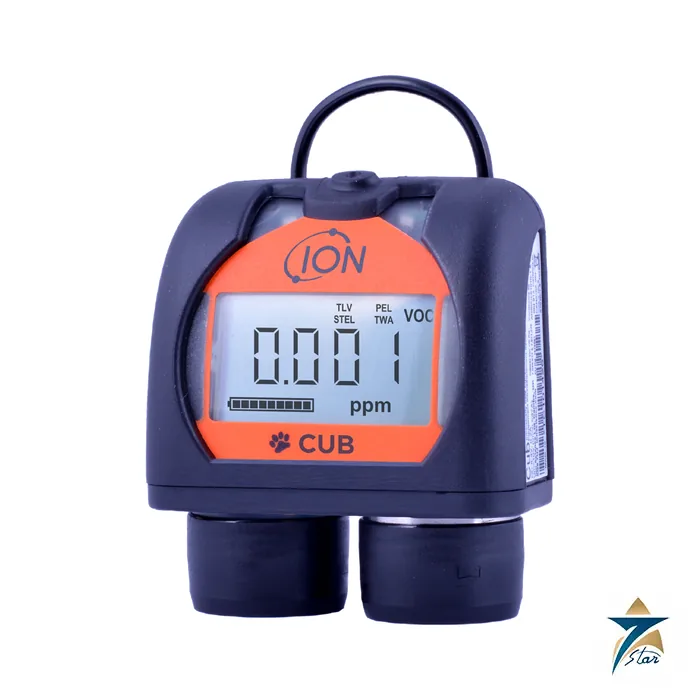
ION Science Cub Personal PID Monitor for VOC Exposure
Description
Overview
The ION Science Cub is a personal photoionisation detector that clips to a worker’s collar or harness and watches the breathing zone for volatile organic compounds. The manufacturer describes it as the smallest and lightest personal PID monitor available, and it weighs just 111 g. Seven Star LLC is an independent supplier serving Oman and the GCC. What follows summarises the Cub brochure, version 1.11, in plain terms for safety managers and industrial hygienists who must choose a wearable VOC monitor.
Unlike a handheld probe, the ION Science Cub has no pump. Vapour reaches the sensor by diffusion, which removes a moving part, keeps the body compact and lets the instrument run for up to 12 hours between charges. The wearer simply switches it on with one button and carries on working; the unit warns of a hazard through a bright backlit display, flashing LEDs, a 95 dB sounder measured at 300 mm and a vibrating alarm that can be felt through heavy clothing.
What sets the ION Science Cub apart
Three ideas run through the brochure. First, sensitivity: the Cub resolves down to 0.001 ppm on the ppb version and spans 1 ppb to 5,000 ppm, which the manufacturer calls the widest range on the market. Second, resilience: the fence electrode design and anti-contamination construction are meant to resist humidity and keep the reading stable without a separate humidity compensation step. Third, economy: consumables are inexpensive, the instrument is easy to service, and a two-year warranty applies when the unit is registered online, subject to the terms of the supplier.
The sensor measures more than 480 selectable compounds when the 10.6 eV lamp is fitted. Readings appear in ppb and ppm, with selectable data logging time, pre-programmed TWA and STEL exposure alarm levels on all models, and storage of up to 30,000 readings that can be downloaded over USB 2.0.
Technical data table for ION Science Cub
| Parameter | Published value |
|---|---|
| Sensitivity | 0.001 ppm isobutylene equivalent (model dependent) |
| Range | 0 to 5,000 ppm |
| Accuracy | Plus or minus 5 percent of display reading plus or minus one digit |
| Response | Under 13 seconds T90 |
| Resolution | ppm model 0.1 ppm; ppb model 0.001 ppm; TAC model 0.01 ppm |
| Lamp options | 10.6 eV or 10.0 eV |
| Data logging | 30,000 readings |
| Communication | USB 2.0 via docking station |
| Calibration | Two-point calibration via docking station |
| Battery | Up to 12 hours; charge time 4 hours |
| Operating temperature | -20 to 60 degrees C; certified -20 to 55 degrees C |
| Ingress protection | IP65 with PTFE filter fitted, IP64 without it |
| Weight and size | 111 g, 61 x 66 x 59 mm |
| Approvals | II 1G Ex ia IIC T4 Ga; Baseefa11ATEX0027; IECEx BAS 11.0014; US and Canadian Class I, II and III Division 1 |
How Cub differs from other Cub variants
The family has three versions. The ppm model, fitted with a 10.6 eV lamp, resolves to 0.1 ppm and suits general VOC exposure checks. The ppb model uses the same lamp but resolves to 0.001 ppm for early-warning work at very low exposure limits, and an existing ppm unit can be upgraded to ppb sensitivity. The Cub TAC carries a 10.0 eV lamp and resolves to 0.01 ppm, which is tuned to total aromatic compounds including benzene. This page covers the standard ION Science Cub with the 10.6 eV lamp; confirm the sensitivity variant you want when you request a quote.
Where the Cub is worn in Oman and the GCC
The brochure names industrial hygiene, chemical and petrochemical plants, oil and gas, pharmaceuticals, health and safety, hazardous materials, first response and environmental work. In the Gulf these translate into operators on refinery turnarounds, sampling crews at tank farms, laboratory staff handling solvents, and responders attending a spill. Because the ION Science Cub stays with the worker, it records personal exposure rather than area concentration, which is the number that exposure limits are actually written around.
Docking, alarms and data
CubDoc docking stations provide USB communication, charging and calibration, depending on the configuration. When exposure exceeds the pre-set limits the instrument gives audible, vibrating and flashing LED alarms, while the large LCD shows the reading in ppb and ppm. Alarm levels follow the TWA and STEL approach, so the unit can warn about both brief peaks and the average over a shift. Data downloaded from the unit can be added to the hygiene file for later review.
Fitting, use and care of the ION Science Cub
Wear the unit in the breathing zone, with the sensor inlet unobstructed. Check the display and alarm indicators at the start of the shift and calibrate through the docking station at the intervals set by your safety procedure. Keep the PTFE filter in place to maintain the IP65 rating, since the brochure notes that the rating drops to IP64 without it. Charge for about four hours, rinse off heavy contamination with a damp cloth rather than solvents, and have the lamp cleaned or replaced according to the manual when the response becomes sluggish.
A personal PID is a screening and warning tool. It reports the combined response to ionisable vapours, so where an exact compound identity matters, use it together with colorimetric tubes or laboratory sampling.
Selection and ordering notes for Cub
Decide between the ppm, ppb and TAC variants, check whether the work calls for the 10.6 eV or 10.0 eV lamp, and plan the docking station and spares at the same time. Intrinsic safety and ATEX or IECEx marking are included, so the unit can enter zones where ignition sources are restricted. For a team deployment, a docking station that charges and calibrates several units simplifies record keeping and daily readiness checks.
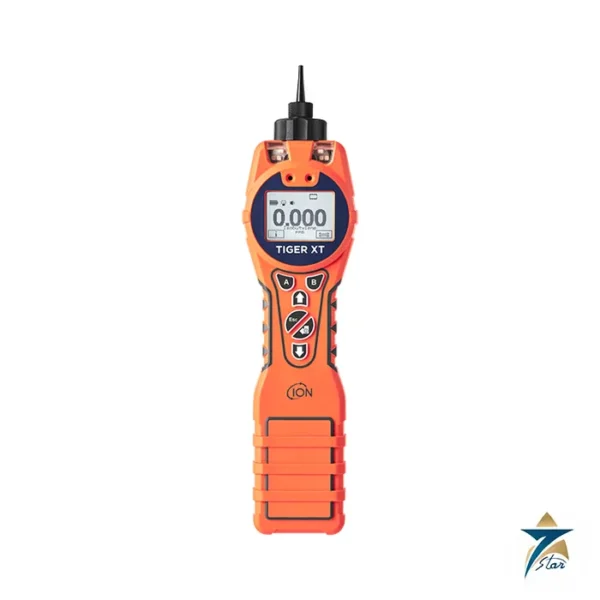
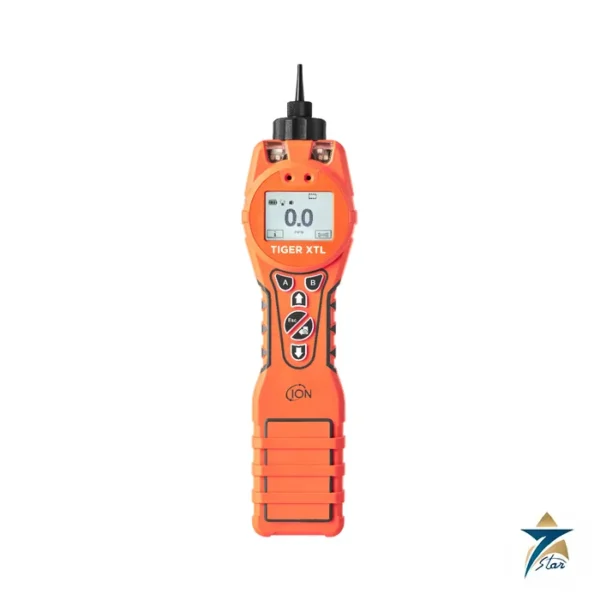
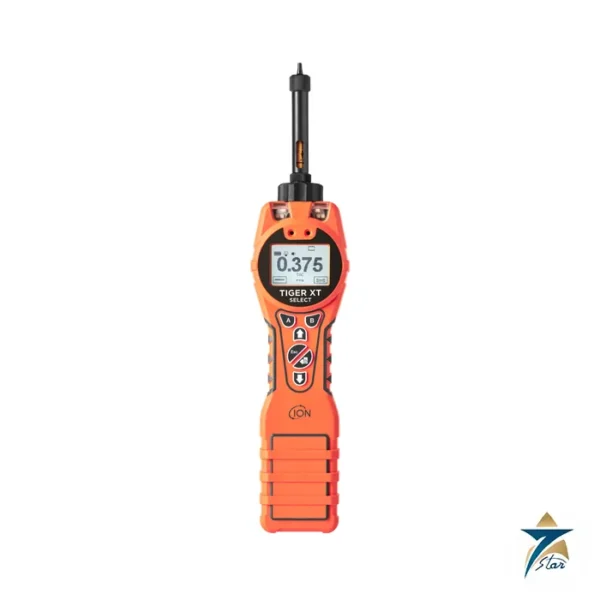
Related items you may also need: ION Science Titan 2 Fixed Benzene Monitor | ION Science Tiger XT Handheld VOC Detector | Simtronics GD10-P00-17DG-0XH-00 Infrared Gas Detector (GD10P Series) | All ION Science products.
Choosing the right ION Science Cub kit
The ION Science Cub is offered as a model with several kit and accessory options, so the exact supply is defined by the points below rather than by the model name alone.
- Target gas or gases and the measuring range needed for the ION Science Cub application.
- Lamp or sensor option where the instrument offers more than one, for example the standard VOC lamp or a selective configuration.
- Hazardous area approval required for the site, such as ATEX or IECEx zone rating.
- Accessories needed with the unit, such as charger, calibration adaptor, sampling probe, carry case or docking station.
- Any data logging, software or calibration certificate requirement for your records.
Share these points, or the part number printed on an existing unit or previous order, and the quotation will list the confirmed kit contents.
Documents and quotation
The manufacturer’s Cub brochure is attached to this page as a datasheet. Send your RFQ with the part number Cub, the variant (ppm, ppb or TAC), the quantity and your delivery location in Oman or the GCC, and we will return availability and lead time.
Datasheets & Documents
- Datasheet ION Science Cub Personal PID Monitor for VOC Exposure Datasheet Download
Reviews (0)
How would you rate this product? Cancel reply
About brand
ION Science is a British maker of gas detection instruments, based in Fowlmere, Cambridgeshire. It has been active since 1989 and is best known for photoionisation detectors (PIDs) that measure volatile organic compounds at low concentrations. Its portable and fixed instruments are used for worker exposure monitoring, leak detection and environmental surveys.
Seven Star LLC is an independent supplier in Muscat. We list ION Science detectors for oil and gas, petrochemical and environmental users in Oman and the GCC.
ION Science company profile
| Active since | 1989, United Kingdom |
|---|---|
| Head office | Fowlmere, Cambridgeshire |
| Core technology | Photoionisation detection (PID) with patented Fence Electrode design |
| Product families | Tiger XT and Cub portable PIDs, Titan benzene monitor, Falco fixed detectors |
Milestones
- 1989: ION Science begins operating.
- 1998: Patents its PID sensor.
- 2002: Patents the Fence Electrode for humidity-resistant PIDs.
- 2017: Opens its head office in Fowlmere.
ION Science product series
The Tiger XT is a handheld VOC detector for hazardous areas, and the Titan 2 is a fixed benzene monitor.
A PID uses ultraviolet light to ionise volatile organic compounds and measures the resulting current, which allows detection down to ppb levels. Response factors convert the reading for each specific compound. General VOC detectors measure the total, while benzene-specific monitors separate benzene from other hydrocarbons, which matters because benzene has very low exposure limits.
Where ION Science detectors are used
Leak detection, confined space entry checks, worker exposure monitoring, refinery and terminal benzene monitoring, and environmental and soil surveys.
Ordering ION Science detectors: what we need
Send the model, the compounds and ranges, lamp type, hazardous-area requirement and accessories such as probes, filters and calibration kits.
Facts checked against ION Science's published company history, October 2026.
Browse ION Science products by category: Gas Analyzer Systems, Fire & Gas Detectors.
FAQ
Questions about the ION Science Cub Personal PID Monitor for VOC
Answers from our engineering team on installation, compatibility and integration.
01How heavy is the ION Science Cub personal PID?
The brochure gives 111 g and dimensions of 61 x 66 x 59 mm, which it describes as the smallest and lightest personal PID monitor available.
02Does the ION Science Cub have a pump?
No. The flow rate is listed as not applicable because the Cub samples by diffusion, which keeps the body compact and the battery life up to 12 hours.
03What range does the ION Science Cub measure?
It covers 0 to 5,000 ppm, with ppb-level sensitivity of 0.001 ppm on the ppb model and a T90 response under 13 seconds.
04What are the Cub variants?
The ppm and ppb models use a 10.6 eV lamp, while the Cub TAC uses a 10.0 eV lamp for total aromatic compounds with 0.01 ppm resolution.
05Is the ION Science Cub intrinsically safe?
Yes. It is marked II 1G Ex ia IIC T4 Ga with ATEX and IECEx certificates and US and Canadian Class I, II and III Division 1 approval.


Reviews
There are no reviews yet.