Brand:

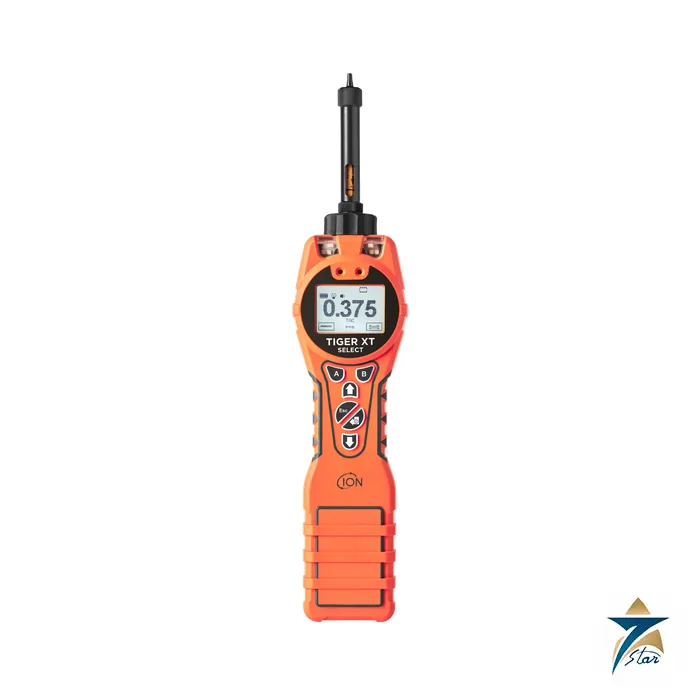
ION Science Tiger XTS Select Handheld Benzene Detector

Description

Overview

The ION Science Tiger XTS, marketed by the manufacturer as the Tiger XT Select, is a handheld photoionisation detector built to find benzene and other total aromatic compounds quickly. Seven Star LLC is an independent supplier serving Oman and the GCC. It shares its body, pump and display with the rest of the Tiger XT range, but it is fitted with a 10.0 eV lamp and is supplied with benzene pre-filter tubes so that the operator can switch between a general VOC reading and a benzene-selective measurement on the same instrument. This page restates the data of the Tiger XT Select brochure, version 1.1.

Benzene work has a particular difficulty: a bare PID responds to every ionisable vapour, so a reading near a fuel tank might be benzene, toluene or something harmless. The ION Science Tiger XTS addresses this by letting the user attach a pre-filter tube that holds back interfering compounds, so that the value displayed during the measurement represents benzene breakthrough rather than a mixture.

Operating modes of the ION Science Tiger XTS

The instrument has a basic and an advanced user mode. Basic mode keeps to the core functions needed to detect benzene and other TACs, which suits crews with limited training. Advanced mode opens up standard running mode, TAC mode and tube mode. In TAC mode the unit calculates 15 minute short-term exposure limits and 8 hour time-weighted averages for total aromatic compounds; in tube mode the displayed data follow the progressive breakthrough of benzene through the pre-filter tube in real time.

Sensitivity depends on the model and mode. On the ppm model the minimum sensitivity is 0.1 ppm in standard running mode and 0.01 ppm in TAC and tube modes. The ppb model resolves 0.001 ppm in standard running and TAC modes and 0.01 ppm in tube mode. The tube response time is about 130 seconds at 20 degrees C and varies with temperature, which is the price of selectivity.

Specification table for ION Science Tiger XTS

Parameter Published value
Lamp 10.0 eV krypton PID lamp
Maximum reading Standard mode up to 20,000 ppm; tube mode 200 ppm or 639 mg per cubic metre benzene
Response Tube mode about 130 seconds at 20 degrees C; direct measurement T90 under 2 seconds
Battery Lithium-ion up to 24 hours, 8 hours to charge; alkaline 3 x AA about 8.5 hours
Data logging 120,000 data log points with date and time stamp
Communication Direct USB
Calibration Two and three point via calibration kit accessory
Alarm Amber and red LEDs, 95 dBA sounder at 300 mm, vibration, pre-programmed TWA and STEL
Flow rate At least 220 ml/min with blocked-flow alarm
Operating temperature -20 to 60 degrees C, humidity 0 to 99 percent RH non-condensing
Protection Designed to IP65
Size and weight About 370 mm x 91 mm x 60 mm, 870 g; carry case 367 x 89 x 90 mm
Intrinsic safety II 1G Ex ia IIC T4 Ga; Class 1 Division 1 Groups A, B, C, D, T4; IECEx SGS 25.0002X; SGS25ATEX0003X

How Tiger XTS differs from other Tiger XT variants

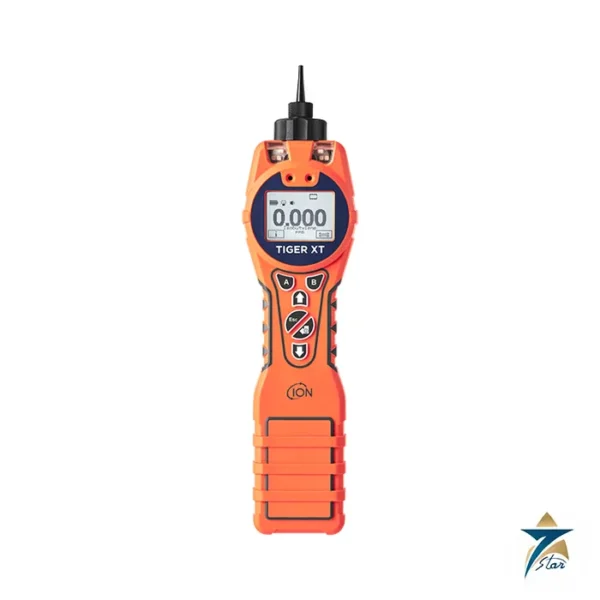
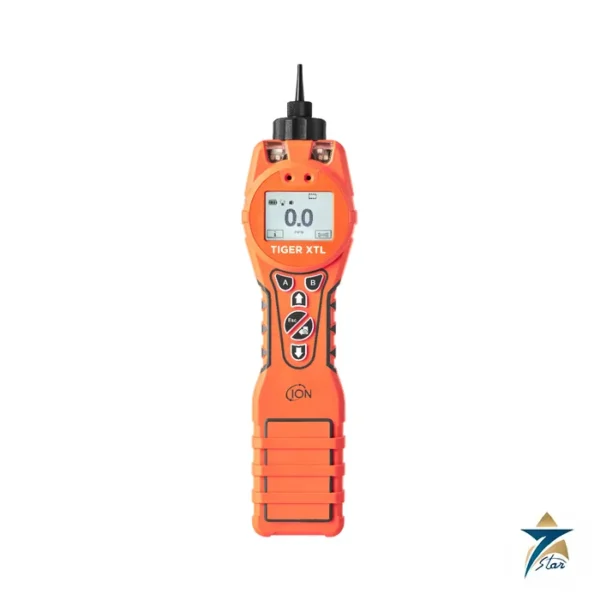
Against the entry-level Tiger XTL, the ION Science Tiger XTS swaps the 10.6 eV lamp for a 10.0 eV lamp, lifts the maximum standard-mode reading from 5,000 ppm to 20,000 ppm, increases logging from 80,000 to 120,000 points and adds TAC and tube modes. Its warranty extension on online registration reaches 5 years, compared with 2 years on the XTL. Compared with the standard Tiger XT, the Select concentrates on aromatic selectivity: the 10.0 eV lamp responds more narrowly than a 10.6 eV lamp, so it ignores some compounds that a general VOC detector would count.

Applications in Oman and the GCC

The brochure suggests confined space entry, plant maintenance, marine downstream monitoring, hazardous material response, and TAC detection at loading docks and barge operations. For Gulf operators that maps to benzene checks at refinery and petrochemical units, tank cleaning and gas-freeing, jetty loading arms at ports, and screening of vessel holds. Benzene has strict exposure limits, so an instrument that can show benzene separately from other aromatics supports the permit-to-work decision instead of leaving the team to guess.

Using the pre-filter tube correctly

Fit a fresh tube to the probe, begin sampling, and watch the progressive indication. The tube retains interfering compounds for a limited time, so note the time and the reading together and do not reuse a tube that has already been exposed to a high concentration. Keep samples within the stated tube-mode maximum of 200 ppm benzene. Store spare tubes according to the manual and check their expiry before a job. When you finish, switch back to standard mode for general VOC screening.

Maintenance and safety notes for Tiger XTS

The unit is certified intrinsically safe from -25 to +45 degrees C with the lithium-ion pack and -25 to +40 degrees C with alkaline cells, and batteries can be changed in a hazardous area. Replace the inlet filter when the blocked-flow alarm appears, charge for eight hours before a long job, and service the lamp as instructed in the manual. Bump test the instrument before each shift and calibrate at the interval set by your procedures.

Ordering information for Tiger XTS

State whether you need the ppm or the ppb model, and list the accessories you want, such as benzene pre-filter tubes, the calibration kit and spare filters. Please confirm the full order code before purchase, since the model and mode set determine the sensitivity quoted in the brochure.

Training matters as much as hardware. Operators should understand that a pre-filter tube is a consumable with a limited capacity, that a reading taken without the tube is a total aromatic value rather than a benzene value, and that the instrument should be zeroed in clean air away from the work area. Short toolbox sessions before a shutdown campaign usually remove most misuse.

Related items you may also need: ION Science Tiger XT Handheld VOC Detector | ION Science Titan 2 Fixed Benzene Monitor | Honeywell Sensepoint XRL Fixed Gas Detector | All ION Science products.

Documents and quotation

The manufacturer’s Tiger XT Select brochure is attached to this page as a datasheet. Please send your RFQ with Tiger XTS, the model (ppm or ppb), quantity and delivery location in Oman or the GCC for a quotation.

Other Models in the TIGERXT Range

Seven Star LLC supplies models from the TIGERXT range in Oman and the GCC. Compare the related models below and request a quote for the one that matches your application.

ModelCategory
ION Science Tiger XTL Handheld VOC Gas DetectorFire & Gas DetectorsView details
ION Science Tiger XTS Select Handheld Benzene DetectorFire & Gas DetectorsYou are viewing this model
Datasheets & Documents
  • PDF Datasheet ION Science Tiger XTS Select Handheld Benzene Detector Datasheet Download
Reviews (0)

Reviews

There are no reviews yet.

How would you rate this product?

It takes about 10 seconds — just tap a star. Your email is never published.

About brand

ION Science is a British maker of gas detection instruments, based in Fowlmere, Cambridgeshire. It has been active since 1989 and is best known for photoionisation detectors (PIDs) that measure volatile organic compounds at low concentrations. Its portable and fixed instruments are used for worker exposure monitoring, leak detection and environmental surveys.

Seven Star LLC is an independent supplier in Muscat. We list ION Science detectors for oil and gas, petrochemical and environmental users in Oman and the GCC.

ION Science company profile

Active since 1989, United Kingdom
Head office Fowlmere, Cambridgeshire
Core technology Photoionisation detection (PID) with patented Fence Electrode design
Product families Tiger XT and Cub portable PIDs, Titan benzene monitor, Falco fixed detectors

Milestones

  • 1989: ION Science begins operating.
  • 1998: Patents its PID sensor.
  • 2002: Patents the Fence Electrode for humidity-resistant PIDs.
  • 2017: Opens its head office in Fowlmere.

ION Science product series

The Tiger XT is a handheld VOC detector for hazardous areas, and the Titan 2 is a fixed benzene monitor.

A PID uses ultraviolet light to ionise volatile organic compounds and measures the resulting current, which allows detection down to ppb levels. Response factors convert the reading for each specific compound. General VOC detectors measure the total, while benzene-specific monitors separate benzene from other hydrocarbons, which matters because benzene has very low exposure limits.

Where ION Science detectors are used

Leak detection, confined space entry checks, worker exposure monitoring, refinery and terminal benzene monitoring, and environmental and soil surveys.

Ordering ION Science detectors: what we need

Send the model, the compounds and ranges, lamp type, hazardous-area requirement and accessories such as probes, filters and calibration kits.

Facts checked against ION Science's published company history, October 2026.

FAQ

Questions about the ION Science Tiger XTS Select Handheld Benzene

Answers from our engineering team on installation, compatibility and integration.

01What does the ION Science Tiger XTS detect?
It detects benzene and other total aromatic compounds with a 10.0 eV lamp, and also works as a general VOC detector without the pre-filter tube.
02How does the benzene tube mode of the Tiger XTS work?
A pre-filter tube holds back interfering compounds, so the real-time display shows benzene breakthrough; response is about 130 seconds at 20 degrees C.
03What is the maximum reading of the Tiger XTS?
In standard mode it reads up to 20,000 ppm, while tube mode is limited to 200 ppm or 639 mg per cubic metre of benzene.
04How many readings can the Tiger XTS log?
The brochure gives 120,000 data log points with date and time stamp, downloadable over direct USB.
05What warranty can be reached on the Tiger XTS?
Registering the instrument online within one month of purchase extends the warranty to up to 5 years.