717 100G pressure calibrator with 0.05 % accuracy and mA loop measurement
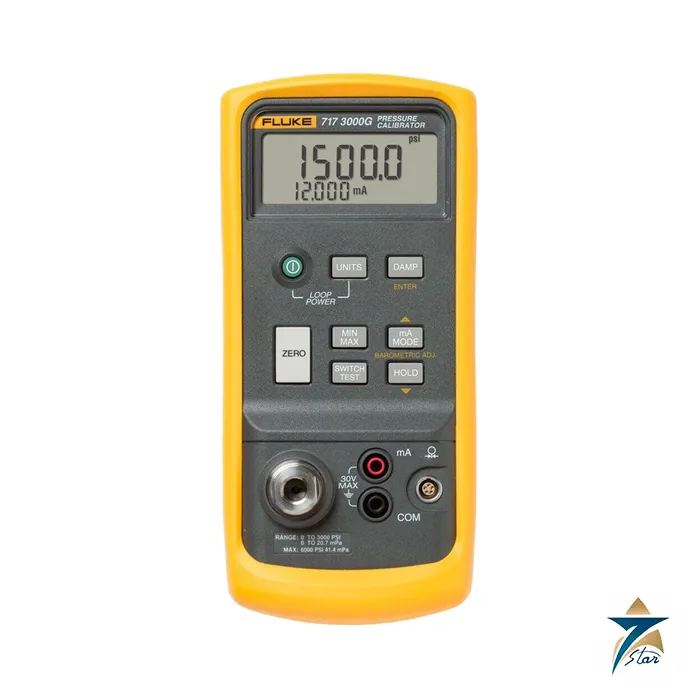
The Fluke 717 100G is a compact handheld pressure calibrator with an internal 100 psig sensor. It measures pressure from -12 psi to 100 psi, measures milliamps at 0.025 % while sourcing 24 V loop power, and accepts any of 29 Fluke 700Pxx pressure modules when the application needs another range. It has no built-in pump, so a hand pump or other pressure source is connected during use. Seven Star LLC supplies the 717 100G in Oman and the GCC as an independent supplier in Muscat, not affiliated with the manufacturer.
The ordering information lists the “Fluke-717 30G” and the “Fluke-717 100G” Pressure Calibrators. The name decodes as follows.
| Element |
Meaning |
Detail |
| 717 |
Model |
Handheld pressure calibrator without internal pump |
| 100 |
Sensor range in psi |
Internal sensor covering -12 to 100 psi |
| G |
Gauge reference |
Measures relative to atmospheric pressure |
717 100G technical specifications
| Parameter |
Specification |
| Manufacturer / part number |
Fluke / 717 100G |
| Pressure range |
-12 psi to 100 psi (-83 kPa to 690 kPa) |
| Resolution |
0.01 psi |
| Accuracy |
0.05 % of full scale, 18 °C to 28 °C, one year |
| Media |
Non-corrosive gases and liquids |
| Pressure connection |
1/8 NPT |
| Extended range |
29 Fluke 700Pxx pressure modules from 10 in H2O to 10,000 psi, up to 0.025 % of full span |
| mA measure |
0 to 24 mA, 0.001 mA resolution, 0.025 % + 1 count |
| Loop supply |
24 V dc, 10 %; drives 20 mA into 1000 Ω with battery above 6.8 V |
| Functions |
Zero, min, max, hold, damp, eleven engineering units |
| Display |
Five-digit LCD |
| Operating / non-operating temperature |
-10 °C to 55 °C / -40 °C to 60 °C |
| Battery |
One 9 V alkaline, 4 to 20 hours typical |
| Size / weight |
187 x 87 x 32 mm / 330 g; with holster and FlexStand 600 g |
| Warranty |
Three years |
How the 717 100G is used for P/I and I/P calibration
To calibrate a pressure transmitter, connect a hand pump to the transmitter and to the 1/8 NPT port of the calibrator, wire the transmitter loop through the calibrator so that it powers the loop and reads the current, then apply pressure points while watching both values on the screen. The calibrator shows pressure and current at the same time, so the error at 0, 25, 50, 75 and 100 % can be compared with the tolerance. For an I/P converter the process is reversed: set a milliamp signal from a separate source and read the output pressure.
The damp function reduces display jitter when pressure is slowly changing, and min and max capture the peak of a pressure switch actuation or relief valve lift.
717 100G compared with the 717 30G and the 718
The 717 30G has the same body and functions but a lower range with 0.001 psi resolution, which suits low-pressure and draft work. The 718 range adds an integrated pump with easy-clean access ports, error percentage calculation and a switch test function. Choose the 717 100G where you already own pumps, or where the weight of the calibrator matters.
| Model |
Range |
Resolution |
Internal pump |
| 717 100G |
-12 to 100 psi |
0.01 psi |
No |
| 717 30G |
-12 to 30 psi |
0.001 psi |
No |
| 718 100G |
-12 to 100 psi |
0.01 psi |
Yes |
Pressure can be shown in eleven engineering units, including psi, inches of water at 4 °C and 20 °C, centimetres of water, bar, mbar, kPa, inches and millimetres of mercury and kg/cm2. This avoids converting by hand when the instrument under test is marked in different units than your procedure. The five-digit display shows pressure and current at the same time, which is the basis of a quick as-found, as-left record for each test point.
Selecting the 717 100G
- Confirm that the maximum pressure of your devices is at or below 100 psi (about 6.9 bar).
- Check media: the internal sensor is for non-corrosive gases and liquids; use a module for other media.
- Decide on the pump: a hand pump with correct fittings is needed with this model.
- Consider a 700Pxx module for ranges above 100 psi.
- Order spare 9 V batteries and appropriate adapters for BSP fittings.
Use and maintenance of the 717 100G
Zero the calibrator before each series with the port open to atmosphere. Do not exceed the stated overpressure of the sensor; use a relief valve when pressurising from a supply. Keep liquids out of the port, since the internal sensor is not isolated for aggressive media. The unit has a protective holster with a stand for hands-free reading. Operating temperature is -10 °C to 55 °C, so protect it from sun in the field. Plan periodic calibration at the interval of your quality system.
Typical applications of the 717 100G in Oman and the GCC
Instrument technicians use the 717 100G to check pressure transmitters on utilities, compressed air and process lines, calibrate pressure gauges and test pressure switches in oil and gas, water and power facilities. Its low weight suits climbing and rooftop work, and the mA function covers the transmitter output in the same connection.
Information to send with an RFQ for the 717 100G
- Part number 717 100G
- Quantity and any 700Pxx modules, pumps or hoses
- Pressure ranges, media and process connections
- Delivery location and time frame
- Calibration certificate requirement
Storage, handling and spares for the Fluke 717 100G
Keep the Fluke 717 100G in its carrying case when it is not in use, and store it in a clean, dry place. Remove or charge the batteries as recommended in the user manual before long storage. Field teams in Oman and the GCC should avoid leaving the instrument in a vehicle in the sun, as high cabin temperatures can exceed the storage range and shorten battery life.
- Check the instrument, cables, hoses or lenses for damage before each job.
- Clean the unit with a soft, slightly damp cloth only; do not use solvents unless the manual allows them.
- Plan a calibration interval that matches your quality system, and keep the calibration certificate with the asset record.
- Order wear parts and accessories, such as batteries, test leads, hoses or adapters, together with the instrument.
For calibration and test work, it helps to state in your RFQ whether you need an accredited calibration certificate with the Fluke 717 100G, so the right documents can be confirmed with the quotation.
Documents and quotation
A datasheet covering the 717 100G and 717 30G is attached on this page.
Send us the part number 717 100G and the quantity and we will confirm availability and a quotation.

























Reviews
There are no reviews yet.