714B thermocouple temperature calibrator for 17 thermocouple types
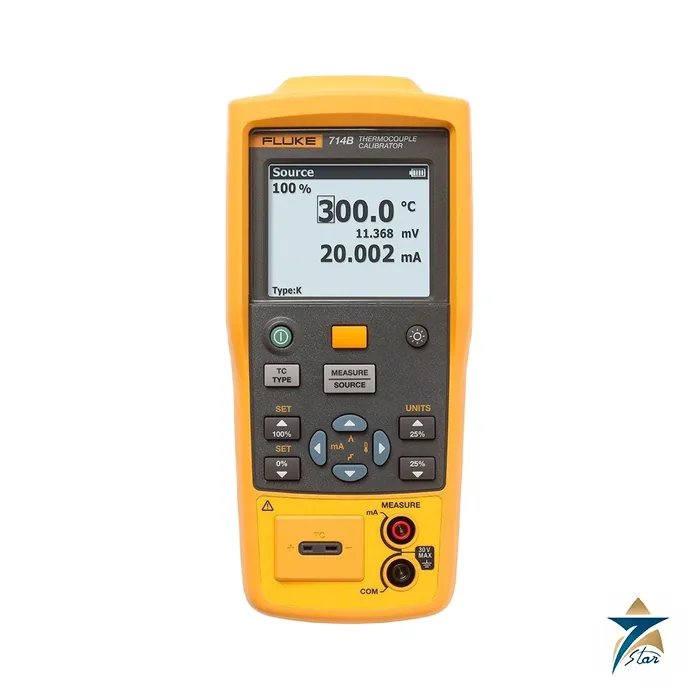
The Fluke 714B is a single-function thermocouple calibrator that measures and simulates seventeen thermocouple types and millivolts. It also measures 4 to 20 mA signals while sourcing a temperature signal, which lets one connection check a thermocouple transmitter from input to output. Seven Star LLC supplies the 714B in Oman and the GCC as an independent supplier in Muscat, not affiliated with the manufacturer.
The ordering list shows “FLUKE-714B Temperature Calibrator”. It shares its datasheet with the RTD version, the 712B.
714B technical specifications
| Parameter |
Specification |
| Manufacturer / part number |
Fluke / 714B |
| Thermocouple types |
17: E, N, J, K, T, B, R, S, C, L, U, BP, XK, G, D, P and M |
| Type K accuracy (1 year, measure) |
0.3 °C from -100 °C to 400 °C; 0.5 °C from 400 °C to 1200 °C; 0.7 °C from 1200 °C to 1372 °C |
| Type K accuracy (1 year, source) |
0.3 °C from -100 °C to 1372 °C; 0.4 °C from -200 °C to -100 °C |
| Type T accuracy (1 year, measure) |
0.3 °C from 0 °C to 400 °C; 0.6 °C from -200 °C to 0 °C |
| Millivolts measure and source |
-10 mV to 75 mV, 0.01 mV resolution, 0.015 % + 10 µV |
| Thermocouple connector |
Miniature thermocouple connector; plug kits 700TC1 and 700TC2 are listed as accessories |
| DC mA measure |
0 to 24 mA, 0.001 mA resolution, 0.010 % + 2 µA |
| Dual inputs / display |
Measure mA while sourcing temperature; backlit display |
| Source functions |
Configurable 0 % and 100 % points, linear ramp and 25 % step |
| Pulsed transmitters |
Supports pulse times as short as 5 ms |
| Calibration basis |
One-year cycle, +18 °C to +28 °C, 5 minute warm-up; 1-year and 2-year specifications |
| Maximum voltage |
30 V between any terminals or to earth |
| Operating / storage temperature |
-10 °C to 50 °C / -30 °C to 60 °C |
| IP rating / drop |
IP52 / 1 m |
| Batteries |
Four AA alkaline |
| Size / weight |
52.5 x 84 x 188.5 mm / 515 g |
| Supplied with |
Magnetic hanging tool, batteries, manual, traceable calibration certificate, test leads |
How the 714B deals with cold junction and sensor type
A thermocouple generates a voltage proportional to the temperature difference between its hot junction and the reference junction at the instrument. When simulating a thermocouple, the 714B outputs the millivolt value for the chosen type and temperature, so a transmitter or controller input can be tested without a furnace. Selecting the wrong type gives a plausible but incorrect reading, so match the type to the instrument configuration, and keep the plug and connector free from drafts so the reference junction temperature is stable.
Accuracy depends on type and range. For example, type R and S have lower accuracy at low temperature and near the top of the range, type B is not stated below 600 °C, and type K and N are better than 1 °C over most of their ranges. Always read the table for your type and range.
Mini-plug kits and probes for the 714B
The datasheet lists thermocouple plug kits: 700TC1 with ten mini-plug connectors in several types, and 700TC2 with seven mini-plugs. It also lists a range of thermocouple probes (80PK series), including bead, immersion, surface, air and piercing types, for use as measuring probes in the field. Order these only if you need to measure temperature in the plant as well as simulate it.
The calibrator also helps when verifying extension wire and compensating cable. Simulate a temperature at the sensor end of the cable, then read the value at the control room; any difference points to wiring, the wrong type of cable or a poorly configured input card. Because 4 to 20 mA is measured at the same time, the same test shows whether the transmitter scaling matches the intended range.
Selecting the 714B
- Check that the thermocouple type of your instruments is among the seventeen.
- Confirm the accuracy table for the temperature range you calibrate.
- Choose the 712B if your sensors are RTDs.
- Add plug kits or probes if you need to connect to bare thermocouple wire.
- Note the 30 V maximum input and the 1 m drop requirement.
Use and maintenance of the 714B
Allow a five-minute warm-up and a few minutes for the connector temperature to stabilise after you plug in thermocouple wires, because a temperature gradient across the connector causes cold junction error. Keep the unit away from drafts and heat sources while working. Recalibrate on a one-year cycle if your system requires the stated specifications, and use the traceable certificate supplied with the unit as the first record.
Typical applications of the 714B in Oman and the GCC
Thermocouples are everywhere in furnaces, fired heaters, turbines and exhaust systems, so the 714B is used for turbine exhaust temperature loops, heater skin and tube metal temperature monitors, boiler flue gas and kiln controls. Technicians simulate the thermocouple at the junction box, read the transmitter or DCS value and correct the loop. In hot outdoor junction boxes, give the calibrator time to match the box temperature before taking critical readings.
Information to send with an RFQ for the 714B
- Part number 714B
- Quantity and any thermocouple plug kits or probes
- Thermocouple types and ranges to be calibrated
- Delivery location and time frame
- Calibration certificate requirement
Storage, handling and spares for the Fluke 714B
Keep the Fluke 714B in its carrying case when it is not in use, and store it in a clean, dry place. Remove or charge the batteries as recommended in the user manual before long storage. Field teams in Oman and the GCC should avoid leaving the instrument in a vehicle in the sun, as high cabin temperatures can exceed the storage range and shorten battery life.
- Check the instrument, cables, hoses or lenses for damage before each job.
- Clean the unit with a soft, slightly damp cloth only; do not use solvents unless the manual allows them.
- Plan a calibration interval that matches your quality system, and keep the calibration certificate with the asset record.
- Order wear parts and accessories, such as batteries, test leads, hoses or adapters, together with the instrument.
For calibration and test work, it helps to state in your RFQ whether you need an accredited calibration certificate with the Fluke 714B, so the right documents can be confirmed with the quotation.
Documents and quotation
A datasheet for the 714B and 712B is attached on this page.
Send us the part number 714B and the quantity and we will confirm availability and a quotation.
Other Models in the Fluke 71xb Calibrator Range
Seven Star LLC supplies models from the Fluke 71xb Calibrator range in Oman and the GCC. Compare the related models below and request a quote for the one that matches your application.



























Reviews
There are no reviews yet.