4195K gauge pressure indicating controller: type letters and what they mean
The 4195K is a pneumatic gauge-pressure indicating controller from the Fisher range. It shows process pressure and set point on one scale, compares the two, and sends a pneumatic output to a control element, typically a diaphragm-actuated control valve, so that the process pressure moves toward the set point. It needs no electrical power, which is why it is still specified on gas, vapor and utility duties where an air or non-corrosive natural gas supply is available.
The type number is a code. The letter after 4195K gives the control mode, and suffix letters add options; a trailing R means reverse-acting construction.
| Code |
Meaning |
| 4195KA |
Proportional only |
| 4195KB |
Proportional plus reset |
| 4195KC |
Proportional plus reset plus rate |
| 4195KS |
Differential gap, for on-off control |
| F suffix |
Anti-reset windup option |
| M suffix |
Remote set point option |
| E suffix |
Integral auto/manual station option, as listed in the bulletin configuration table |
4195K specifications
| Parameter |
Specification |
| Manufacturer / part number |
Fisher 4195K series (4195KA, KB, KC, KS and option variants) |
| Supply medium |
Air or non-corrosive natural gas |
| Output signal (P, P+I, P+I+D) |
0.2 to 1.0 bar (3 to 15 psig) or 0.4 to 2.0 bar (6 to 30 psig) |
| Output (differential gap) |
0 to 1.4 bar (0 to 20 psig) or 0 to 2.4 bar (0 to 35 psig) |
| Action |
Field-reversible between direct and reverse |
| Proportional band |
5 to 500% of process scale span |
| Reset |
0.01 to more than 74 minutes per repeat |
| Rate |
0 to 20 minutes |
| Differential gap adjustment |
5 to 100% of process scale span |
| Repeatability |
0.4% of output span |
| Dead band |
Less than 0.4% of process scale span |
| Steady-state air consumption |
0.08 m3/hr (2.8 scfh) for 0.2 to 1.0 bar output; 0.07 m3/hr (2.5 scfh) for 0.4 to 2.0 bar output (without auto/manual station) |
| Ambient temperature limits |
-40 to 71°C (-40 to 160°F) |
| Process / supply connections |
Standard 1/4 NPT internal stainless steel; optional 1/2 NPT adaptors; supply and output 1/4 NPT |
| Housing |
NEMA 3 (weatherproof) and IEC 529 IP54 |
| Mounting |
Actuator, panel, wall or pipestand |
| Weight |
4.5 kg (10 pounds) approximate |
The bulletin lists ATEX Group II Category 2 gas and dust marking (Ex h IIC / IIIC) and conformity with the Customs Union technical regulation for equipment of that category; confirm the marking on the delivered unit.
How the 4195K controls pressure
A Bourdon tube or capsular sensing element converts process pressure into motion that moves a pointer over the process scale. The same mechanism compares the pointer position with the operator set point through a flapper-and-nozzle arrangement, and a pneumatic relay amplifies the nozzle pressure into the output signal. In a proportional-only unit the output changes in proportion to the error. Reset adds a slow corrective action to remove offset, and rate adds a derivative contribution for lag-heavy loops. A differential gap controller instead switches its output between low and high as pressure crosses the band, giving on-off control.
Anti-reset windup limits integral build-up during start-up or when the valve is saturated. A remote set point option lets the set point follow a 0.2 to 1.0 bar or 0.4 to 2.0 bar pneumatic signal, so the unit can sit in a cascade or ratio scheme.
Capsular and Bourdon sensing ranges for 4195K selection
Standard capsular ranges in the bulletin run from 0 to 150 mbar through 0 to 2 bar for positive pressure, vacuum ranges such as -1 to 0 bar and compound ranges such as -1 to 1 bar, with imperial equivalents from 0 to 60 in. wc to 0 to 30 psig and from -30 in. Hg to 15 psig. Each element has a minimum and maximum span that can be positioned anywhere in the operating range, and a maximum allowable pressure that must not be exceeded. Higher ranges are covered by Bourdon elements. Pick the range so that normal operation sits around the middle of the scale span to keep resolution.
Where the 4195K fits in the control loop
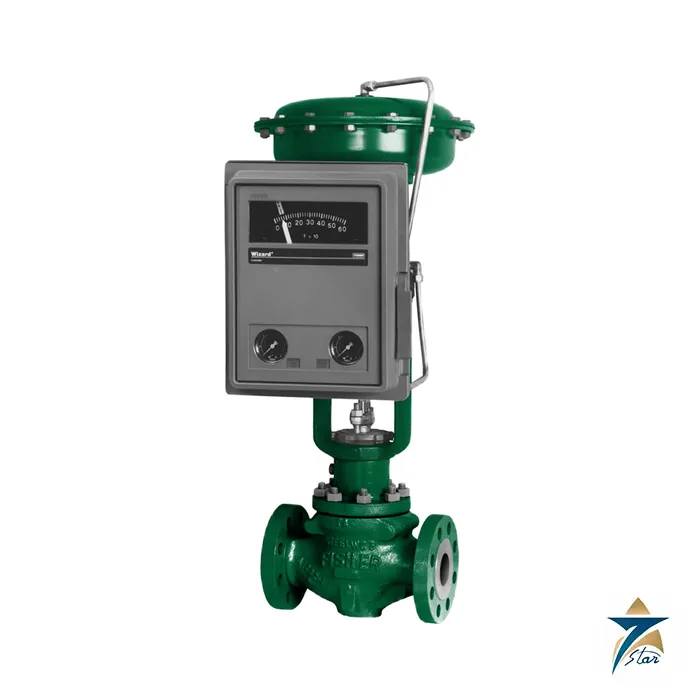
The 4195K usually mounts on a pneumatic diaphragm actuator or on a pipestand beside the valve and controls pressure at that point. It sits alongside other Fisher pneumatic instruments such as the 2500 level controller on the vessel side, the 3582 positioner when finer valve positioning is needed, and the C1 controller for new installations that need low emission operation. Where a transmitter-based DCS loop is preferred, a Fisher FIELDVUE positioner on the same actuator may be a better fit; the 4195K is for local, self-contained loops.
4195K selection and ordering checklist
- Control mode: proportional, proportional plus reset, plus rate, or differential gap.
- Sensing element: capsular or Bourdon, range, and material compatible with the process fluid (see the construction materials table in the bulletin).
- Maximum process pressure compared with the allowable pressure of the chosen element.
- Output range, 0.2 to 1.0 bar or 0.4 to 2.0 bar, matched to the actuator.
- Direct or reverse action (reverse-acting constructions carry an R in the type number).
- Options: anti-reset windup, remote set point, auto/manual station, external feedback.
- Supply medium (air or non-corrosive natural gas) and supply pressure available.
- Mounting style and hazardous area marking required.
Installation, calibration and maintenance
Mount the controller where the case can be read and the adjustments reached, keeping tubing between controller and actuator short because response depends on volume. The supply should be clean, dry and regulated to the pressure listed for the chosen output range. Set point, zero and span of the process pointer are adjusted without special tools, and set point and proportional band do not interact. A rubber plug in the plastic case pops out to relieve case overpressure. A clean-out wire lets technicians clear the relay primary orifice in service, which is the most common cure for a sluggish or unstable output.
Spares to keep: relay assemblies, gauges, tubing and fittings, and diaphragm kits. Check the supply gauge and output gauge after any maintenance.
Typical 4195K applications in Oman and the GCC
Typical Gulf uses include fuel gas and instrument gas header pressure, separator and scrubber pressure, steam and utility pressure at heaters and boilers, and pressure holding on package skids at remote wellheads. The weatherproof housing and a -40 to 71°C ambient range suit outdoor mounting, although direct summer sun on a case close to a hot line should be shielded. Where the supply is natural gas, ensure it is non-corrosive and that vented gas is routed safely.
Information to send with a 4195K enquiry
- Complete type number including mode and option letters, or the control duty and options required.
- Process fluid, normal and maximum pressure, and desired scale range.
- Output range and actuator type.
- Supply medium and pressure.
- Hazardous area requirement and site ambient temperature.
- Quantity and destination.
Documents and quotation for the 4195K controller
A manufacturer product bulletin is attached on this page; the configuration, range and materials tables in it should be used to complete the type number. Seven Star LLC is an independent supplier in Muscat.
Send the 4195K type number and range and we will confirm availability and quote.




















Reviews
There are no reviews yet.