
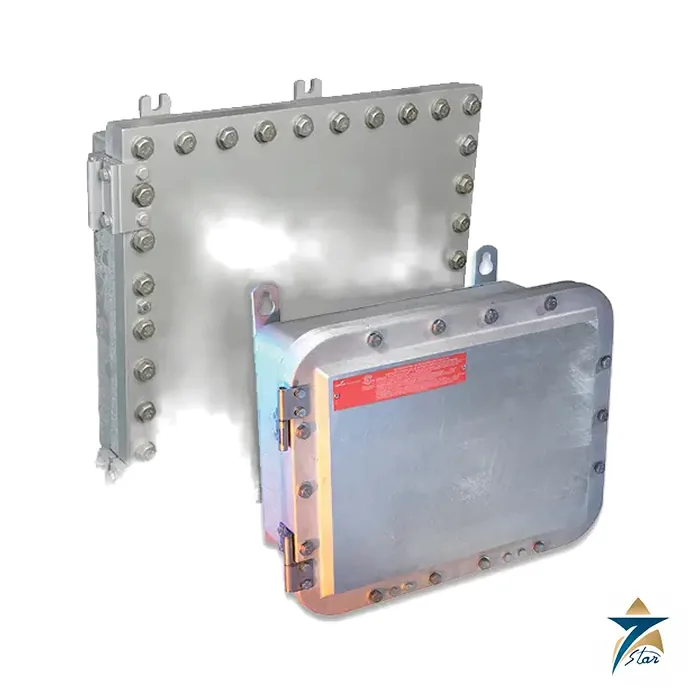
The Cooper Crouse-Hinds (Eaton) EJB Series explosionproof custom-built control panels, often specified simply as a Crouse-Hinds EJB control panel, are engineered enclosures that group pilot lights, pushbuttons, selector switches, potentiometers and other control devices into a single Ex d housing for process control in classified hazardous locations. Rather than a single fixed catalog item, the EJB is a custom-engineered enclosure line: each panel is configured to a customer’s specific device count, layout, window placement and nameplate marking, letting instrumentation and controls teams consolidate switchgear into the minimum enclosure footprint a Zone 1 or Class I, Division 1 area will allow. EJB panels are listed for Class I, Division 1 and Class II, Division 1 hazardous areas under NEC/CEC, and carry ATEX certification (II 2 G Ex d IIB + H2, IP66) for installations built to IEC hazardous-area codes.
Seven Star LLC works with Cooper Crouse-Hinds (Eaton) as a trusted regional supplier to specify and supply EJB custom control panels for projects across Oman and the GCC. Because every EJB panel is built to order against a device schedule, our engineering team coordinates directly with your project’s electrical and instrumentation drawings to confirm device counts, window sizing, entry locations and nameplate text before the panel is manufactured – reducing rework and re-certification risk once the panel reaches site in Muscat, Sohar, Duqm or Salalah.
An EJB panel does not sense a process variable itself; its function is to house the field control devices – pilot lights, pushbuttons, selector switches, potentiometers from Crouse-Hinds’ EMP series – inside a flameproof enclosure so that any arcing or sparking generated by normal switching operation is contained. The enclosure is designed so that if an internal ignition were to occur within the classified gas group rating, the flame path and joint clearances between body and cover cool the escaping gases below their ignition temperature before they reach the surrounding atmosphere, preventing the internal event from igniting a surrounding explosive gas or dust mixture.
Because EJB panels are custom-built, the “operating principle” each panel implements is defined at the design stage: the customer’s control schematic determines how many devices are mounted on the internal mounting plate, whether an EJB explosionproof glass viewing window is fitted so operators can see indicator lamps or a gauge without opening the enclosure, and how internal wiring is routed to the external entries. Internal and external ground terminations are built into every EJB body to simplify equipotential bonding once the panel is landed and wired on site, and NPT or metric entries can be specified to match the plant’s conduit or cable standard.
EJB enclosures are constructed from copper-free aluminum, with a Corro-free epoxy powder coat available where the installation environment is corrosive – a relevant option for coastal, offshore and desalination sites across Oman where salt-laden air accelerates uncoated aluminum corrosion. A neoprene cover gasket between body and cover delivers a NEMA 4 / IP66 watertight seal, while captive, quick-release stainless steel triple-lead cover bolts and stainless steel hinges make it faster and safer for technicians to open the enclosure for maintenance without losing loose hardware inside a classified area. Tap-in mounting feet offer a simple way to fix the enclosure to structural steel or a panel frame and can be replaced individually if damaged, without requiring a new enclosure.
Every EJB panel ships with an internal mounting plate as standard, giving the panel builder a rigid, pre-drilled surface for device layout, and an optional engraved nameplate scheme so each pushbutton, selector switch or pilot light is clearly labeled to match the plant’s control philosophy document. Device markings can also be added in the field where an as-built change is required after commissioning. Enclosure types available include NEMA 3, 3R, 4, 4X, 7BCD and 9EFG, letting a single EJB platform cover both indoor process areas and outdoor, weather-exposed control stations on the same specification.
EJB custom control panels are specified wherever a hazardous-area process needs a grouped set of local control and indication devices – motor start/stop stations, valve actuator control panels, package unit local control panels, pump skid control stations and process interlocking panels – installed directly in the Zone 1/Class I Division 1 area rather than routed back to a remote non-hazardous control room. This makes them a standard component on refinery process units, gas compression and metering stations, offshore platform topsides, LNG trains and petrochemical plant utility areas.
As a trusted Cooper Crouse-Hinds (Eaton) supplier, Seven Star LLC supports EPC contractors, panel fabricators and plant engineering teams across Oman and the GCC in specifying EJB panels from device schedule through to delivery, including coordination on window placement, nameplate engraving and entry configuration. Whether you are building out local control stations for a new gas processing train in Sohar or replacing an ageing custom enclosure during a shutdown at a Salalah facility, our team can turn your control philosophy drawing into a correctly certified EJB quotation.
| Model | EJB Custom-Built Explosionproof Control Panel |
|---|---|
| Manufacturer | Cooper Crouse-Hinds (Eaton) |
| NEC/CEC Rating | Class I, Div 1 & 2, Groups B, C, D; Class I, Zones 1 & 2; Class II, Div 1, Groups E, F, G; Class II, Div 2, Groups F, G; Class III |
| Standards | UL1203, cUL to CSA C22.2 No. 30 |
| ATEX Certification | II 2 G Ex d IIB + H2, IP66 |
| Enclosure Types | NEMA 3, 3R, 4, 4X, 7BCD, 9EFG |
| Body Material | Copper-free aluminum, optional Corro-free epoxy powder coat |
| Sealing | Neoprene cover gasket, NEMA 4/IP66 watertight |
| Entries | NPT or metric, per customer specification |
| Configuration | Custom-engineered per customer device schedule |
Q: Is the EJB a fixed catalog product or a custom-built enclosure?
A: The EJB is a custom-built platform – each panel is configured to the customer’s device schedule, window requirements and nameplate markings rather than sold as a single fixed part number.
Q: What hazardous-area classifications does the EJB cover?
A: EJB panels are listed for Class I, Divisions 1 & 2 and Class II, Division 1 under NEC/CEC, and carry ATEX Ex d IIB + H2 certification for IEC-classified installations.
Q: Can I see indicator lights inside the panel without opening it?
A: Yes, an optional EJB explosionproof glass viewing window can be specified so operators can see pilot lights or gauges without opening the enclosure.
Q: Does Seven Star LLC help specify the panel, or only supply it?
A: Both. As a trusted Cooper Crouse-Hinds (Eaton) supplier, our engineering team works from your control schematic to confirm device count, window placement, entries and nameplate text before the panel is manufactured.
Q: Is a corrosion-resistant finish available for coastal sites in Oman?
A: Yes, an optional Corro-free epoxy powder coat over the copper-free aluminum body is available for coastal and offshore installations.
Browse Cooper Crouse-Hinds products by category: Automation Accessories, Pipes & Fittings, Electrical & Power Modules.
Choose the option that best fits your needs to get the fastest response from our team.
Automatically fill the RFQ form with this product's details for a faster process.
Manually enter multiple part numbers, specific brands, or custom requirements.









Reviews
There are no reviews yet.