RMCL55BD analog converter and what the part number covers
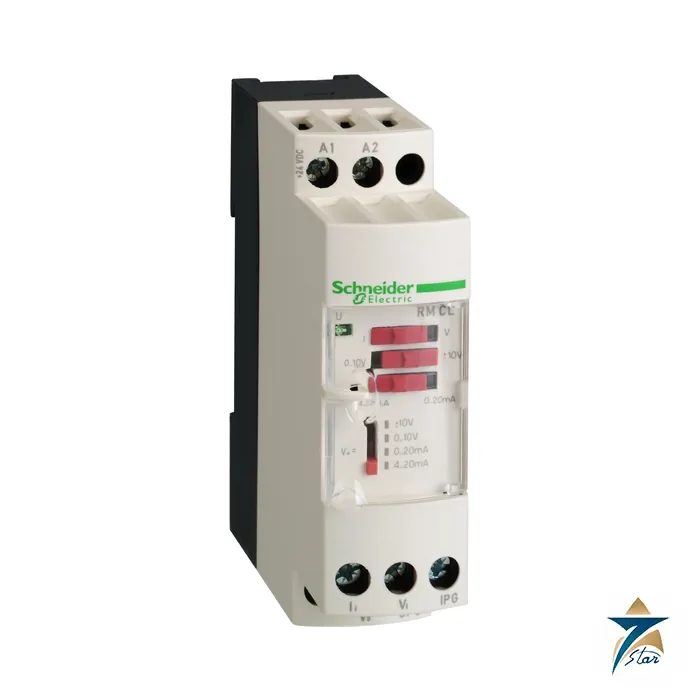
RMCL55BD belongs to the Harmony Analog range from Schneider Electric and is described in its datasheet as a voltage/current signal converter with an isolated supply and switchable output. It takes 0–20 mA, 4–20 mA, ±10 V DC or 0–10 V DC at the input and delivers 0–20 mA, 4–20 mA (load up to 500 Ω), ±10 V or 0–10 V (100 kΩ or more), switchable; the output form is switchable on the front of the module. The datasheet (dated 29 Jun 2026) shows it as discontinued on 29 Jun 2026, so availability has to be confirmed per order.
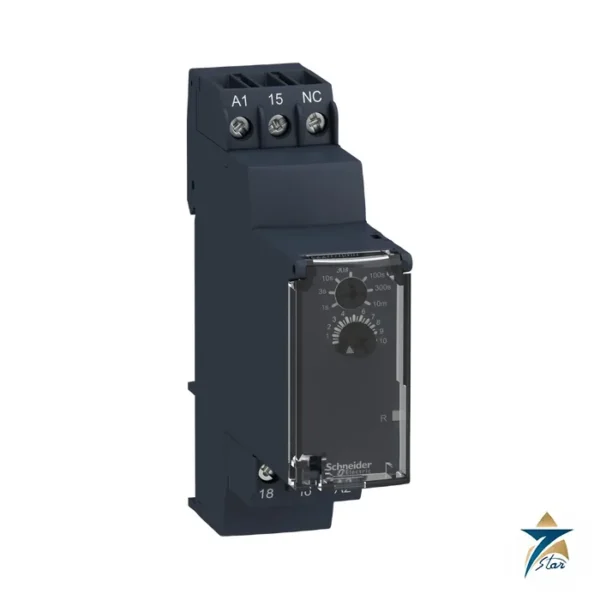
The supply is 24 V DC ± 20 %, isolated (isolated per the datasheet), and a green LED confirms power. The housing is the familiar DIN-rail enclosure with screw terminals on the top and bottom rows, designed for control cabinets rather than field mounting.
Because the converter changes the form of a signal rather than conditioning a specific sensor, it is usually selected after the receiving device is known. Seven Star LLC supplies RMCL55BD in Oman and the GCC as an independent supplier, mainly for panel retrofits and spares.
RMCL55BD technical specifications
| Parameter |
Specification |
| Manufacturer / part number |
Schneider Electric / RMCL55BD |
| Range |
Harmony Analog |
| Product type |
Voltage/current converter |
| Analog input |
Current 0–20 mA; Current 4–20 mA; Voltage ± 10 V DC; Voltage 0–10 V DC |
| Analog output |
Current 0–20 mA ≤ 500 Ohm switchable; Current 4–20 mA ≤ 500 Ohm switchable; Voltage ± 10 V ≥ 100 kOhm switchable; Voltage 0–10 V ≥ 100 kOhm switchable |
| Supply |
24 V DC ± 20 %, isolated |
| Current consumption |
≤ 70 mA for voltage output; ≤ 90 mA for current output |
| Output protection |
Reverse polarity protection on output; Short-circuit protection on output; Overvoltage protection on output (± 30 V) |
| Indicator |
LED (green) for power ON |
| Insulation voltage |
2 kV |
| Surge withstand |
0.5 kV during 1.2/50 µs conforming to IEC 61000-4-5 |
| Mounting |
By screws (mounting plate); Clip-on (35 mm symmetrical DIN rail) |
| Terminal torque |
0.6–1.1 N.m |
| Operating temperature |
0–50 °C side by side; 0–60 °C with 2 cm spacing |
| Storage temperature |
-40–85 °C |
| Shock / vibration |
50 gn for 11 ms conforming to IEC 60068-2-27; 5 gn (f= 10–100 Hz) conforming to IEC 60068-2-6 |
| Reliability |
B10d = 20000; MTTFd = 21.6 years |
| Net weight |
0.12 kg |
Where RMCL55BD is used in Oman and the GCC
Converters like this appear in pump skids, ventilation plant, switchrooms, desalination utilities and older process panels across Oman, where a legacy instrument speaks a different signal standard from the new controller. The listed operating limit is 0–50 °C side by side or 0–60 °C with 2 cm spacing, which suits an air-conditioned electrical room but needs checking for sun-loaded outdoor cabinets in Muscat or inland sites.
Dust and humidity are managed by the enclosure around the module, not by the module itself; the datasheet lists pollution degree 2. Seven Star LLC typically supplies such converters for brownfield replacements, where matching the original wiring is more important than adding features.
Fitting RMCL55BD into a signal chain
Compare the three Harmony Analog converters seen together: RMCA61BD accepts AC/DC current up to 15 A, RMCL55BD converts between 0–20 mA, 4–20 mA and ±10 V / 0–10 V with selectable outputs, and RMCN22BD handles 4–20 mA and 0–10 V only with a non-isolated supply. Choosing among them comes down to the input quantity, whether the output must be switchable, and whether the 24 V DC supply needs to be isolated from the signal side.
RMCL55BD is one of these three, so confirm the input and output standards against the controller or recorder you are connecting before you order.
How the conversion behaves in service
The module reads the input, rescales it and drives the output stage. For RMCL55BD the datasheet states the following abnormal-state behaviour: a defined abnormal output when the input is lost; the datasheet tabulates the value for each selected output range. A receiving analog card should therefore be configured so that this level is read as a fault, not as a valid process value.
Output protection is stated as reverse-polarity, short-circuit and overvoltage protection on the output (overvoltage up to ±30 V). That helps when a long cable run is mis-wired during commissioning, but it does not replace proper loop wiring checks.
Use case in plain terms: translating one signal standard into another, for instance a 0–10 V drive reference into a 4–20 mA loop, or a bipolar ±10 V signal into a unipolar current.
Information to send with an RFQ
To quote correctly we need the following:
- Exact part number RMCL55BD and quantity.
- Input and output signal standards actually used in your loop.
- Whether you need a like-for-like replacement or are open to the current successor offered by the manufacturer.
- Delivery location in Oman or the GCC and the target date.
Family comparison: three Harmony Analog converters
| Part number |
Input |
Output |
Supply |
| RMCA61BD |
AC/DC current 0–1.5 / 0–5 / 0–15 A |
0–20 mA, 4–20 mA, 0–10 V by cabling |
24 V DC, isolated |
| RMCL55BD (this page) |
0–20 mA, 4–20 mA, ±10 V, 0–10 V |
Same four, switchable |
24 V DC, isolated |
| RMCN22BD |
4–20 mA, 0–10 V |
4–20 mA, 0–10 V by cabling |
24 V DC, non-isolated |
Selection and ordering checklist for RMCL55BD
Before requesting a quotation, confirm these points:
- Input signal type and range, including whether it is AC, DC or bipolar.
- Required output form and whether the load stays within the stated limits (500 Ω maximum for current, 100 kΩ minimum for voltage).
- Whether a isolated supply matches your 24 V DC distribution; the datasheet gives 24 V DC ± 20 %, isolated.
- Rail space and spacing: the datasheet allows 0–50 °C side by side and 0–60 °C with 2 cm spacing.
- Whether a discontinued part is acceptable or a current replacement should be quoted instead.
Installation, commissioning and maintenance
Mount the module on a 35 mm symmetrical rail or on a plate with screws. Tighten terminals within 0.6–1.1 N·m, and keep the signal wiring away from power cables; the datasheet quotes fast-transient immunity of 1 kV on the input and output and 2 kV on the supply.
During commissioning, apply a known input, measure the output with a calibrator, and also simulate a broken input wire to see how the receiving device reacts. For RMCL55BD the green LED only proves that supply is present, so it cannot show whether the signal path is healthy.
These modules have no user-serviceable parts. Keep one spare on the shelf where the loop is critical and record the wiring selection used, because a replacement has to be cabled in the same way.
Documents and quotation
The datasheet for RMCL55BD is attached to this page (document dated 29 Jun 2026); it marks the product as discontinued on 29 Jun 2026. Treat it as the reference for every figure above, and expect us to confirm stock or a current replacement before we quote.
Send the part number, quantity, required delivery point and any project reference through the quotation form or by email. Seven Star LLC is an independent industrial supplier based in Muscat, serving customers across Oman and the GCC, and we reply with availability and lead time for this exact part number.
Other Models in the Schneider Harmony Analog Range
Seven Star LLC supplies models from the Schneider Harmony Analog range in Oman and the GCC. Compare the related models below and request a quote for the one that matches your application.






















Reviews
There are no reviews yet.