What the CAD32F7 is and how its code is built
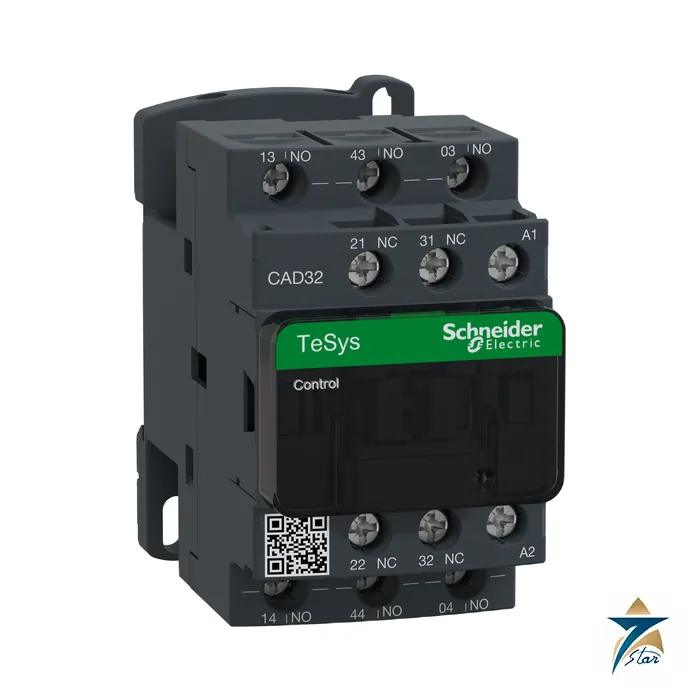
This page covers the CAD32F7, a TeSys D control relay from Schneider Electric with three normally open and two normally closed contacts and a 110 V AC 50/60 Hz coil. It belongs to the CAD range, which uses the same compact housing as the TeSys D contactors but is built for control duty. Seven Star LLC is an independent supplier in Muscat and supplies the CAD32F7 in Oman and the GCC.
Part-number logic: the family is TeSys D control relay (CAD), the contact block is three normally open and two normally closed contacts, and the suffix F7 corresponds to the 110 V AC 50/60 Hz coil. That is exactly what the manufacturer’s description says for this reference, so a quote request should always quote the complete CAD32F7 and never just the family prefix.
Choosing the supply for the CAD32F7 coil
The coil is the one part that distinguishes the CAD32F7 from its siblings, so it deserves the closest reading.
The 110 V AC coil suits control circuits supplied from a 110 V transformer winding, a common arrangement on machinery and older switchboards where the control voltage is deliberately lower than the 415 V power supply. The datasheet gives 70 VA inrush and 8 VA hold-in at 50 Hz, equal to about 0.64 A at pull-in and 73 mA held in at 110 V.
The operational window of 0.8 to 1.1 Uc at 50 Hz corresponds to about 88 to 121 V, and the drop-out band of 0.3 to 0.6 Uc to about 33 to 66 V. The relatively high drop-out threshold of an AC coil means the relay releases promptly even when the circuit has some leakage. In a panel with both 110 V AC and 110 V DC reference numbers on the shelf, confirm the nameplate before fitting, since the two coils look identical from the front.
Sizing the coil circuit is straightforward with the datasheet figures. The listed power is 70 VA inrush and 8 VA hold-in at 50 Hz; at 110 V that is roughly 0.64 A on pull-in and 72.7 mA held in. The coil operates within 88 to 121 V at 50 Hz (0.8 to 1.1 Uc), from 93.5 V at 60 Hz and releases within 33 to 66 V (0.3 to 0.6 Uc). As these currents are derived rather than quoted, leave margin in the supply and check them against the nameplate of the exact relay you receive.
CAD32F7 specification table
| Parameter |
Specification |
| Manufacturer / part number |
Schneider Electric / CAD32F7 |
| Range / type |
TeSys Deca control relay (TeSys CAD) |
| Pole contact composition |
3 NO + 2 NC |
| Utilisation categories |
AC-15; AC-14; DC-13 |
| Rated operational voltage (Ue) |
≤ 690 V AC 25 to 400 Hz |
| Control circuit voltage (Uc) |
110 V AC 50/60 Hz |
| Control voltage limits |
0.3 to 0.6 Uc (-40 to 70 °C):drop-out AC 50/60 Hz; 0.8 to 1.1 Uc (-40 to 60 °C):operational AC 50 Hz; 0.85 to 1.1 Uc (-40 to 60 °C):operational AC 60 Hz; 1 to 1.1 Uc (60 to 70 °C):operational AC 50/60 Hz |
| Operating time |
12 to 22 ms coil energisation and NO closing; 4 to 12 ms coil de-energisation and NO opening; 4 to 19 ms coil energisation and NC opening; 6 to 17 ms coil de-energisation and NC closing |
| Inrush / hold-in power |
70 VA 50 Hz (at 20 °C) / 8 VA 50 Hz (at 20 °C) |
| Thermal current (Ith) |
10 A (at 60 °C) |
| Rated making capacity |
140 A AC conforming to IEC 60947-5-1; 250 A DC conforming to IEC 60947-5-1 |
| Associated fuse |
10 A gG conforming to IEC 60947-5-1 |
| Insulation voltage (Ui) |
690 V IEC 60947-5-1; 600 V UL and CSA |
| Mechanical durability / rate |
30 Mcycles / 180 cyc/mn |
| Mounting / terminals |
DIN rail or plate; screw clamp 1 to 4 mm², 1.7 N.m |
| Dimensions (H x W x D) |
77 mm x 45 mm x 84 mm |
| Net weight |
0.58 kg |
| Degree of protection |
IP2X front face conforming to VDE 0106 |
| Ambient temperature, operation |
-40 to 60 °C; 60 to 70 °C with derating |
| Ambient temperature, storage |
-60 to 80 °C |
| Certifications |
CB; CCC; UL; CSA; EAC; CE; UKCA |
Pre-order checklist for the CAD32F7
- Coil: 110 V AC 50/60 Hz, confirmed from the supply drawing or the nameplate of the relay being replaced.
- Contacts: three normally open and two normally closed contacts, matched to the interlock and signalling circuits.
- Supply sizing: about 0.64 A at pull-in and 72.7 mA held in (derived from the datasheet power).
- Window: operates within 88 to 121 V at 50 Hz (0.8 to 1.1 Uc), from 93.5 V at 60 Hz and releases at 33 to 66 V (0.3 to 0.6 Uc).
- Contact load of the CAD32F7: 10 A thermal, AC-15, AC-14 or DC-13 duties; use a contactor for motor-power loads.
- Space: 77 mm high, 45 mm wide and 84 mm deep.
- Environment: operation up to 60 °C, up to 70 °C with derating; storage -60 to 80 °C.
- Type: AC and DC coils of the same voltage are different references; do not mix them.
Where the contacts of the CAD32F7 earn their keep
The 3 NO + 2 NC configuration is the most flexible arrangement for a control relay, because the normally closed pair lets one device take part in interlocking and fault-reset circuits as well as repeating a signal. The datasheet lists a non-overlap time of 1.5 ms on energisation and 1.5 ms on de-energisation between the normally closed and normally open contacts, so that the two groups do not conduct at the same time during a transition.
Use the normally closed contacts for permissive and interlock loops that must fall away on operation, such as stopping a second starter while the first is running, or for a healthy-state signal that drops out when the relay operates. The normally open contacts are available to repeat start, run and trip signals. If a circuit needs more than three normally open contacts and no normally closed ones, the 5 NO version of the same family is the better match.
Contact data from the datasheet apply to all five poles: 10 A conventional thermal current at 60 °C, utilisation categories AC-15, AC-14 and DC-13, a rated operational voltage up to 690 V AC, and a minimum switching capability of 17 V and 5 mA, which makes the contacts suitable for low-level signals as well as for 24 V PLC inputs.
Sibling references: CAD32F7 and the other CAD32 relays
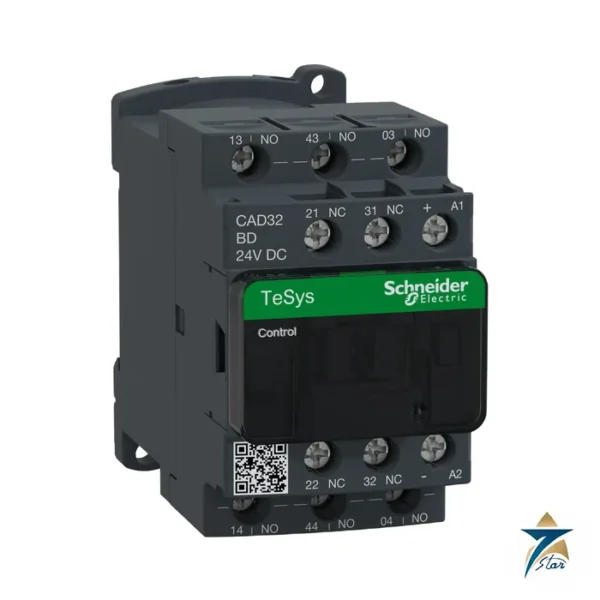
The CAD32F7 is one member of a family of TeSys D control relays that share the housing, the contact data and the mounting. Only the coil voltage and type change from one reference to the next, together with the contact arrangement: the CAD32 series is 3 NO + 2 NC and the CAD50 series is 5 NO. The table lists the CAD32 references we are asked for most.
If the supply is not in the table, ask us; the CAD50 series has the other contact arrangement. AC-coil versions are 84 mm deep and DC-coil versions 93 mm, which matters in a shallow enclosure.
| Reference |
Coil voltage and type |
Contacts |
| CAD32BD |
24 V DC standard |
3 NO + 2 NC |
| CAD32BL |
24 V DC low consumption |
3 NO + 2 NC |
| CAD32D7 |
42 V AC 50/60 Hz |
3 NO + 2 NC |
| CAD32ED |
48 V DC standard |
3 NO + 2 NC |
| CAD32F7 (this page) |
110 V AC 50/60 Hz |
3 NO + 2 NC |
| CAD32FD |
110 V DC standard |
3 NO + 2 NC |
| CAD32JD |
12 V DC standard |
3 NO + 2 NC |
| CAD32M7 |
220 V AC 50/60 Hz |
3 NO + 2 NC |
| CAD32MD |
220 V DC standard |
3 NO + 2 NC |
| CAD32N7 |
415 V AC 50/60 Hz |
3 NO + 2 NC |
| CAD32R7 |
440 V AC 50/60 Hz |
3 NO + 2 NC |
| CAD32U7 |
240 V AC 50/60 Hz |
3 NO + 2 NC |
| CAD32V7 |
400 V AC 50/60 Hz |
3 NO + 2 NC |
Applications of the CAD32F7 in Oman and the GCC
Mains-voltage AC coils at 110 to 240 V are used for general control: starting pumps and fans, repeating status signals and building interlocks between motor starters. In Oman the nominal single-phase voltage is 240 V, so the 220, 230 and 240 V coils are the ones most often seen in local panels, depending on how the equipment was originally specified.
Typical sites include water pumping stations, air-handling plant rooms, workshop panels and packaged equipment on oil and gas wellpads. High ambient temperature and fine dust are the main stresses; the relay gives IP2X at the front face and is meant to sit inside an enclosure with sensible ventilation and filtering rather than in the open.
For the CAD32F7, that means three normally open and two normally closed contacts from one 110 V AC 50/60 Hz command, sitting next to LC1D contactors of the same TeSys D family on the same rail.
Fitting the CAD32F7 in a panel
Mount the CAD32F7 on a 35 mm DIN rail or on a plate; the datasheet lists both. It measures 77 mm x 45 mm x 84 mm and weighs 0.58 kg, so allow space for the wires to bend at the terminals and for air to circulate around the housing. Tighten the screw-clamp terminals to 1.7 N.m with a Philips No 2, Pozidriv No 2 or 6 mm flat screwdriver, and do not exceed the cable sizes of 1 to 4 mm² per terminal listed in the datasheet.
Commissioning is simple: energise the coil at nominal voltage, verify that all five poles move together, and check the contact action with a meter before connecting the field loads. The mechanical durability is 30 million cycles and the maximum operating rate is 180 cycles per minute, so in normal control duty there is no routine wear item to schedule. In a dusty site, clean the panel and check terminal tightness during planned shutdowns, because loose terminals, more often than the relay itself, cause intermittent faults.
RFQ details for the CAD32F7
- Full reference CAD32F7 and the quantity
- The coil voltage and type seen on the supply drawing or on the old relay nameplate
- The load or circuit each contact will switch (voltage, current, signal level)
- Panel or machine the relay must fit, and whether it is a spare, a replacement or a new installation
- Delivery location in Oman or the GCC and the date required
Documents and quotation
A datasheet for this product is attached on this page. It lists the electrical, mechanical and environmental data summarised above, and it is worth reading beside the panel drawing before you order.
Send us the part number, quantity and application and we will confirm availability and a quotation. Seven Star LLC is an independent supplier in Muscat and is not affiliated with the manufacturer.
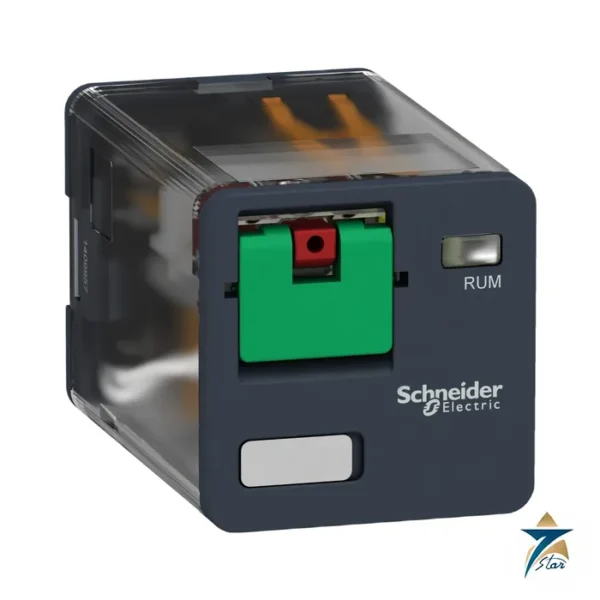
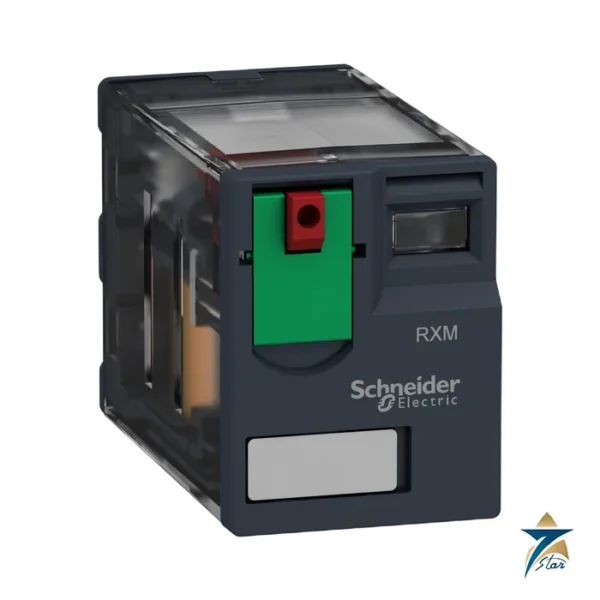
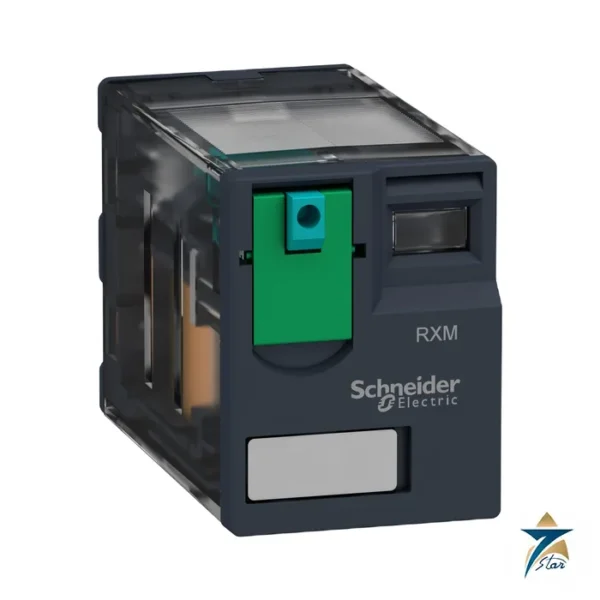
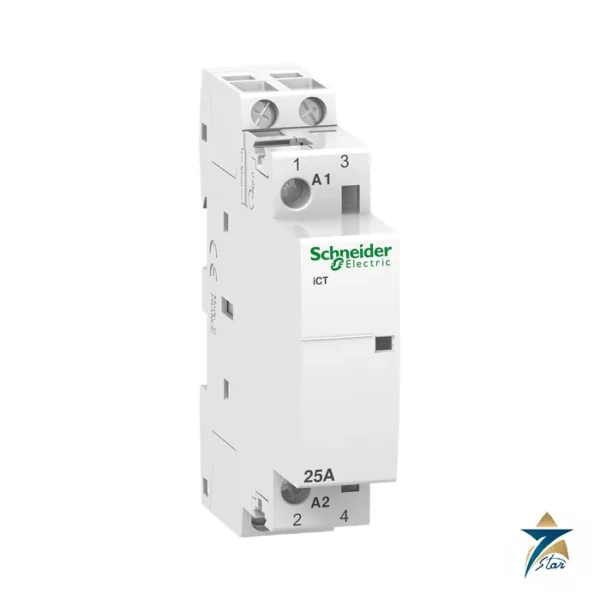
Other Models in the Se Cad32 Range
Seven Star LLC supplies models from the Se Cad32 range in Oman and the GCC. Compare the related models below and request a quote for the one that matches your application.




















Reviews
There are no reviews yet.