- Automation & ControlView all 3,062 products
- Automation Accessories
- AC Drives
- PLC & I/O Cards
- Industrial Communications
- Vibration Monitoring
- Isolator & Barrier
- Controllers & Data Acquisition
- Safety Switches & Guard Locking
- Motor Soft Starters
- Encoders
- CCTV & Security
- Pneumatic Cylinders
- HMI Displays
- Servo Drives
- Industrial Computers
- Machine Vision
- Automation Software
- Robotics
Brand: Schneider Electric
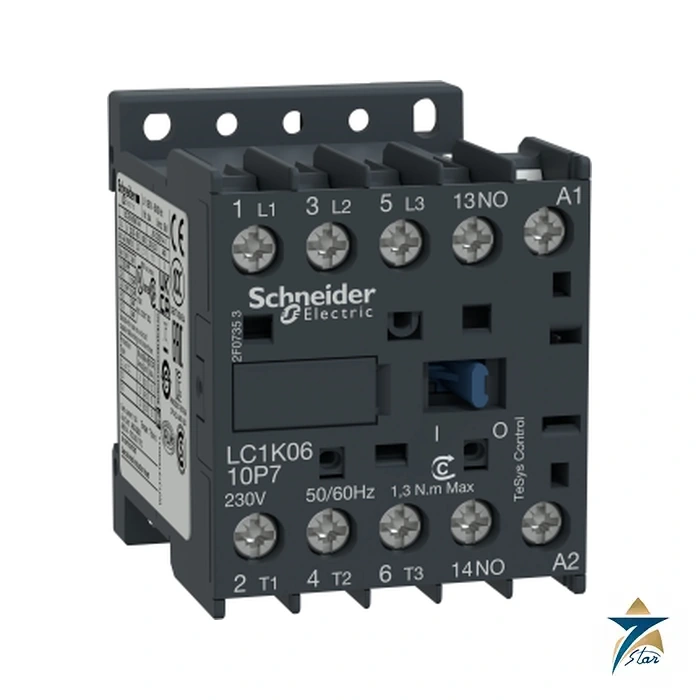
Schneider Electric LC1K0610P7 TeSys K Contactor
Description
Compact TeSys K motor switching
The Schneider Electric LC1K0610P7 is a TeSys K three-pole contactor with a 6 A AC-3 rating at up to 440 V and ambient below 60 °C. It has one normally open auxiliary contact and a 230 V AC, 50/60 Hz control coil.
The complete LC1K0610P7 reference identifies the electrical execution. The coil supply must be checked separately from the main-circuit voltage: a 230 V AC coil does not mean that every motor circuit uses 230 V.
Technical specifications
| Parameter | Specification |
|---|---|
| Manufacturer | Schneider Electric |
| Range / reference | TeSys K / LC1K0610P7 |
| Main poles | 3 |
| AC-3 current rating | 6 A, for applications up to 440 V |
| Control coil | 230 V AC |
| Built-in auxiliary contact | 1 normally open |
| AC-3 motor power at 380–415 V | 2.2 kW, 50/60 Hz |
| Connections / mounting | Screw clamp terminals / rail or plate |
| Dimensions, H × W × D | 58 × 45 × 57 mm |
| Net mass | 0.18 kg |
| Coil suppression | No built-in suppressor module |
Select the contactor for the actual circuit
Compare the AC-3 load rating, number of main poles, auxiliary-contact requirement and available control supply with the installed arrangement. Other TeSys K references may share the housing while using different coils or auxiliary-contact combinations.
Identify the overload-protection arrangement and any additional accessories separately. A contactor switches the load; the starter design must also provide the required circuit and motor protection.
The screw-clamp terminal execution supports rail or plate mounting. Its 45 mm width is useful when checking the available starter space. The coil has no built-in suppressor module, so identify any required suppression accessory with the control-circuit design.
How the LC1K0610P7 Contactor Works
A contactor is an electrically operated switch for power circuits. Inside the LC1K0610P7 there is an electromagnet with a fixed core, a moving armature and the 230 V AC coil. When the coil is energised, the magnetic force pulls the armature in and closes the three main poles, connecting the supply to the motor. At the same time the built-in auxiliary contact closes, which is commonly used as a self-holding (latching) contact with a start push button, or as a status signal to a PLC. When the coil supply is removed, return springs open the main and auxiliary contacts and the motor stops.
The utilisation category AC-3 describes switching squirrel-cage motors: closing on the high starting current and breaking the normal running current. The 6 A AC-3 rating and 2.2 kW at 380–415 V therefore refer to direct-on-line motor starting. For other duties, such as frequent inching and plugging (AC-4) or resistive loads (AC-1), the permissible current differs, and the Schneider Electric datasheet should be consulted.
LC1K0610P7 Reference Code Explained
Schneider Electric TeSys K references follow a consistent structure that helps when identifying a replacement:
- LC1K – TeSys K contactor with AC control circuit.
- 06 – 6 A AC-3 rating.
- 10 – built-in auxiliary contact: one normally open, no normally closed (an “01” reference has one normally closed contact instead).
- P7 – coil voltage code for 230 V AC, 50/60 Hz.
The coil code is the part most often confused during replacement. Other TeSys K coil codes cover different control voltages, and a contactor with the wrong coil voltage will either not pull in or will overheat and fail. Always compare the coil code on the old contactor and the actual control-circuit voltage.
Building a Starter Around the LC1K0610P7
In the TeSys K range, the contactor is usually combined with a matching thermal overload relay to form a direct-on-line starter, and two contactors can be combined with a mechanical interlock to build a reversing starter. Add-on auxiliary contact blocks and coil suppressor modules are also offered for the range. When replacing a contactor in an existing starter, check that any clip-on accessories fitted to the old device are transferred or reordered, and that the overload relay setting still matches the motor full-load current on its nameplate.
Installation and Maintenance Notes
- Isolate and lock out the power and control supplies before working on the starter.
- Mount the contactor on the rail or plate as specified and observe clearance to adjacent devices for heat dissipation.
- Tighten the screw clamp terminals to the torque given in the Schneider Electric instructions; loose terminals are a common cause of overheating.
- Where the coil is switched by PLC outputs or sensitive electronics, consider a suitable suppressor, since this reference has no built-in suppression.
- During inspections, look for discoloured terminals, a humming coil or chattering contacts, which can indicate low control voltage, a dirty magnet face or a worn device.
- Coordinate the contactor with a suitable thermal overload relay or motor circuit breaker so that the motor and cable are protected.
Typical Applications in Oman & the GCC
Compact contactors like the Schneider Electric LC1K0610P7 are widely used in small motor starters for pumps, fans, compressors and conveyors, in HVAC and water treatment control panels, and in machine control cabinets where panel space is limited. In hot climates, the ambient temperature inside the enclosure should be considered, because the published AC-3 rating applies for ambient temperatures below 60 °C.
Why Source from Seven Star LLC
Seven Star LLC supplies Schneider Electric control and switching components to panel builders, maintenance teams and contractors across Oman and the GCC. Our team can help confirm the correct ordering code, including the coil voltage and auxiliary contact arrangement, before you place an order.
Quotation and replacement identification
Send Seven Star LLC the LC1K0610P7 reference, quantity, motor voltage and current, coil supply and a photograph of the existing label. State any required auxiliary contacts and associated starter components.
Browse Contactors & Overload Relays for related switching and protection components.
Datasheets & Documents
- Datasheet Schneider Electric LC1K0610P7 Product Datasheet — English, 8 October 2026 Download
Reviews (0)
How would you rate this product? Cancel reply
About brand
Schneider Electric is the French group for energy management and industrial automation: low and medium voltage switchgear and circuit breakers, motor control, drives, PLCs, power monitoring, UPS systems and building management. Its history goes back to 1836, when the brothers Adolphe and Eugène Schneider took over the iron and steel works at Le Creusot in Burgundy. Over the 20th century the company left steel and heavy engineering and became an electrical group through acquisitions such as Merlin Gerin, Télémécanique, Square D and Modicon. Its head office is in Rueil-Malmaison near Paris, and its shares are listed on Euronext Paris.
Schneider Electric company profile
| Origins | 1836, Le Creusot, France: Adolphe and Eugène Schneider take over the Le Creusot foundry |
|---|---|
| Headquarters | Rueil-Malmaison (Paris region), France |
| Ownership | Public company listed on Euronext Paris |
| Key acquisitions | Télémécanique (1988), Square D (1991), Merlin Gerin (1992), Modicon (1997), APC (2007), Invensys (2014); majority owner of AVEVA software |
| Brand names still in use | Acti9, ComPacT and MasterPacT breakers, TeSys motor control, Altivar drives, Altistart soft starters, Modicon PLCs, Harmony control components, PowerLogic and Easergy protection and metering, APC UPS, EcoStruxure software platform |
| Product families | Low voltage distribution, medium voltage switchgear and protection relays, motor control and drives, PLCs and HMIs, power meters, UPS and cooling, enclosures, building automation and energy software |
Milestones
- 1836: The Schneider brothers acquire the Le Creusot works; the business grows in steel, locomotives and heavy engineering.
- 1975: First investment in Merlin Gerin, a French maker of electrical distribution equipment.
- 1988–1992: Télémécanique, Square D (USA) and Merlin Gerin join the group, making it an electrical specialist.
- 1997: Modicon, the company behind the first programmable logic controller, joins the group.
- 1999: The group takes the name Schneider Electric.
- 2007 and 2014: APC (UPS and data centre power) and Invensys (process automation) are acquired.
Choosing Schneider Electric breakers and motor control
Circuit breakers are chosen by current and breaking capacity. Acti9 miniature circuit breakers (iC60, C120) protect final circuits up to 125 A. ComPacT NSX molded case breakers cover about 16 to 630 A, and the letter after the frame size sets the breaking capacity: B, F, N, H, S, L from lowest to highest. MasterPacT air circuit breakers are used as main incomers on large switchboards. For motors, a TeSys contactor with an LRD overload relay or a GV2 motor circuit breaker suits direct starting, an Altistart soft starter reduces starting current, and an Altivar drive controls speed. The breaking capacity must always be at least the prospective short-circuit current at the point of installation.
Where Schneider Electric products are used
In Oman and the GCC, Schneider Electric equipment is found in main and sub-main switchboards of commercial and residential buildings, motor control centres in water, oil and gas and industrial plants, substations protected by Sepam and Easergy relays, data centres powered by Galaxy and APC UPS systems, and buildings controlled by EcoStruxure Building Operation.
APC by Schneider Electric: UPS and critical power
Since 2007, APC has been part of Schneider Electric and is now its product brand for uninterruptible power supplies, replacement batteries, battery packs, network management cards and rack power distribution. Our APC catalogue covers Smart-UPS line-interactive and on-line models, Easy UPS On-Line, the modular Symmetra LX, RM and PX ranges, Silcon three-phase systems and their spare part kits, and the RBC cartridges that keep them running. Schneider Electric breakers, drives and PLCs can be quoted together with APC UPS systems in one request.
Schneider Electric products we list
| Family | Examples |
|---|---|
| Circuit breakers | Acti9 iC60N, C120N, NSX100F, NSX250N, NSX630, EasyPact EZC, MasterPacT MTZ1, MasterPacT NW |
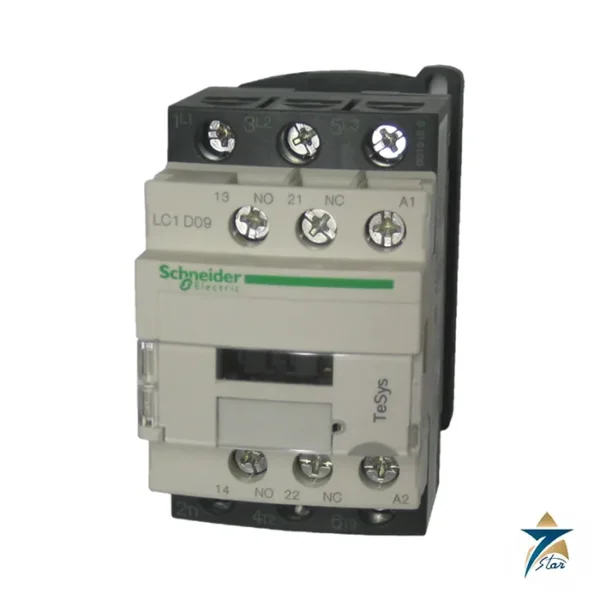
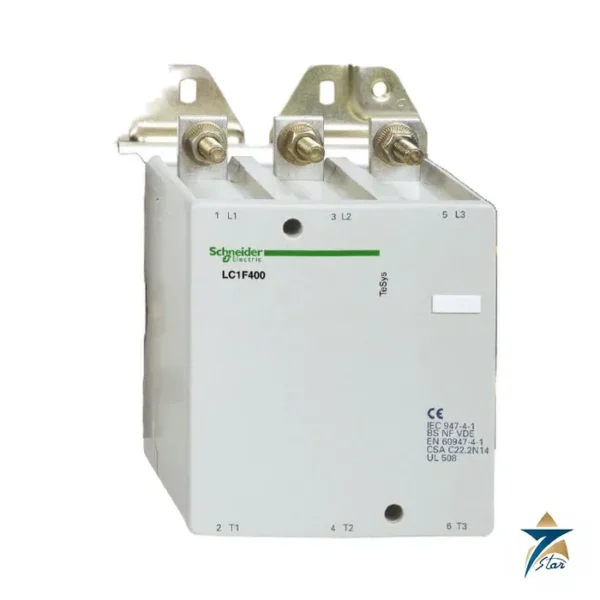
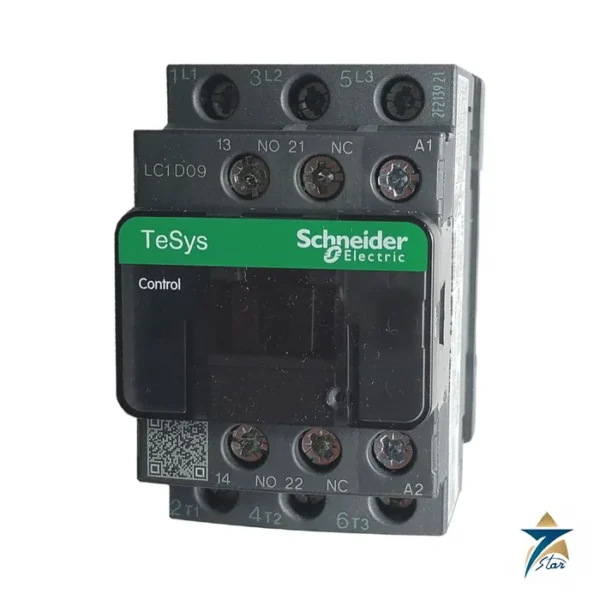
| Motor control | TeSys Deca LC1D, TeSys F, LRD overload relay, GV2ME08, Altistart 22, Altistart 480 |
| Drives | Altivar 12, Altivar 320, ATV340, Altivar Process 630, ATV930, Lexium 32 servo |
| PLCs, HMIs and relays | Modicon M221, M241, M580 BMEP582040, Zelio Logic, Magelis HMISTU655 |
| Protection, metering and power | Sepam series 20, Easergy P3U30, MiCOM P139, PM5560, iEM3255, Galaxy VS UPS |
Ordering Schneider Electric products: what we need
Send the commercial reference from the label (for example LC1D18M7 or ATV320U22N4C). For breakers, confirm the rated current, number of poles, breaking capacity and trip unit. For contactors, give the coil voltage. For drives, give the motor power and supply voltage. APC products are listed on their own brand page.
Facts checked against Schneider Electric's published company history, October 2026.
Browse Schneider Electric products by category: Circuit Breaker, Electrical & Power Modules, AC Drives, PLC & I/O Cards, Metering Systems, UPS and Batteries.
FAQ
Questions about the Schneider Electric LC1K0610P7 TeSys K Contactor
Answers from our engineering team on installation, compatibility and integration.
01Who manufactures LC1K0610P7?
It is a Schneider Electric TeSys K contactor.
02What coil voltage does this reference use?
The LC1K0610P7 execution has a 230 V AC coil for 50/60 Hz.
03How many main poles and auxiliary contacts are provided?
It has three main poles and one normally open auxiliary contact.
04Does the contactor alone provide motor overload protection?
The starter design needs the appropriate overload and circuit-protection arrangement in addition to the contactor.
05What details help identify a replacement?
Send the complete reference, quantity, main-circuit rating, coil supply and a photograph of the existing contactor label.


Reviews
There are no reviews yet.