Brand:

Fluke 835 Laser Belt Alignment Tool

Description

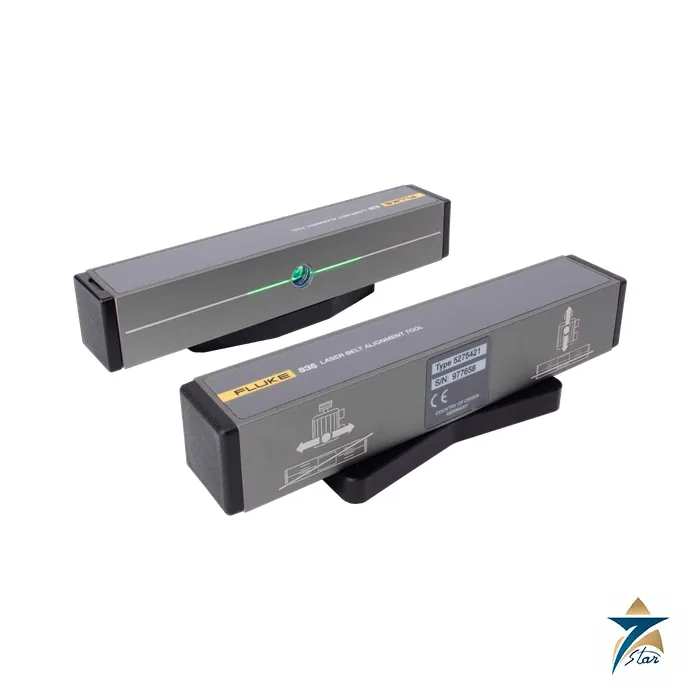
The Fluke 835 is a laser belt alignment tool for pulley and sprocket pairs on belt-driven machines. A laser unit and a reflector unit, both held by strong magnets, show offset, vertical angle and horizontal angle together, so one person can align a drive without straight edges or string.

Belt and pulley alignment by one person

Misaligned pulleys wear belts and bearings, waste power and raise vibration. The 835 uses the reflected-beam principle that Fluke relates to its OPTALIGN heritage: the transmitted laser line and its reflection are compared with reference lines, which doubles the effective distance and improves angular resolution.

Because offset and both angles appear at the same moment, there is no need to cross-check or work through a long sequence. Corrections are made live, and the drive is aligned when the transmitted line and the reflected line meet their respective reference lines.

Technical specifications

Parameter Specification
Model / part no. Fluke 835 / 5255306
Accuracy (laser and reflector) 0.2 degrees
Laser wavelength / class 505 to 535 nm (green) / Class 2
Measuring distance 10 m between units
Laser line length 7 m at 5 m distance
Controls Laser ON/OFF rocker switch
Mounting Strong magnets
Batteries / run time 4 AAA alkaline / 6 hours
Operating temperature -5 to 40 C
Storage temperature -10 to 70 C
Laser unit weight / size 0.3 kg / 37 x 40 x 170 mm
Reflector weight / size 0.27 kg / 37 x 40 x 170 mm
Reflector window 21 x 32 mm
Housing Gray anodized aluminum
Supplied with Laser unit, reflector unit, carrying case, quick reference guide, safety sheet

How an alignment is carried out

The reflector is mounted on the machine that will be moved, normally the motor, and the laser transmitter goes on the stationary driven component. Position of the laser line on the reflector indicates vertical angularity and offset, while the reflected line on the transmitter shows horizontal angularity. The technician then corrects each condition in turn while watching the lines.

The housings are anodized aluminum with no small parts to lose, and the tool is small enough to carry in a tool bag. It does not replace shaft alignment equipment for direct-coupled machines; it is made for pulleys and sprockets. The laser is Class 2, so avoid looking into the beam.

A typical drive check takes four steps: switch on the laser and mount both units on the pulley faces, read offset and vertical angle on the reflector, read horizontal angle on the transmitter, then shim or move the motor until the lines agree. Fluke says the benefits include longer-lasting bearings, belts and seals as well as lower energy waste and fewer unplanned stops. Magnetic mounting means the pulley face must be ferrous and free of heavy dirt or paint build-up, and the units should be seated flat before readings are taken.

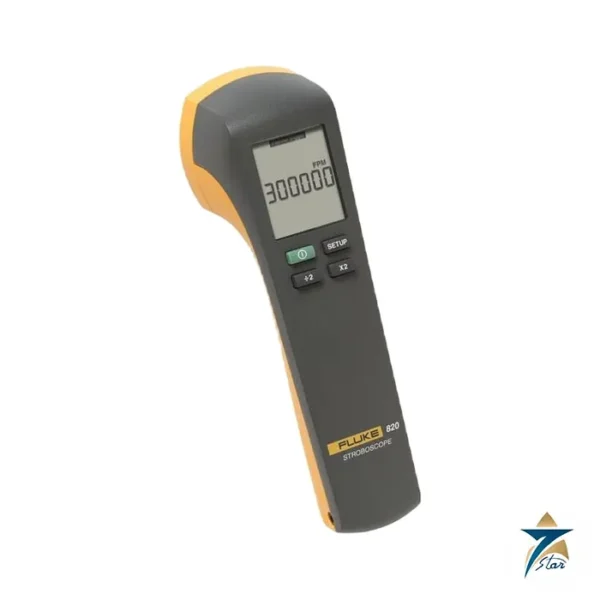
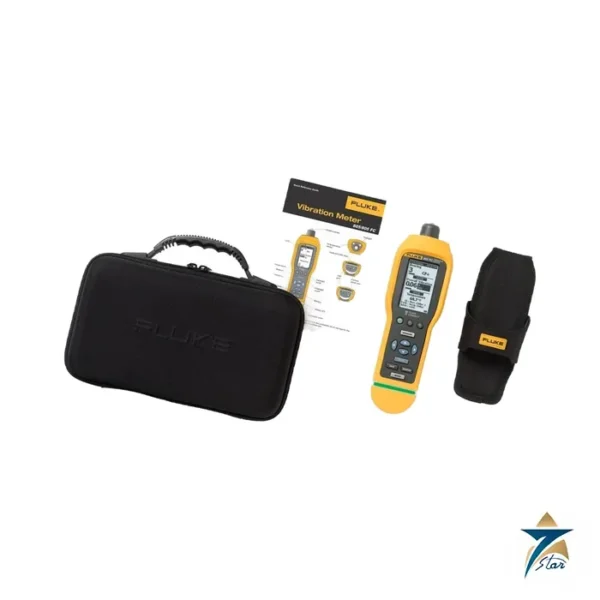
Related Fluke products: Fluke 805 FC Vibration Meter and Fluke 820-2 LED Stroboscope.

Documents and quotation

The linked PDF is the Fluke 835 technical data sheet. The product page also lists a quick reference guide and safety sheet. Please confirm the pulley face widths and materials, since magnets need a ferrous face, and the working distance, which should stay within 10 m, before ordering. Send us the model, quantity and delivery location and we will prepare a quotation; Seven Star LLC supplies from Muscat as an independent supplier. See our Portable Test and Measurement range and the Fluke 810 handheld vibration tester for related instruments.


Datasheets & Documents
  • PDF Datasheet Fluke 835 Laser Belt Alignment Tool technical data sheet (PDF) Download
Reviews (0)

Reviews

There are no reviews yet.

How would you rate this product?

It takes about 10 seconds — just tap a star. Your email is never published.

About brand

Fluke is the American maker of handheld electronic test tools: digital multimeters, clamp meters, insulation testers, process calibrators, thermometers, vibration meters and power quality analysers. John Fluke founded the John Fluke Engineering Company in Springdale, Connecticut, in June 1948 and moved it to Seattle in 1952. Fluke is headquartered in Everett, Washington, was acquired by Danaher in 1998 and has been part of Fortive since Fortive's spin-off from Danaher in 2016.

Seven Star LLC lists Fluke process calibrators, electrical test tools and bench calibrators, and sources them for maintenance teams and calibration laboratories in Oman.

Fluke company profile

Founded June 1948, Springdale, Connecticut, USA, as the John Fluke Engineering Company
Founder John M. Fluke Sr.
Headquarters Everett, Washington, USA (moved to the Seattle area in 1952)
Ownership Danaher from 1998; part of Fortive (NYSE: FTV) since July 2016
Product families Digital multimeters and clamp meters, insulation resistance testers, process and loop calibrators, infrared thermometers and thermal imagers, vibration meters, power quality analysers, Fluke Calibration laboratory standards

Milestones

  • 1948: John Fluke starts the company in Springdale, Connecticut.
  • 1952: The company moves to Seattle
  • 1987: A joint venture with Philips leads to the ScopeMeter handheld oscilloscope.
  • 1998: Danaher acquires Fluke.
  • 2016: Fluke becomes part of Fortive, spun off from Danaher in July.

Fluke calibrators and test tools listed

The main Fluke products on this page fall into three groups, besides other test tools such as further multimeters, a thermometer, an anemometer, a vibration tester and a portable appliance tester:

  • Process tools: the 754 documenting process calibrator with HART, 789 ProcessMeter, 721 dual sensor pressure calibrator and 729 automatic pressure calibrator
  • Electrical test: the 376 FC true-RMS clamp meter with iFlex probe and the 1587 FC insulation multimeter
  • Fluke Calibration bench standards: 5522A, 5502A, 5500A and 5080A multi-product calibrators, the 5720A multifunction calibrator, 8508A reference multimeter, 6100A electrical power standard and 9640A RF reference source

Several of the bench models belong to earlier generations. When a model is no longer produced, we check the manufacturer's documentation and propose the successor it names.

Where Fluke instruments are used

Fluke process calibrators are used for loop checks, transmitter calibration and valve tests in oil and gas, power and water plants. Clamp meters and insulation testers serve electrical maintenance on motors, switchgear and cables. The bench calibrators and reference multimeters are the working standards of electrical calibration laboratories in the GCC, where they calibrate multimeters, clamp meters, process tools and power analyzers.
Fluke products we list

Family Examples
Portable Test & Measurement 117 Electrician’s True-rms Multimeter with, 1507 Insulation Resistance Tester, 1550C 5 kV Insulation Resistance Tester, 1587 FC Insulation Multimeter, 376 FC True-RMS AC/DC Clamp Meter with iFlex, 5080A Multi-Product Calibrator, 5500A Multi-Product Calibrator, 5502A Multi-Product Calibrator and 17 more
Lubrication & Bearing Maintenance 805 FC Vibration Meter

Ordering Fluke instruments: what we need

Send the exact model with its suffix, since versions differ. A Fluke 721, for example, is defined by its two pressure ranges, and a 729 by its maximum pressure. For bench calibrators, list the options you need, such as oscilloscope calibration or power quality options, the line voltage, and the type of calibration certificate you require from the manufacturer. For Fluke multimeters and clamp meters, add the kit contents wanted, such as probes, leads or cases.

Facts checked against published histories of Fluke Corporation and Fortive, October 2026.

FAQ

Questions about the Fluke 835 Laser Belt Alignment Tool

Answers from our engineering team on installation, compatibility and integration.

01What does the Fluke 835 align?
Belt-driven pulleys and sprockets, showing offset, vertical angle and horizontal angle together.
02How accurate is it?
Fluke lists 0.2 degrees for both the laser and the reflector.
03What laser does it use?
A green laser of 505 to 535 nm, Class 2.
04How is it powered?
Four AAA alkaline batteries give about 6 hours of operation.
05How is it mounted?
Strong magnets hold the laser and reflector units on the pulley faces.