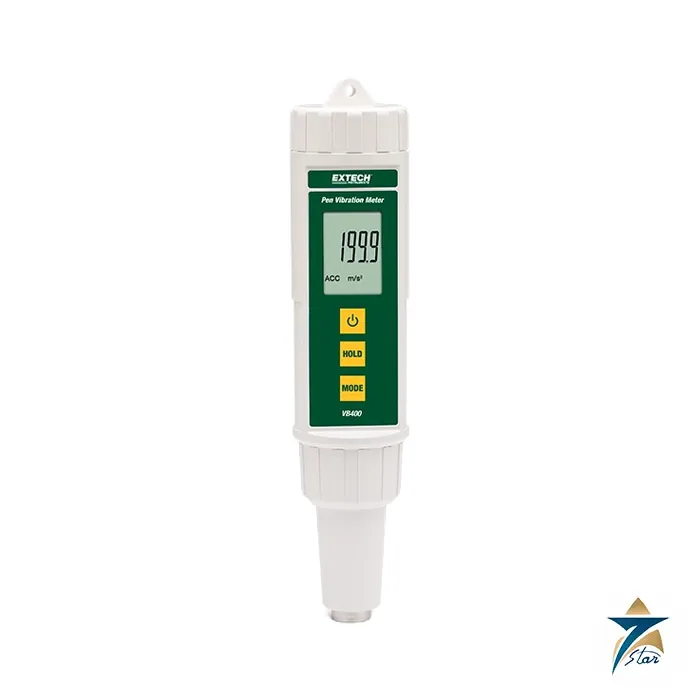
Extech VB400 pen vibration meter for machine condition checks
The Extech VB400 is a pen-style vibration meter that measures RMS acceleration and RMS velocity on motors, bearings, fans, pumps and other rotating machinery. It covers 10 Hz to 1 kHz, reads in metric or imperial units, and has a slim sensing head on the end of the meter, so it can be pressed on a bearing housing in tight places. It offers a zero adjustment, data hold, a low battery indicator and an IP65 dust and water resistant housing.
The VB400 is supplied with a test pin tip for non-ferrous surfaces, a magnetic base for ferrous surfaces, four AAA batteries and a pouch case. The user manual states that the sensitivity is designed to meet ISO 2954.
Technical specifications of the VB400
| Parameter |
Specification |
| Manufacturer / part number |
Extech / VB400 |
| Acceleration (RMS) |
656 ft/s²; 20.39 g; 200 m/s² |
| Velocity (RMS) |
7.87 in/s; 2.00 cm/s; 200 mm/s |
| Frequency range |
10 Hz to 1 kHz |
| Resolution |
1 ft/s², 0.01 g, 0.1 m/s²; 0.02 in/s, 0.01 cm/s, 0.1 mm/s |
| Basic accuracy |
±(5% + 2 digits) |
| Functions |
Zero adjustment, data hold, low battery indicator |
| Protection |
IP65 water and dust resistant |
| Accessories supplied |
Test pin tip, magnetic base, 4 x AAA batteries, pouch case |
| Dimensions / weight |
Meter 175 x 40 x 32 mm; sensing head 9 mm diameter x 30 mm; approx. 240 g |
The figures above are from the VB400 datasheet and user manual.
Acceleration versus velocity on the VB400
Vibration velocity in mm/s RMS is the most common measure of overall machine health, because it correlates with the energy of vibration in the frequency range of most rotating equipment and is the quantity used in common severity charts. Acceleration is more sensitive to high-frequency content, such as rolling-element bearing defects and gear mesh. The VB400 shows both, so a technician can check overall velocity against the machine’s allowed value and use acceleration as an early indicator of bearing wear.
To take a reading, the manual states that the meter should be held perpendicular to the surface to maintain accuracy; for ferrous surfaces fit the magnetic base, for non-ferrous surfaces place the sensing head with the test pin tip against the vibration sensor point. Allow the reading to settle, then press hold to freeze it. The meter zero can drift by a few digits with temperature and battery changes, and the zero adjustment removes the error.
Typical uses of the VB400
- Routine rounds on pumps, fans and motors, recording velocity at each bearing in horizontal, vertical and axial directions.
- Acceptance checks after installation or alignment.
- Quick comparison of identical machines to spot the odd one out.
- Checking the effect of balancing or alignment corrections.
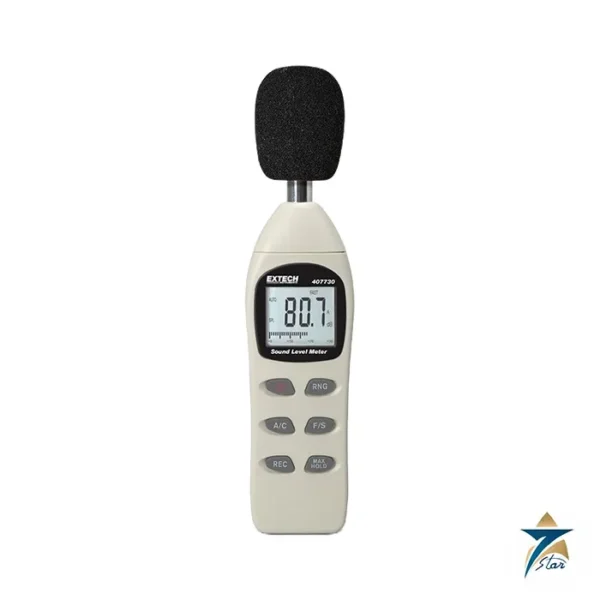
The VB400 is a screening tool. When the readings rise, an analyser with frequency spectrum is needed to identify the fault; for a datalogging meter, look at the Extech 407860.
Selection checklist for the VB400
- Confirm that the machine speeds fall within a vibration frequency range of 10 Hz to 1 kHz (600 to 60,000 rpm for the fundamental).
- Decide whether velocity and acceleration RMS values are enough, or whether spectrum analysis is needed.
- Check that the surfaces are ferrous for the magnetic base or use the test pin tip.
- Consider an IP65 housing suitable for dusty and damp areas.
- Plan to keep a table of baseline readings for each machine.
Measurement practice and care with the VB400
Always measure at the same points on each machine, with the same orientation, and mark the points with paint so that readings are repeatable. Press the sensing head firmly and perpendicular to the surface, because a tilted probe lowers the reading. Avoid measuring on thin covers or guards that resonate. Zero the meter in a quiet position before use, replace the AAA batteries when the indicator shows, and keep the sensing head free from oil and dirt. Store the VB400 in its pouch.
Applications of the VB400 in Oman and the GCC
Pumps, compressors and cooling-water fans run for long periods in high ambient temperatures in Oman and the GCC, which accelerates bearing wear. Plant maintenance teams in oil and gas, power and desalination facilities use pen vibration meters for weekly rounds, building a record that shows a trend long before a failure. The IP65 housing copes with dust and washdown, and the pen format fits in a coverall pocket.
Setting alert levels from baseline readings
Alert levels are best set from your own data. After installation and alignment, take a set of readings on each bearing when the machine is in good condition, and record the machine load. A common practice is to define a level at which the reading is investigated and a higher level at which the machine is scheduled for repair, using the manufacturer’s guidance or a recognised severity chart for the class of machine. Review the levels when the load or the mounting changes.
Information to send with an RFQ for the VB400
- Part number VB400 and the required quantity
- Machine types and speed range to be checked
- Spare tips or magnetic bases, and whether a calibration certificate is required
- Delivery location in Oman or the GCC and the required lead time
- Whether calibration documentation or a traceable calibration certificate is required
Documents and quotation
A datasheet for the Extech VB400 is attached on this page. It lists the measuring ranges, frequency range and accuracy.
Send us the part number VB400, the quantity and the delivery location in Oman or the GCC, and we will reply with availability and a quotation. Seven Star LLC is an independent supplier in Muscat and is not affiliated with the manufacturer.



















Reviews
There are no reviews yet.