- Automation & ControlView all 3,096 products
- Automation Accessories
- AC Drives
- PLC & I/O Cards
- Industrial Communications
- Vibration Monitoring
- Isolator & Barrier
- Controllers & Data Acquisition
- Safety Switches & Guard Locking
- Encoders
- Motor Soft Starters
- CCTV & Security
- Pneumatic Cylinders
- HMI Displays
- Servo Drives
- Industrial Computers
- Machine Vision
- Automation Software
- Robotics
Brand: SICK
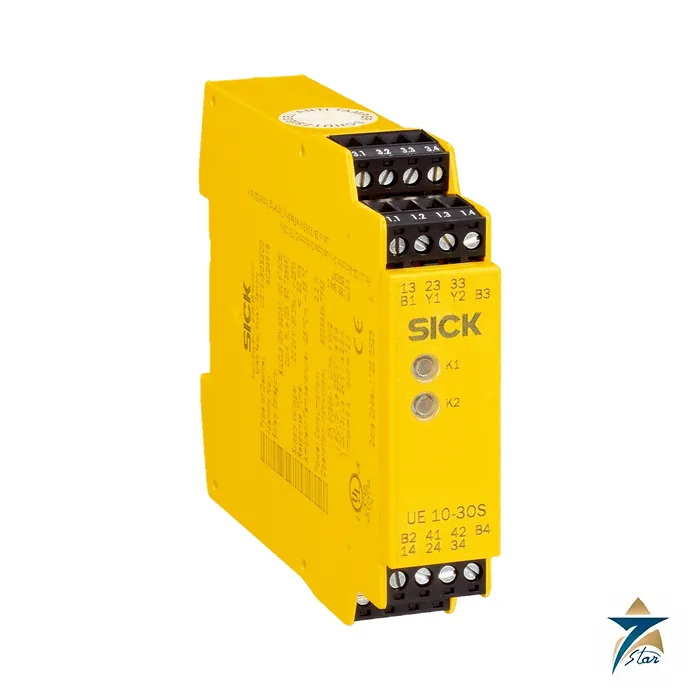
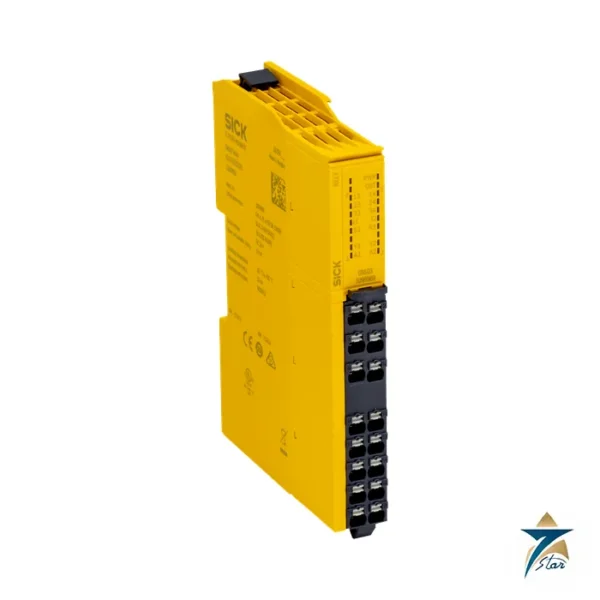
SICK UE10-3OS2D0 Safety Relay, 3 N/O Enabling Contacts, 24 V DC
Description
Overview
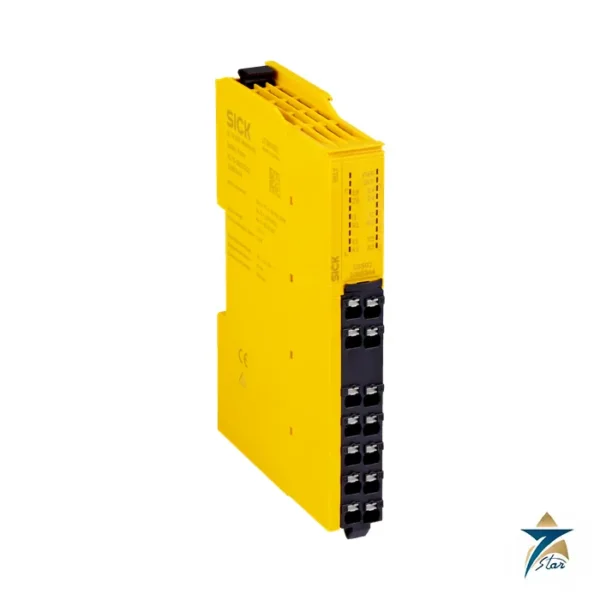
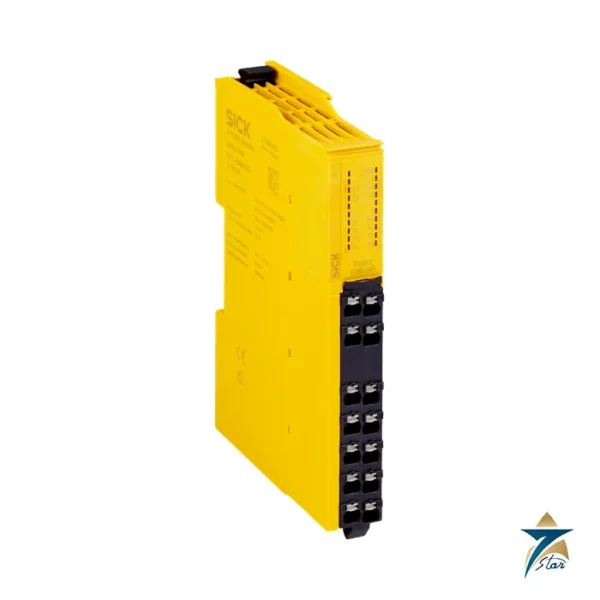
The SICK UE10-3OS2D0 is a safety relay module in a narrow 22.5 mm housing. It provides three positively driven normally open enabling contacts that are relevant for safety, one normally closed signaling contact and one normally closed feedback contact for external device monitoring. In plain terms it is a compact block that switches the load circuits of a machine safely when its 24 V DC input coil is de-energised by an emergency stop, guard door or safety controller.
The safety data are strong for such a small device: SIL 3 under IEC 61508, Category 4 and Performance Level e under EN ISO 13849, with a mean probability of dangerous failure of 3.0 x 10 to the minus 8 per hour and a mission time of 20 years. The data sheet adds the condition that these values apply when the feedback path Y1-Y2 is monitored by an appropriate main unit, so the module is normally operated together with a suitable evaluating device.
Seven Star LLC is an independent supplier serving Oman and the GCC. This page uses the manufacturer data for part number 6024917.
Contact ratings and switching capacity of the SICK UE10-3OS2D0
The three enabling paths 13/14, 23/24 and 33/34 switch from 10 V AC up to 230 V AC or from 10 V DC up to 300 V DC at currents between 5 mA and 6 A, and the total current through the module must stay at or below 12 A. The signaling path 41/42 has the same voltage and current window but is not safety-relevant, and the feedback path Y1/Y2 is meant for 10 V DC to 24 V DC at 5 mA to 100 mA.
Rated operating currents depend on duty. At 230 V AC the module allows 4 A at 360 switching cycles per hour or 3 A at 3,600 cycles per hour; at 24 V DC it allows 4 A at 360 cycles per hour or 2.5 A at 3,600 cycles per hour, all under usage category AC-15 and DC-13 of EN 60947-5-1. Contacts are a silver alloy with gold flash, which keeps low-level switching reliable, and the relay contacts have a mechanical life of 1 x 10 to the 7th and an electrical life of 2 x 10 to the 6th switching cycles.
Technical specifications of the SICK UE10-3OS2D0
| Parameter | Value |
|---|---|
| Type / part number | UE10-3OS2D0 / 6024917 |
| Safety integrity level | SIL 3 (IEC 61508) |
| Category / Performance level | Category 4 / PL e (EN ISO 13849) |
| PFHD | 3.0 x 10 to the minus 8 per hour |
| Mission time | 20 years |
| Input voltage | 24 V DC (15 V to 30 V) |
| Input current | 500 mA or less |
| Power consumption | 2.4 W (DC) |
| Response time | 20 ms or less |
| Enabling current paths | 3 N/O, positively driven, safety-relevant |
| Signaling current path | 1 N/C, not safety-relevant |
| Feedback current path | 1 N/C for external device monitoring |
| Contact material | Silver alloy, gold flashed |
| Switching voltage (enabling) | 10 to 230 V AC, 10 to 300 V DC |
| Current loading | 5 mA to 6 A per path, total up to 12 A |
| Usage category | AC-15 / DC-13 (EN 60947-5-1) |
| Rated insulation voltage | 300 V AC |
| Rated impulse withstand voltage | 4 kV |
| Overvoltage category | III |
| Contamination rating | 3 (EN 50178) |
| Dimensions (W x H x D) | 22.5 mm x 114 mm x 96.5 mm |
| Weight | 0.2 kg |
B10d values depend on the load: 1.26 x 10 to the 6th cycles at 230 V AC and 1.5 A, 5.9 x 10 to the 6th at 230 V AC and 0.75 A, 4.35 x 10 to the 5th at 24 V DC and 2.5 A, and 1 x 10 to the 7th at 24 V DC and 0.63 A. Use the value that matches the actual load when calculating the Performance Level of a complete safety function.
Wiring and integration advice for UE10-3OS2D0
Supply the coil through terminals B1-B2 or B3-B4 with a stabilised 24 V DC source. Where the output circuit exceeds 25 V AC or 60 V DC, the data sheet requires a PELV arrangement; below those levels PELV or SELV may be used. Connect the normally closed contacts of each downstream contactor into the Y1-Y2 feedback path so that a welded contact prevents re-enabling, because that is the external device monitoring on which the stated category depends.
Keep each enabling contact in series with a separate contactor or a separate load line where possible, and fuse the output paths in line with the 6 A per path and 12 A total limits. The module snaps onto a standard DIN rail and the 22.5 mm width lets several be mounted side by side with ample room for wiring.
How UE10-3OS2D0 differs from other UE10 relays
The UE10 range includes variants with different contact numbers and supply options. The SICK UE10-3OS2D0 is the type with three enabling N/O contacts, one N/C signaling contact and a feedback path, fed with 24 V DC. A version with two enabling paths provides fewer safety contacts, and a unit with different coil voltage cannot be driven from a 24 V DC control supply. Confirm the number 6024917, because relay modules with similar names exist.
Do not assume that a different contact configuration is interchangeable: the wiring of the terminals, the response time and the rated currents all depend on the exact type code.
Typical applications in Oman and the GCC
This relay is a typical component in emergency stop circuits for pumps, compressors, conveyors and packaging machines. In oil and gas workshops and fabrication yards it serves as the output stage of guard door monitoring on machine tools and presses. Water treatment plants use it to remove power from dosing and mixing equipment when a maintenance cover is opened.
Panel builders in Oman value the narrow body because control cabinets are crowded; one module gives three safe contacts in 22.5 mm of rail space.
Testing and maintenance of the UE10-3OS2D0
Test the safety function at commissioning and at periodic intervals: operate the emergency stop, confirm that all enabling contacts open, and verify that the machine cannot restart until the reset sequence is complete and the feedback contacts are closed. Contact life depends on load, so compare the actual switching frequency against the electrical life of 2 x 10 to the 6th cycles and replace the relay before that figure is reached.
Keep dust and humidity out of the control cabinet: the contamination rating is 3 under EN 50178. After a short circuit or an overload event that welds contacts, replace the module rather than attempting repair.
Related items you may also need: SICK IME30-38NNSZC0S M30 Inductive Sensor, 38 mm Triple Range | SICK WL4SL-3P2232 W4 Retro-Reflective Sensor | SICK UC30-215163 UC30 Ultrasonic Sensor | All SICK products.
Documents and quotation
The manufacturer data sheet for the SICK UE10-3OS2D0 is attached to this page and carries the dimensional drawing and the full list of electrical data.
Send your RFQ with the part number UE10-3OS2D0, the quantity and the delivery location in Oman or the GCC. Seven Star LLC will check availability of the SICK UE10-3OS2D0 and can quote the matching main unit or terminal accessories on the same request.
Datasheets & Documents
- Datasheet SICK UE10-3OS2D0 Safety Relay, 3 N/O Enabling Contacts, 24 V DC Datasheet Download
Reviews (0)
How would you rate this product? Cancel reply
About brand
SICK is the German maker of industrial sensors: photoelectric and proximity sensors, safety laser scanners and light curtains, encoders, distance sensors, code readers and gas analysers. Erwin Sick, an optics engineer, founded it in Munich in 1946, and in 1952 it introduced its first marketable accident-prevention light curtain, which protected press operators by stopping the machine when a hand broke the light beam. The company moved to Waldkirch in the Black Forest in 1956 and is still headquartered there. It is a privately held company, and has been an Aktiengesellschaft (AG) since 1996.
SICK company profile
| Founded | 1946, Munich, Germany, by Erwin Sick (1909–1988) |
|---|---|
| Headquarters | Waldkirch, Baden-Württemberg, Germany (since 1956) |
| Ownership | Privately held; after the founder's death in 1988 his widow Gisela Sick became the main shareholder. Legal form SICK AG since 1996 |
| Size | More than 12,000 employees and group revenue of about EUR 2.3 billion (company figures for 2023) |
| First breakthrough | Accident-prevention light curtain for presses, shown in Hanover in 1952 |
| International growth | First foreign subsidiary in France in 1972, United States in 1976; today sales and service companies worldwide |
| Product families | Photoelectric, inductive, capacitive, magnetic and ultrasonic sensors; safety laser scanners, light curtains, safety controllers and relays; encoders and motor feedback systems; distance sensors and LiDAR; barcode and 2D code readers and machine vision; gas analysers, dust and flow measurement for process and emissions monitoring |
Milestones
- 1946: Erwin Sick receives a licence to run his engineering firm in Munich.
- 1952: The first marketable accident-prevention light curtain is presented in Hanover and goes into series production.
- 1956: The company moves to Waldkirch with 25 employees.
- 1972 and 1976: Subsidiaries are founded in France and the United States.
- 1996: SICK becomes an Aktiengesellschaft.
- Today: Sensors for factory and logistics automation, machine safety and process analysis, with a large share of revenue outside Germany.
Choosing a SICK sensor
For object detection, the sensing principle comes first. A retro-reflective sensor (WL series) sends light to a reflector and switches when an object breaks the beam; it is reliable over long distances and easy to align. A sensor with background suppression (WTB series) detects an object at a set distance and ignores what is behind it, which suits conveyors with shiny or dark backgrounds. A through-beam pair (WS/WE) gives the longest range and the highest reliability in dust. For transparent bottles and film, use a model built for transparent objects (for example WL12G-3B or WL150-P420). The digits in the code also matter: "P" usually means a PNP output and "N" NPN, and the last digits set the connector or cable. For machine guarding, a safety laser scanner such as nanoScan3 or microScan3 protects an area, while a safety controller such as Flexi Soft combines several safety devices.
Where SICK products are used
In Oman and the GCC, SICK sensors are used in packaging and bottling lines, food and beverage plants, logistics and airport baggage handling, cement and steel plants, ports and cranes, automated warehouses, and on machines built by European OEMs. SICK safety scanners guard robots and automated guided vehicles, and its encoders give position feedback on motors, hoists and conveyors.
SICK products we list
| Family | Examples |
|---|---|
| Photoelectric sensors | WL12-3P2431, WTB12-3P2431, GTB6-P4211, VL18-4P3240, WL12G-3B2531, WS/WE100, KT5W contrast, W26 IO-Link |
| Proximity, cylinder and ultrasonic sensors | IME12-08NPSZC0S, IME18-05BPSZC0S, MZT8, UM18 4-20 mA, UM30, UFN3 fork |
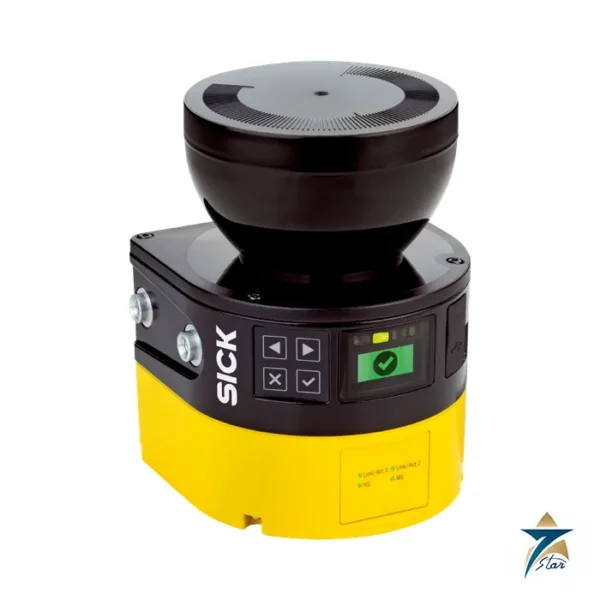
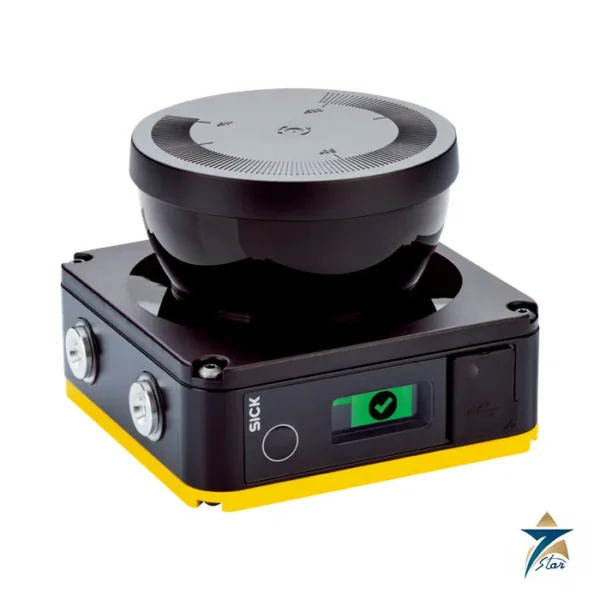
| Machine safety | nanoScan3, microScan3, S300 Professional, Flexi Soft FX3-CPU1, FX3-XTIO, ReLy OSSD |
| Encoders and motor feedback | DFS60B, AFM60 PROFINET, AFS60 SSI, ATM60 PROFIBUS, SRS50, EFS50 |
| Distance sensors and code readers | DT50, DL50, DT35, Lector632 |
Ordering SICK products: what we need
Send the type code and the 7-digit SICK part number from the label (for example WTB12-3P2431 together with its part number). For a replacement sensor, add the output (PNP or NPN), connection (M8, M12 or cable) and sensing distance. For encoders, add the interface (incremental, SSI, PROFIBUS, PROFINET), resolution and shaft type. For safety scanners, tell us the model and whether the existing configuration needs to be kept.
Frequently requested SICK models: SICK WTB4-3 Miniature Photoelectric Proximity Sensor, SICK IME18-08NPSZW2K Inductive Proximity Sensor, SICK DT35-B15251 Laser Distance Sensor, SICK microScan3 Safety Laser Scanner, SICK RZT7-03ZUS-KWB T-Slot Cylinder Sensor.
Facts checked against SICK's published company history and annual figures, October 2026.
Browse SICK products by category: Sensors & Transmitters.
FAQ
Questions about the SICK UE10-3OS2D0 Safety Relay, 3 N/O Enabling
Answers from our engineering team on installation, compatibility and integration.
01What safety rating does the UE10-3OS2D0 have?
It is rated SIL 3, Category 4 and Performance Level e, with PFHD of 3.0 x 10 to the minus 8 per hour when the Y1-Y2 feedback path is monitored by a suitable main unit.
02How many contacts does the UE10-3OS2D0 provide?
It provides 3 normally open positively driven enabling contacts, 1 normally closed signaling contact and 1 normally closed feedback contact for external device monitoring.
03What supply does the UE10-3OS2D0 need?
The input is 24 V DC within 15 V to 30 V, drawing 500 mA or less, with a power consumption of 2.4 W.
04What load can the UE10-3OS2D0 switch?
Each enabling path switches 5 mA to 6 A at up to 230 V AC or 300 V DC, with a total current limit of 12 A and usage category AC-15 and DC-13.
05How wide is the UE10-3OS2D0?
The housing is 22.5 mm wide, 114 mm high and 96.5 mm deep, and weighs 0.2 kg.


Reviews
There are no reviews yet.