Overview
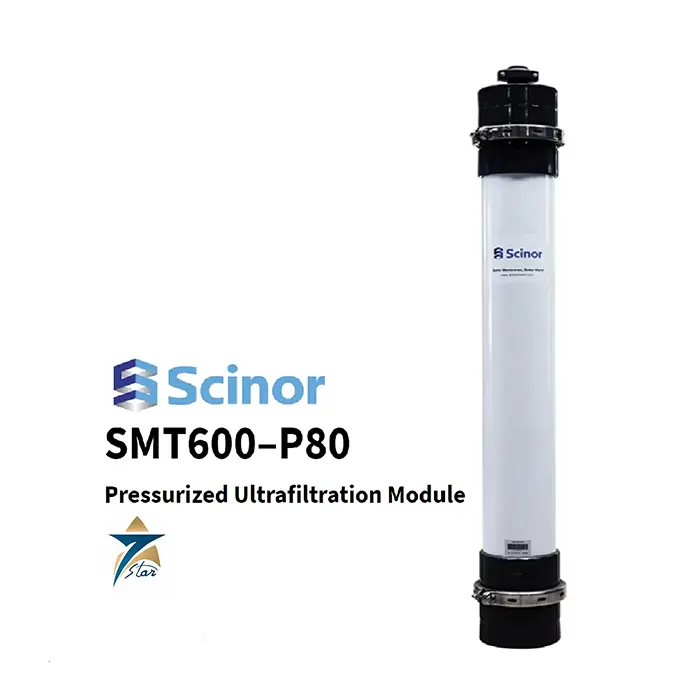
The Scinor SMT600-P80 is a pressurized hollow-fiber ultrafiltration module from the Scinor SMT600 series. It uses PVDF membranes produced by Thermally Induced Phase Separation (TIPS) and provides 80 m² of effective membrane area per module, which makes it suitable as a building block for large water treatment plants.
The module operates outside-in, in dead-end or cross-flow mode depending on the application, and is cleaned by backwash, air scour, maintenance clean and clean-in-place (CIP). Scinor states that the SMT600-P80 is available as a retrofit for installations built around other major membrane suppliers’ modules. It is used for potable water, wastewater reuse, desalination pretreatment and industrial water.
Key Features
- TIPS PVDF hollow fibers with 0.1 µm nominal pore size
- 80 m² (861 ft²) effective area in one pressurized module
- Outside-in flow configuration, dead-end or cross-flow operation
- Sodium hypochlorite tolerance up to 5000 mg/L
- Filtered water turbidity ≤0.1 NTU and SDI ≤3
- Certified to NSF/ANSI 61 and NSF/ANSI 419
Technical Specifications
| Parameter |
Value |
| Part number |
SMT600-P80 |
| Fiber material |
PVDF (TIPS), hollow fiber |
| Effective area |
80 m² (861 ft²) |
| Nominal pore size |
0.1 µm |
| Fiber ID / OD |
0.7 mm / 1.3 mm |
| Dimensions |
Ø225 mm x 2360 mm |
| Port size |
DN50 |
| Housing / head material |
U-PVC / ABS |
| Potting material |
Epoxy resin |
| Operating temperature |
1–40 °C |
| pH range |
1–11 continuous; 1–13 CIP |
| Max. NaClO |
5000 mg/L |
| Backwash flux |
50–120 L/m²h (30–70 gfd) |
| Air scour flow |
5–12 Nm³/h per module |
| Max. feed pressure |
0.4 MPa (60 psi) |
| Operating / max. TMP |
0.02–0.15 MPa / 0.3 MPa |
| Max. backwash and air scour pressure |
0.25 MPa (36 psi) |
| Filtered water quality |
Turbidity ≤0.1 NTU; SDI ≤3; E. coli non-detect |
Applications
- Pretreatment ahead of seawater and brackish water reverse osmosis in desalination plants
- Municipal drinking water treatment
- Tertiary treatment and reuse of municipal and industrial wastewater
- Process and utility water for oil & gas, power and petrochemical facilities
- Replacement of modules in existing ultrafiltration trains
Why Seven Star LLC
Seven Star LLC supplies Scinor ultrafiltration modules to water treatment customers across Oman and the GCC. Before quoting a replacement, we confirm the module dimensions, port arrangement and operating conditions of your existing rack so that the supplied modules fit the installation.
Request a Quote for Scinor SMT600-P80 – Pressurized Ultrafiltration Module
Send your request through our inquiry form with the part number, number of modules, feed water type and whether the modules replace an existing brand in a current rack. Seven Star LLC will confirm the configuration and return a quotation for delivery in Oman and the GCC.
How the SMT600-P80 Ultrafiltration Module Works
In an outside-in pressurized module, feed water fills the shell side around thousands of hollow fibers. The applied pressure drives water through the fiber wall into the fiber lumen, while particles, colloids, bacteria and most suspended solids larger than the membrane pores are retained on the outer surface. Filtrate is collected from the fiber lumens at the module head. In dead-end mode all feed water passes through the membrane and the retained solids are removed periodically; in cross-flow mode part of the feed is circulated along the fiber surface to limit the build-up of solids, which suits feed water with a higher solids load.
Over each filtration cycle the solids layer increases the transmembrane pressure (TMP). The cycle ends with a backwash, in which filtrate is pushed back through the fibers from the inside, often combined with air scour on the shell side to shake loose deposits. Maintenance cleans with a low concentration of chemical, and full clean-in-place with acid and alkaline or oxidising solutions, restore permeability when backwashing alone is no longer enough. The wide pH and hypochlorite tolerance of TIPS PVDF fibers is what makes these chemical cleans possible without damaging the membrane.
SMT600-P80 Selection & Design Notes
- Feed water quality: turbidity, suspended solids, organic load, oil and grease and temperature determine the design flux and cleaning frequency. Seawater intakes affected by algal blooms need a more conservative design.
- Pre-screening: a fine strainer upstream of the rack protects the fibers from abrasive or sharp particles.
- Number of modules: plant capacity divided by the design flux and the 80 m² area per module gives the active module count; add allowance for backwash downtime and for one train out of service during cleaning.
- Retrofit: when replacing modules from another supplier, compare overall length, port positions and connection type with the existing rack before ordering.
- Integrity: plan a regular pressure-decay or similar integrity test to detect broken fibers, especially where the filtrate feeds reverse osmosis or drinking water.
Installation & Maintenance
New modules are usually shipped wet with a preservation solution; flush them to drain before putting the filtrate into service, and keep the fibers wet at all times once they are installed. Avoid water hammer and pressure surges when starting pumps and opening valves, and keep feed, backwash and air pressures inside the limits in the specification table. Trend TMP, flux and filtrate turbidity: a steady rise in TMP after cleaning points to irreversible fouling or an undersized pretreatment step.
Typical Applications in Oman & the GCC
Ultrafiltration is widely used ahead of seawater reverse osmosis in the region, where it gives a more stable RO feed than conventional media filtration during periods of poor intake water. It is also used for treated sewage effluent reuse, produced water polishing and industrial process water. Seven Star LLC supplies the Scinor SMT600-P80 across Oman and the GCC; send your feed water analysis and rack drawing and our team can help confirm the module configuration.
Related Products




















Reviews
There are no reviews yet.