A light steel V-bank box filter for high-airflow air handling units
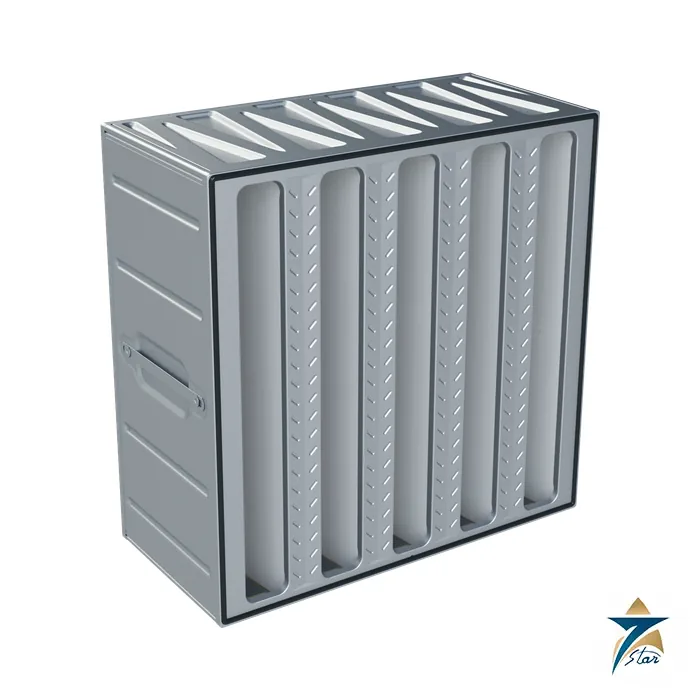
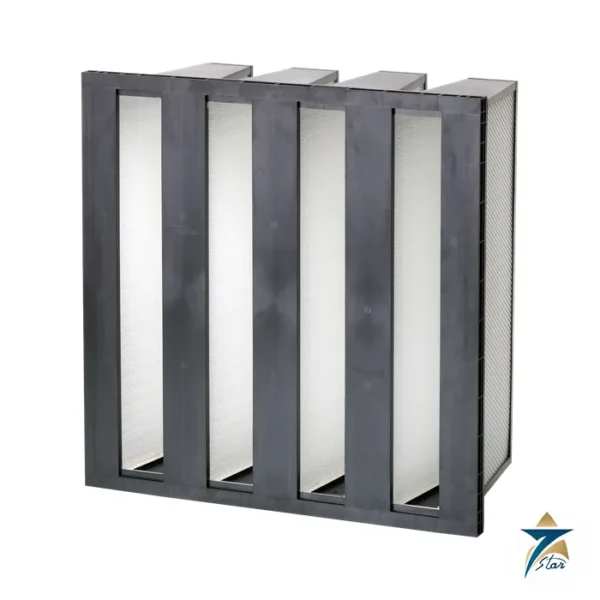
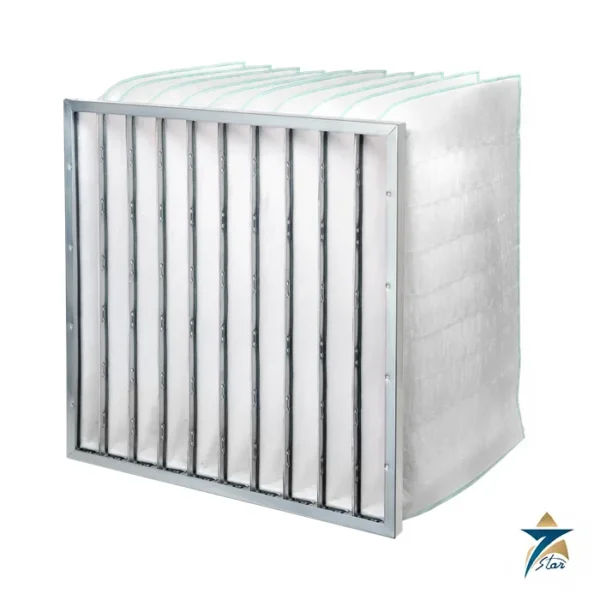
The Camfil Opakair OPE-0170-610x610x292-P0-2HH is a compact fine filter built as a V-bank inside a galvanised steel box. Camfil calls it the lightest V-bank steel box filter in the industry, aimed at air handling systems with high airflows, and states that it runs at very high velocity (up to 3.5 m/s) and is optimised for bag-in bag-out safe change.
This is the F8 / ePM1 70% type in the full 610 x 610 mm face and 292 mm depth, with a nominal airflow of 4,500 m3/h, 22 m2 of glass fibre media and only 9 kg weight. At that airflow the media area is about 205 m3/h per m2 (derived), and the sheet prints 120 Pa initial pressure drop.
Datasheet advantages
- Strong and airtight frame; most convenient handling.
- Lightest V-bank steel box filter in the industry (Camfil statement).
- Designed for very high velocity, up to 3.5 m/s.
- Optimised for bag-in bag-out safe change.
- Glass fibre media with hot-melt separators, polyurethane gasket and sealant, galvanised steel frame.
Technical specification
| Parameter |
Value |
| Type code |
OPE-0170-610x610x292-P0-2HH |
| EN 779 / ISO 16890 |
F8 / ePM1 70% |
| Dimensions W x H x D |
610 x 610 x 292 mm |
| Nominal airflow |
4,500 m3/h |
| Initial pressure drop |
120 Pa |
| Media area |
22.0 m2 |
| Weight |
9 kg |
| Frame |
Galvanised steel |
| Gasket / sealant |
Polyurethane / polyurethane |
| Media / separator |
Glass fibre / hot-melt |
| Max airflow |
1.1 x nominal flow |
| Max temperature |
70 degC |
| Relative humidity |
Max 100% |
| Recommended final pressure drop |
Initial + 100 Pa or initial x 3 if lower (EN 13053) |
Opakair types on the sheet
| Type |
Class |
Airflow |
Initial pressure drop |
| OPE-0155-610x610x292-P0-2HH |
F7 / ePM1 55% |
4,500 m3/h |
110 Pa |
| OPE-0170-610x610x292-P0-2HH (this page) |
F8 / ePM1 70% |
4,500 m3/h |
120 Pa |
| OPE-0180-610x610x292-P0-2HH |
F9 / ePM1 80% |
4,500 m3/h |
130 Pa |
| OPE-1070-610x610x292-P0-2HH |
M6 / ePM10 70% |
4,500 m3/h |
100 Pa |
| OPE-0170-610x305x292-P0-1HW |
F8 / ePM1 70% |
2,050 m3/h |
120 Pa |
The code appears to encode class, face size, depth, and a suffix for the frame arrangement (2HH for the full size, 1HW for the half-height size); the datasheet page we fetched does not define the suffix, so confirm P0 and 2HH on the enquiry rather than assuming.
Why the 1.1 times airflow limit matters
The sheet permits only 1.1 x nominal airflow, against 1.25 x for the bag filters. For this unit that is a ceiling of 4,950 m3/h (derived). Do not size a bank on overload: at the nominal 4,500 m3/h the pressure drop is already 120 Pa and rises faster for V-banks.
The recommended final pressure drop is 220 Pa (120 + 100, derived).
Installation notes
The Opakair is meant for bag-in bag-out systems, in which the filter is changed through a sealed bag to protect staff. If you do not use a BIBO housing, a standard holding frame with sealing is needed. Camfil emphasises convenient handling and a low weight of 9 kg for this size.
What to send with an Opakair enquiry
- Full type string and quantity.
- Face velocity and airflow per filter (nominal 4,500 m3/h, maximum 4,950 m3/h derived).
- Whether the housing is bag-in bag-out.
- Required class and efficiency basis (F8 / ePM1 70% here).
- Target final pressure drop, 220 Pa derived from the sheet.
Opakair is built around galvanised steel and glass fibre media, so request disposal guidance if used in contaminated service.
Reading the Opakair code and class
The code begins OPE, continues with a four-digit class block (0170 here, which the table links to F8 and ePM1 70%), then face width x height x depth in millimetres, then P0 and a frame or handling suffix (2HH). The half-height versions in the table end with 1HW. Class blocks printed on the sheet are 1070 (M6, ePM10 70%), 0155 (F7, ePM1 55%), 0170 (F8, ePM1 70%) and 0180 (F9, ePM1 80%).
All 610 x 610 versions deliver 4,500 m3/h with 22.0 m2 of media and weigh 9 kg; only the resistance changes from 100 Pa (M6) to 110, 120 and 130 Pa for the three fine grades. The class therefore changes the energy cost, but not the size, flow or weight, which makes a swap between grades straightforward mechanically.
Typical use
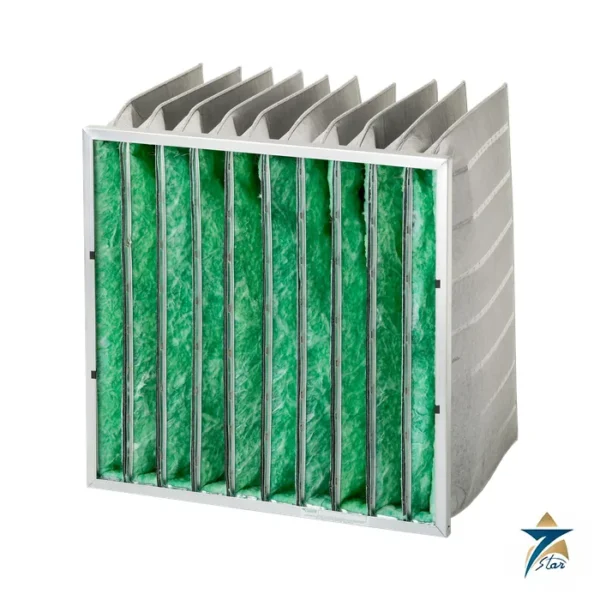
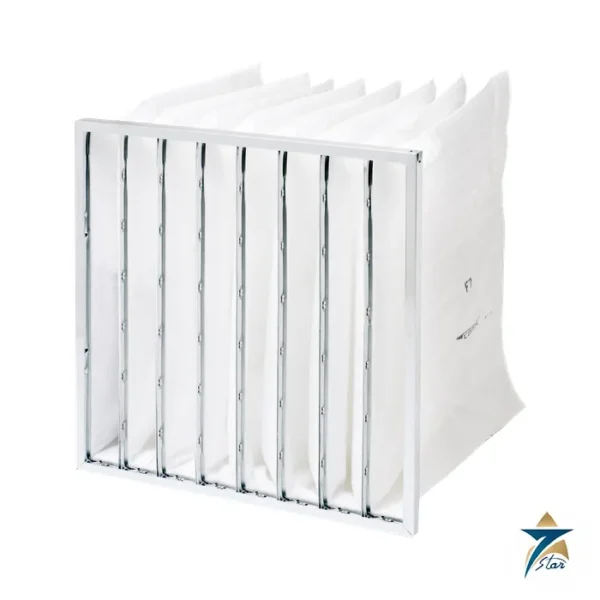
Final filtration in AHUs with high airflow, such as shopping malls, airports and large offices, fits the application statement on the sheet. For a lower-resistance but deeper option see Camfil bag filters on the site; for HEPA stages see other filtration elements.
Fitting and replacement notes
The Opakair is designed for a bag-in bag-out change, so check that the housing supports that arrangement if the filtered air is hazardous. Install it with the V-bank in the correct airflow direction, seal the frame to the housing and record the initial pressure drop of 120 Pa at nominal airflow, which gives the baseline for replacement decisions.
Information needed for a quotation
Send the full filter code, the quantity, the housing or frame type it must fit, the delivery location in Oman or the GCC and any prefilters or accessories, so that the complete filter set can be quoted together.
Documents and supply information
The manufacturer data sheet is attached to this page and should be read together with the project specification before a purchase is confirmed. Filter class, airflow, pressure drop and dimensions are quoted as printed on that sheet. Lead time, stock position and certificates available with the shipment are confirmed in the quotation, and we supply to Oman and the wider GCC region for industrial, utility and building services projects.
Frequently asked questions
What class is the OPE-0170 type? F8 under EN 779 and ePM1 70% under ISO 16890.
What airflow can it handle? 4,500 m3/h nominal, with a maximum of 1.1 x nominal.
What is the initial pressure drop? 120 Pa at nominal airflow.
What is the weight? 9 kg.
Is Seven Star LLC the manufacturer? No. Seven Star LLC is an independent supplier in Muscat; confirm the exact type, size and class with the datasheet before ordering.



Reviews
There are no reviews yet.