Brand:

Yokogawa DX2020T-3-4-2 20-Channel Touch Daqstation Recorder

Description

Yokogawa DX2020T-3-4-2 at a glance

Order string DX2020T-3-4-2
Series Yokogawa DX2000T touch Daqstation
Channels 20 universal inputs
Display 10.4-inch TFT color LCD, 640 x 480 pixels, analog resistive touch
Shortest scan 1 s; 125 ms in fast sampling mode (A/D integration fixed at 1.67 ms)
A/D integration 20 ms (50 Hz), 16.7 ms (60 Hz), 100 ms, or AUTO
Internal memory 400 MB flash (suffix -3)
External medium CompactFlash card with media (suffix -4)
Language / units English, German, French; degF and DST (suffix -2)
Case size 288 W x 288 H x 221.6 D mm; 226 mm deep with /H2 or /PM1
Weight About 6.3 kg without options
Panel thickness 2 to 26 mm, flush mounting, tilt down to 30 degrees
Supply 100 to 240 VAC, 50/60 Hz, allowed 90 to 132 or 180 to 264 VAC
Consumption at 100 VAC 28 VA LCD off, 42 VA normal, 74 VA maximum
Consumption at 240 VAC 38 VA, 54 VA and 100 VA respectively
Operating ambient 0 to 50 C, 20 to 80 percent RH between 5 and 40 C
Vibration in service 10 to 60 Hz, 0.2 m/s2 or less

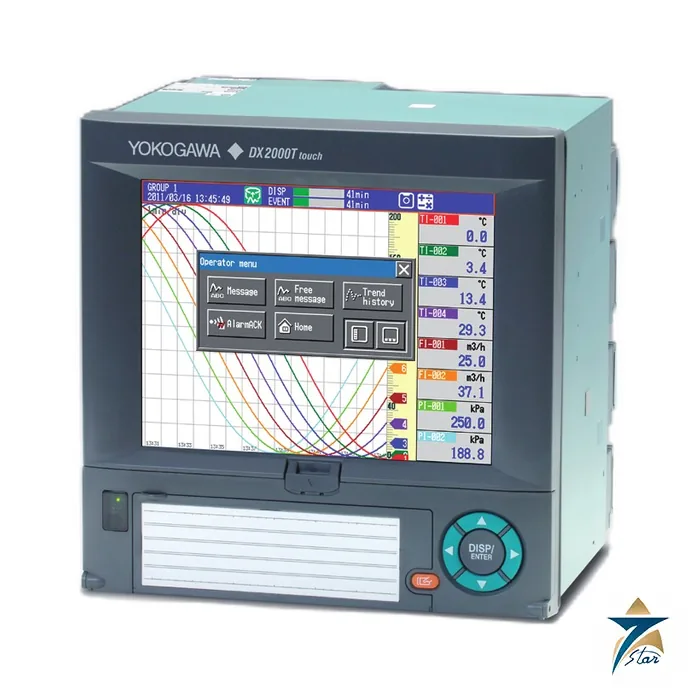
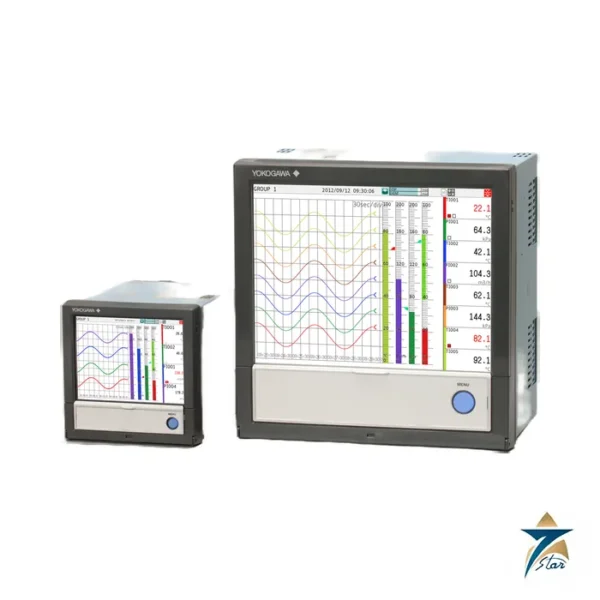
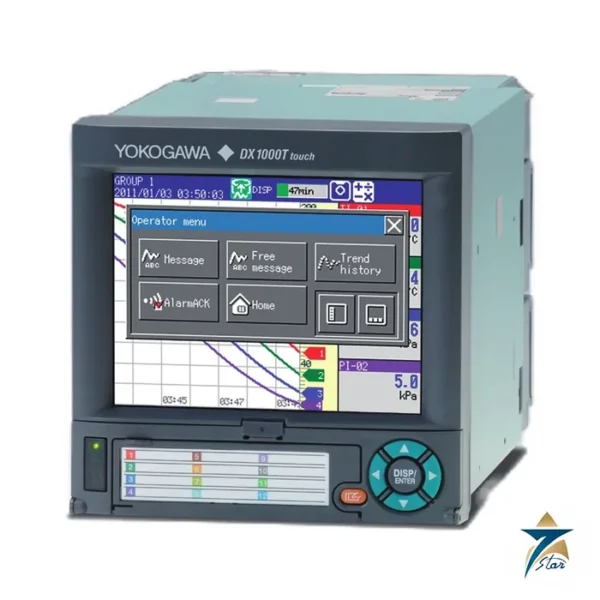
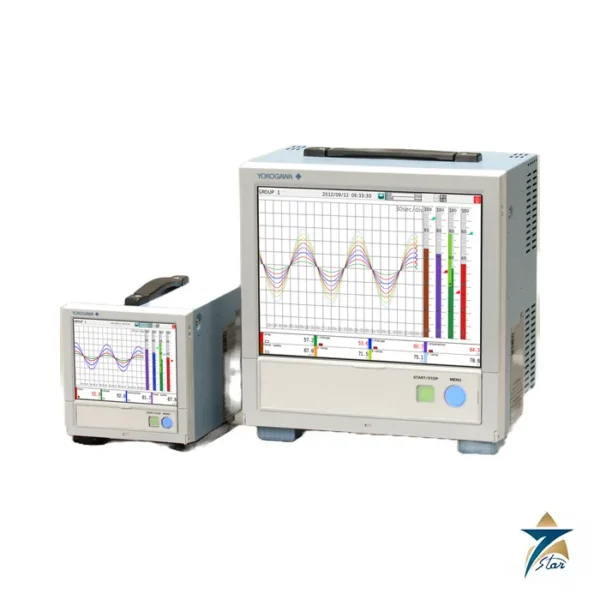
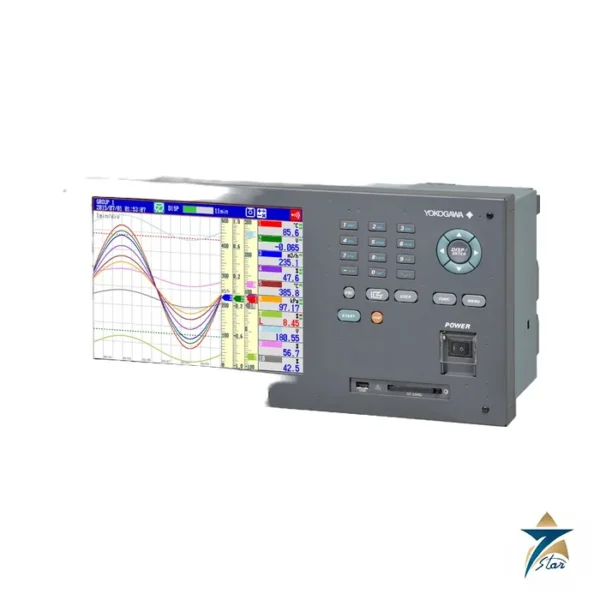
If you are searching for a roomy panel recorder, the Yokogawa DX2020T-3-4-2 is the twenty-channel member of the DX2000T touch family. It trades the compact 144 mm bezel of the DX1000T for a 288 mm square front, and the extra area is used for a 10.4-inch VGA display that can show up to ten channels per screen, with trend, digital, bar graph and circular views. Everything quoted here is taken from Yokogawa General Specifications GS 04L45B02-01EN (9th edition, April 2019).

Why the DX2020T-3-4-2 suits larger measuring groups

Twenty inputs and thirty-six configurable display groups let one DX2020T-3-4-2 cover a complete process area rather than a single loop. Each group can combine measurement and computed channels, and up to ten scales can be drawn along the trend with bar graph, green band and alarm marks. Trend direction is selectable among vertical, horizontal, landscape, horizontal-split and circular layouts, and the display register function can store up to eight display types for quick recall. Operator shortcuts such as message entry, alarm acknowledgment and the switch to trend history sit in a touch operator menu, so routine rounds need very little keypad work.

Inputs accepted by DX2020T-3-4-2

  • DC voltage: 20 mV, 60 mV, 200 mV, 2 V, 6 V, 20 V and 50 V ranges, plus a 1-5 V range with burnout upscale or downscale detection.
  • Thermocouples: R, S and B (IEC 60584-1), K, E, J, T, N, W, L, U and WRe, from minus 270 C for type N up to 2400 C for WRe.
  • RTD: Pt100 from minus 200 to 600 C and JPt100 from minus 200 to 550 C with 1 mA measuring current.
  • Digital input: TTL level (below 2.4 V is off, above 2.4 V is on) or contact closure for event recording.
  • DC current: through an external shunt resistor.
  • Computation per channel: differential between any two channels, linear scaling from minus 30000 to 30000, square root with a 0 to 5 percent low-level cut, moving average over 2 to 400 cycles.

How DX2020T-3-4-2 differs from other DX2000T variants

Within the series the channel count of the DX2020T-3-4-2 and its siblings drives most of the differences. The DX2004T and DX2008T scan at 125 ms and weigh 6.0 and 6.3 kg; from the DX2010T upward the base interval is 1 s. The DX2020T shares its 6.3 kg mass with the eight-channel unit, while the 30-channel unit is about 6.9 kg and the 40 and 48 channel models about 7.3 kg. The /N2 three-leg isolated RTD option and the /MC1 external input function are offered only on the DX2010T and larger models, so DX2020T-3-4-2 qualifies for both, whereas the four and eight channel units do not.

Memory, recording and event handling

On a DX2020T-3-4-2, data is kept in a 400 MB internal flash area and written out to the CF card either periodically or when a file is complete; a delete-oldest-file behavior for a nearly full card can be switched on or off. Event files can be tied to alarms, remote signals, timers or the USER key. A built-in alarm summary stores the latest 1000 alarms, and the message summary holds the latest 450 messages, each with a jump to the corresponding point of the trend history.

Application fit in Oman and the GCC

With a front this size, a DX2020T-3-4-2 is frequently installed on central control room panels, compressor skids and utility switchrooms where operators stand a few metres away. Typical duties for a DX2020T-3-4-2 are recording turbine bearing and winding temperatures from thermocouples and RTDs, logging cooling-water and fire-water header pressures, trending flow totals from pulse inputs, and archiving pump station data in water networks. Because the screen can be mirrored to a monitor through the optional VGA output, the same trend page can be repeated in a supervisor office.

Options that change the wiring of the DX2020T

Order codes after the slash change what the DX2020T-3-4-2 offers at its rear terminals, so decide early. The relay outputs run from /A1 (2 points) to /A5 (24 points), the /F2 code gives a fail output together with 22 alarm points, /F1 adds a fail or status relay, and all alarm and fail options are mutually incompatible in the combinations listed in the datasheet. The transmitter supply options /TPS4 and /TPS8 deliver 24 VDC for four or eight loops, but they cannot be mixed with /A5 or /F2. Communications are /C2 RS-232, /C3 RS-422A or RS-485, /CP1 PROFIBUS-DP and /USB1. For a 24 V panel add /P1; on that supply the maximum consumption is 45 VA at 24 VDC. The clamped input terminal /H2 accepts wire sizes of 0.08 to 1.5 mm2.

Commissioning checklist for DX2020T-3-4-2

  • Cut the panel opening for the DX2020T-3-4-2 288 mm bezel and verify clearance for 221.6 mm depth, or 226 mm with clamped terminals.
  • Check supply category and fusing; the unit withstands interruptions shorter than one power cycle.
  • Wire thermocouples with matching compensating cable and set burnout direction per channel.
  • Set the DX2020T-3-4-2 A/D integration to match the mains frequency, or leave it on AUTO.
  • Create DX2020T-3-4-2 display groups, tags (with tag comments) and alarm levels, then set the touch panel lock password.
  • Insert the CF card, start a test recording and confirm that the file opens in the viewer software.

Maintenance notes

On the DX2020T-3-4-2, replace the lithium memory backup battery before its roughly ten-year life ends, export the setup file to the card after each change, and clean the touch surface with a soft cloth. A calibration correction option (/CC1) is also listed. Keep the full DX2020T-3-4-2 suffix and option string on record, since a replacement must match it.

Documents and quotation

The Yokogawa datasheet GS 04L45B02-01EN is available on this page. Seven Star LLC is an independent supplier serving Oman and the GCC and is not affiliated with the manufacturer. Send an RFQ naming DX2020T-3-4-2, the option codes (for example /A5, /D5, /C3, /M1), the power cord code and the required quantity.

Datasheets & Documents
  • PDF Datasheet Yokogawa DX2020T-3-4-2 Datasheet Download
Reviews (0)

Reviews

There are no reviews yet.

How would you rate this product?

It takes about 10 seconds — just tap a star. Your email is never published.

About brand

Yokogawa is the Japanese measurement and industrial automation company behind the DPharp EJA and EJX pressure transmitters, CENTUM distributed control systems and ProSafe-RS safety systems. Tamisuke Yokogawa set it up in 1915 as an electric meter research institute in Shibuya, Tokyo. It began selling electric meters in 1917, was incorporated as Yokogawa Electric Works in 1920, and has been Yokogawa Electric Corporation since 1986. In 1975 it released CENTUM, which it describes as the world's first distributed control system.

Seven Star LLC is an independent supplier in Muscat. We list Yokogawa transmitters, flowmeters, analysers, controllers, recorders and CENTUM and ProSafe spare modules, and supply them to oil and gas, power, water and process plants in Oman and the GCC by model code.

Yokogawa at a glance

Established 1915, Shibuya, Tokyo, by Tamisuke Yokogawa with Ichiro Yokogawa and Shin Aoki
Milestones Electric meters from 1917; incorporated in 1920; CENTUM DCS in 1975; renamed Yokogawa Electric Corporation in 1986
Headquarters Tokyo, Japan
Product families Pressure and temperature transmitters, magnetic, vortex and Coriolis flowmeters, liquid and gas analysers, controllers and recorders, CENTUM VP DCS, ProSafe-RS safety systems and STARDOM controllers

Yokogawa products we list

Family Models Typical use
Pressure and DP transmitters EJA110E, EJA430E, EJA530E, EJX110A, EJX530A, EJX910A multivariable Pressure, level and DP flow measurement in process plants
Temperature transmitters YTA610, YTA710 RTD and thermocouple signals converted to 4-20 mA, HART or fieldbus
Flowmeters ADMAG AXG, ADMAG AXW, ROTAMASS TI, VY vortex, VF701 Water and conductive liquids, mass flow of hydrocarbons, steam and gas
Analysers TDLS8000 laser gas analyser, FLXA402, FLXA21 DO, E7042UD zirconia cell, K9471DS cover Combustion O2, in-situ gas analysis, pH, conductivity and dissolved oxygen
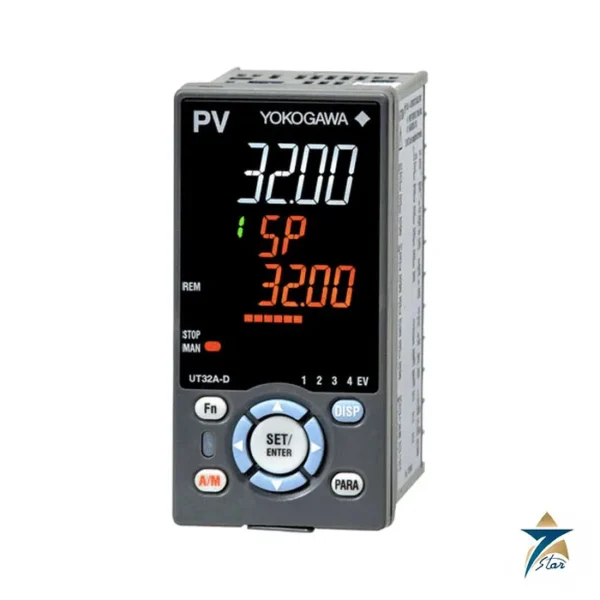
Controllers and recorders UT35A/UT32A, UT32A-D, UT55A/UT52A, UT75A, UP35A/UP32A, UP55A, YS1700, GX10/GX20, GP10/GP20, GM10, µR20000 Single-loop control, furnace programs and data recording
Control and safety systems CP451-10 processor, ADV161, ADV551, node interface unit, ProSafe-RS, ProSafe-RS Lite, ProSafe-SLS, FCN-500 Spares and expansions for CENTUM DCS, safety systems and STARDOM
Battery packs S9129FA, S9185FA, S9548FA Memory backup batteries for DCS and controller modules

The EJA and EJX transmitters use Yokogawa's DPharp sensor: two silicon resonators whose vibration frequency changes with pressure, so the output is a digital frequency rather than an analogue strain signal. The model code describes the instrument completely. In EJA110E, "110" is a differential pressure transmitter, and the letters after the dash set the span, wetted materials, process connection, electrical output and approvals. When you replace a transmitter, sending the full code from the nameplate avoids a mismatch in range or materials.

Where Yokogawa products are used

In Oman and the GCC, Yokogawa transmitters, analysers and control systems are found in oil and gas production, gas processing and LNG, refineries and petrochemical plants, power and desalination stations, and water treatment. Many plants still run CENTUM CS 3000 and CENTUM VP systems that need spare I/O modules and batteries.

Ordering Yokogawa products: what we need

Send the full model and suffix code from the nameplate (for example EJA110E-JMS5J-912NN/KF22) and the style code. For DCS modules, add the module type and system version. For analysers, send the sensor type, measuring range and process conditions.

Facts checked against Yokogawa's corporate history, October 2026.

FAQ

Questions about the Yokogawa DX2020T-3-4-2 20-Channel Touch Daqstation

Answers from our engineering team on installation, compatibility and integration.

01How many inputs does the DX2020T-3-4-2 have compared with other DX2000T models?
The DX2000T range offers 4, 8, 10, 20, 30, 40 and 48 channels. The DX2020T-3-4-2 is the twenty-channel unit, with a 1 s shortest interval and a 125 ms fast sampling mode.
02What screen does the DX2020T-3-4-2 use?
A 10.4-inch TFT color LCD at 640 x 480 pixels with an analog resistive touch panel rated for at least 100,000 operations at a load of 0.1 to 2.0 N.
03How large is the DX2020T-3-4-2 and how much does it weigh?
The case is 288 x 288 mm with a depth of 221.6 mm, or 226 mm if the /H2 or /PM1 option is specified. The twenty-channel DX2020T weighs about 6.3 kg without options.
04Which alarm output options can be added to the DX2020T-3-4-2?
Alarm relay options of 2, 4, 6, 12 or 24 points (/A1 to /A5) or the /F2 fail plus 22 alarm point option; these cannot be combined with each other, and /A5 cannot be used with /F1.
05Can the DX2020T-3-4-2 show its screen on an external monitor?
Yes, the optional /D5 VGA output gives 640 x 480 pixels on a 15-pin D-SUB (DB15HD) connector, so the trend screen can be repeated on a separate display.