Overview: High-Precision Sourcing with KROHNE SUMMIT 8800
The KROHNE SUMMIT 8800 functions as a next-generation supervisory flow computer engineered specifically to handle complex fiscal and custody transfer (CT) measurements within global midstream oil and gas infrastructures, refining facilities, and heavy chemical processing industries. In large-scale pipeline systems, high-capacity custody nodes, and offshore offloading terminals across Oman and the GCC region, total system integrity and dynamic computation accuracy are mandatory to mitigate systemic transactional financial risks. Seven Star LLC supplies this advanced processing unit as an independent vendor and technical consultant, providing a reliable channel for plant engineers who need to maintain continuous custody processing cycles. By executing multi-stream calculation matrix logic in under 0.25 seconds per cycle, the instrument ensures absolute metrological compliance while dropping overall local hardware installation costs through its highly integrated hardware footprint.
Measurement Principle and Metrological Logic
The core computational framework of the device relies on real-time multi-variable integration and algorithmic density reduction following international metrological standards. The processor concurrently captures input streams from field-mounted flowmeters, pressure instrumentation, temperature devices, and gas chromatographs via highly isolated analog or digital networks. For gas streams, the internal computing matrix dynamically calculates real-time compressibility factors using AGA8, ISO 12213, or GERG-2008 algorithms to convert raw volumetric values into exact mass or standard reference conditions. For liquid applications, the unit integrates API MPMS chapters and ASTM D1250 tables to perform automated compensation for pressure and temperature effects on density. This advanced calculation topology eliminates processing delays, ensuring that totalized flow energy and mass metrics are updated down to 0.25-second windows, preventing cumulative calculation drift across high-volume pipeline custody systems.
Engineering Design and Redundancy Architecture
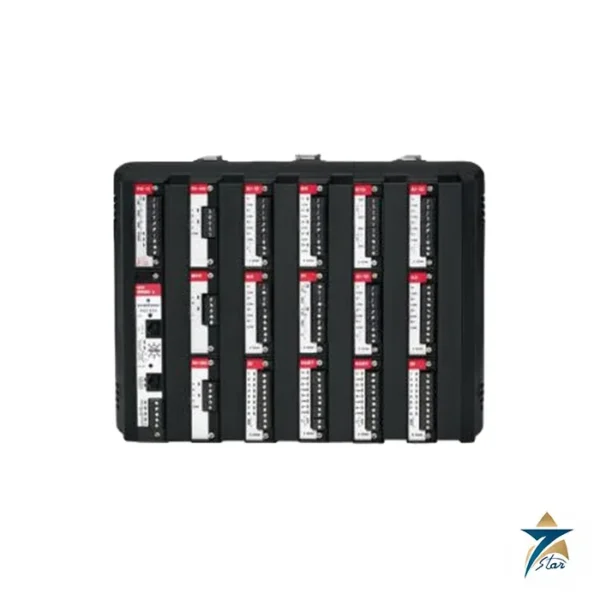
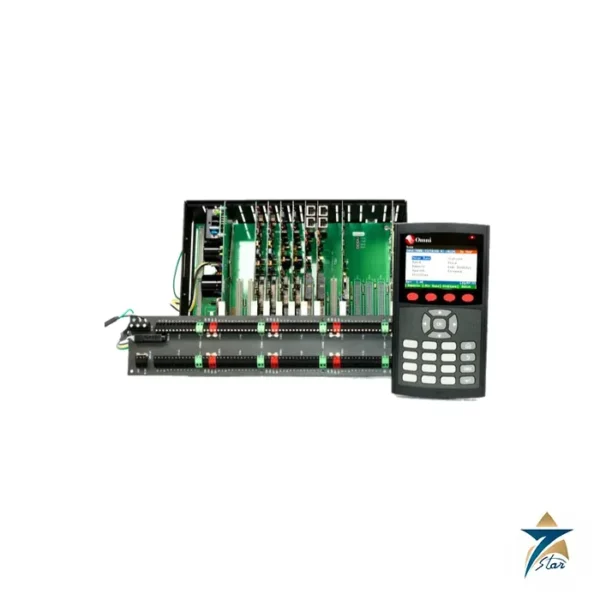
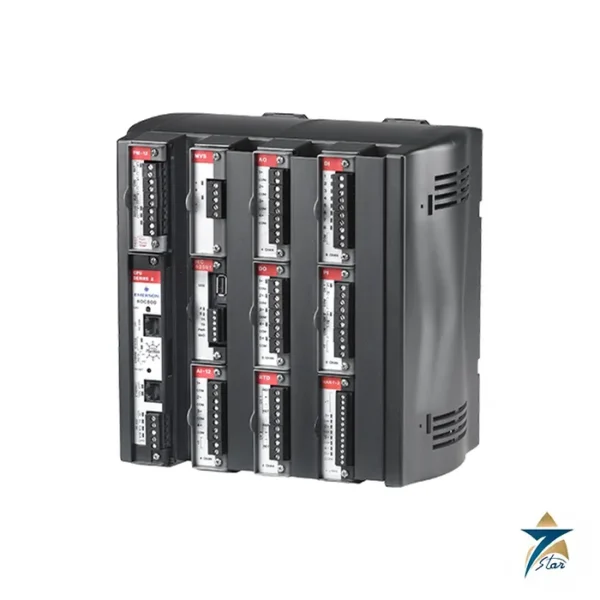
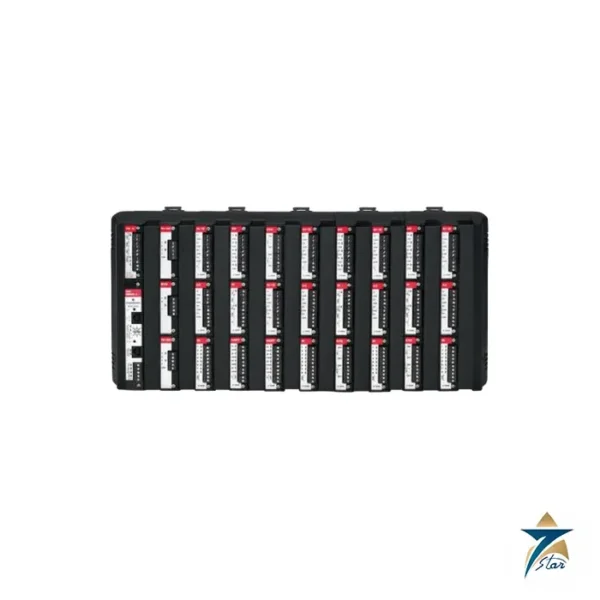
The structural configuration of the computer is centered on modular versatility and absolute operational safety within secure control room racks. Housed within a rugged 19-inch panel-mount or rack-mount enclosure, the chassis incorporates six expandable card slots that can be loaded with application-specific run boards or communication modules. Each slot-in I/O board is equipped with an independent onboard microprocessor to distribute processing loads and eliminate central CPU failure points. The front interface features a highly intuitive 5.7-inch full-color graphical touchscreen combined with a unique “twist and click” rotary optical navigation dial for rapid onsite configuration. For mission-critical installations, the platform supports a dual-redundant duty-standby network layout over independent Ethernet ports, guaranteeing that communication issues on one node do not degrade master fiscal tracking operations. Long-term compliance logging is managed via a high-capacity internal 64MB non-volatile memory block paired with a removable 4GB industrial SD card designed to store extensive metrological audit trails for decades of operation.
Key Features of the SUMMIT 8800 System
The modular computing platform delivers an exhaustive suite of technical advantages optimized for professional B2B process automation and commercial energy exchange:
-
High-speed dynamic processing executing complete multi-variable metrological equations within 0.25 seconds per fiscal stream.
-
Up to 5 different meter types combined in one flow computer, allowing liquid and gas lines to be processed simultaneously.
-
Wide input protocol versatility accepting direct pulses, analog 4-20mA loops, HART communications, and serial Modbus RTU or TCP arrays.
-
Compliance with major international standards including OIML, ISO, API, AGA and GOST.
-
Comprehensive performance monitoring software that tracks transmitter health, reducing the logistical necessity for manual calibration sequences.
-
Segregated multi-level authorization security layers that completely separate fiscal data records from common routine maintenance logging paths.
Industrial Applications across the Middle East
Sourcing this precision flow tracking node supports numerous high-capacity fluid and gas distribution networks throughout the region:
-
Custody Transfer Pipeline Terminals: Managing real-time fiscal oil and gas accounting at major cross-country transport distribution nodes in Oman.
-
LNG Transport and Liquefaction Plants: Measuring cryo-fluid mass and vapor balances during intensive offloading and regasification processing cycles.
-
Refinery Hydrocarbon Blending: Coordinating multi-product liquid stream calculations and automated batch totalization parameters for downstream processing.
-
Hydrogen Infrastructure Management: Providing precise, certified volume and mass calculations for pure hydrogen and green gas grid injection loops.
-
Underground Gas Storage (UGS) Nodes: Regulating real-time pressure-compensated flow tracking during seasonal gas extraction and injection operations.
Technical Specifications Table
| Specification |
Technical Data |
| Product Model Number |
SUMMIT 8800 |
| Manufacturer Platform |
KROHNE Messtechnik |
| Media Type Handling |
Gases, Vapors, Liquids, Multi-Product Applications |
| Calculation Cycle Speed |
Down to 0.25 Seconds per Stream |
| Stream Capacity Limit |
Up to 5 different meter types per flow computer |
| Display Configuration |
5.7-inch Full-Colour Graphical Touchscreen |
| Local Navigation Controls |
“Twist and Click” Optical Rotary Dial |
| Memory Capacity Array |
64 MB Internal Non-Volatile Memory / 4 GB Removable SD Card |
| Communication Protocols |
Modbus RTU, Modbus TCP, HART, Analog 4-20mA, Digital Pulse |
| Metrological Compliance |
OIML R117, AGA8, AGA3, AGA7, API MPMS, MID, ISO |
| Enclosure Protection Class |
IP20 (Indoor Front Panel Configuration) |
| Supply Voltage Range |
+24 VDC (±10% Compliance Limits) |
| Non-CT liquid applications |
Up to 8 non-CT multi-product liquid applications per flow computer |
| Hydrogen |
Approved for CT applications with up to 100% hydrogen |
| Redundancy |
Redundant operation in duty-standby configuration |
| Metering types |
Gas turbine/PD, ultrasonic, DP and Coriolis; liquid turbine, ultrasonic, DP and Coriolis; steam ultrasonic; gas master meter, liquid prover |
| HART loading |
Up to 3 transmitters per HART loop, up to 4 variables each; master 1, master 2 or burst mode |
| Gas compressibility options |
AGA8, SGERG, NX19 (Standard / GOST / G9) or user Z-table of up to 50 pressures × 50 temperatures |
| Liquid correction options |
ASTM D1250 / IP200 Table 54, API 12.2.5.3 Table 54A, GPA TP-25, GPA TP-27 / API 11.2.4; API 11.2.1M and 11.2.2M |
| Liquid products |
Up to 8 products definable, selectable per stream at run time |
| Steam properties |
IAPWS-IF97 |
Stream Configuration Flexibility and Communications
What distinguishes the KROHNE SUMMIT 8800 from single-purpose totalisers is that each of its measuring streams is configured independently of the others. Any combination of gas, liquid, and steam can be assigned across the streams within one chassis, the flowmeter technology can be selected individually per stream, and metric or imperial engineering units can be chosen stream by stream – a practical necessity on Omani terminals where a legacy imperial-based export line and a metric utility line report into the same fiscal cabinet. Each of the six card slots hosts a board carrying its own 32-bit microprocessor, so the input scanning and primary conversion for a stream run locally on that board while the central processor is left free for calculation, reporting, and communications.
The dedicated communication board provides one or two Ethernet ports together with three serial ports, which is what allows a single unit to serve a DCS over Modbus TCP, a local SCADA node over serial Modbus RTU, and a supervisory or accounting system simultaneously without contention on a single link. The platform complies with major international standards including OIML, ISO, API, AGA and GOST, and KROHNE has approved it for applications carrying up to 100% hydrogen – directly relevant to the green hydrogen projects now developing in Duqm and the Omani interior.
Reporting, Audit Trails and Non-Fiscal Duty
Beyond custody transfer, the SUMMIT 8800 supports up to eight non-CT multi-product liquid applications, so the same hardware standard can be carried across a site’s fiscal and non-fiscal measurement points and maintained by one engineering team with one spares holding. Reports are generated on the device and distributed automatically by email or as HTML, and an embedded internet browser allows the unit to be interrogated remotely without proprietary client software, which materially reduces the number of site visits required to retrieve batch and period reports from remote pumping or offloading stations. The unit is rated for an ambient range of –10 to +55°C in its panel installation, and the multilingual touchscreen interface allows local operators and visiting metrology witnesses to work in their own language during proving and verification.
SUMMIT 8800 Stream Configuration, Meter Types and Signal Handling
The KROHNE configurator allows one to five streams plus a prover to be defined in a single SUMMIT 8800, and each stream is independent of the others. A stream can be gas, liquid or steam, and the available metering types are turbine or positive displacement, ultrasonic, differential pressure and Coriolis for both gas and liquid, with ultrasonic for steam. Engineering units can be metric or US customary per stream. The prover can be a master meter, a small-volume prover or a uni- or bi-directional pipe prover, and streams can be combined into a station.
Secondary measurements arrive through HART, 4-20 mA, direct PRT, pulse, status or serial signals. The handbook allows one to three pressure and one to three temperature transmitters per stream, with averaging available. On a HART loop the flow computer restricts itself to three transmitters so that the update time stays below one second, and it can act as master 1, master 2 or listen in burst mode, which lets two redundant flow computers read the same transmitter.
The manufacturer product page adds several capacity statements that are useful when sizing a system: custody-transfer measurement is processed within 0.25 seconds, up to five different meter types can be combined in one unit, up to eight non-fiscal multi-product liquid applications can run in one flow computer, and two units can operate as a duty-standby redundant pair. KROHNE also states that the device is approved for custody-transfer applications with up to 100% hydrogen and complies with OIML, ISO, API, AGA and GOST standards.
SUMMIT 8800 Gas Compressibility and Liquid Correction Options
For gas line density the configurator offers several compressibility methods: AGA8 from the full gas composition, SGERG from relative density with combinations of heating value, CO2, N2 and H2, and NX19 in three versions (Standard, GOST and G9). A fixed keypad value or a user table of up to 50 pressures by 50 temperatures can be used instead. Heating value and molecular weight can be calculated to ISO 6976, speed of sound can be checked against AGA 10, and steam properties follow IAPWS-IF97.
For liquids, up to eight products can be defined, each with its own category, density limits and correction factors, and the product in use can be changed from the display at run time. Temperature correction can be taken from ASTM D1250 / IP200 Table 54, API 12.2.5.3 Table 54A, GPA TP-25 or GPA TP-27 (API 11.2.4) at base temperatures of 60 °F, 15 °C or 20 °C. Compressibility can follow API 11.2.1M or 11.2.2M, and a shrinkage factor to API bulletin 2509C can be applied.
KROHNE SUMMIT 8800 FAQ
What is the KROHNE SUMMIT 8800?
A supervisory flow computer for fiscal and custody transfer measurement in midstream oil and gas, refining and chemical processing.
How fast is its calculation cycle?
It executes multi-stream calculations in under 0.25 seconds per cycle.
Which gas calculation standards does it use?
AGA8, ISO 12213 or GERG-2008 algorithms for compressibility factors.
How does it compensate liquid measurements?
It integrates API MPMS chapters and ASTM D1250 tables for automated pressure and temperature compensation of density.
What inputs does it capture?
Signals from field flowmeters, pressure and temperature instruments and gas chromatographs over isolated analog or digital networks.
Request a Quote for KROHNE SUMMIT 8800 Flow Computer
Seven Star LLC is a premier specialized supplier of high-reliability industrial instrumentation and custody metering upgrades across Oman and the GCC. To obtain a formal B2B price quotation, verify module compatibility parameters, or request the official technical datasheet for the KROHNE SUMMIT 8800 Flow Computer, contact our corporate sales division today.















Reviews
There are no reviews yet.