


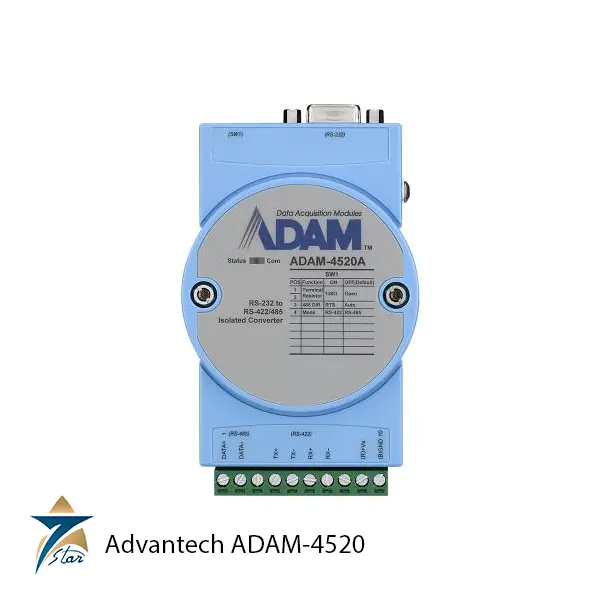
The Advantech ADAM-4520 serves as a crucial data communication bridge in industrial automation and telemetry topologies. Engineered to convert standard RS-232 signals into balanced RS-422 or RS-485 signals, this compact module allows legacy computing hardware to interface seamlessly with long-distance multi-drop industrial networks. In the sprawling industrial plants, manufacturing hubs, and water telemetry networks of Oman and the wider Middle East, serial communication lines are often subjected to severe ground loop currents and transient voltage spikes. Seven Star LLC supplies the ADAM-4520 as a rugged, field-proven solution to safeguard central control systems while expanding data networks up to 1.2 kilometers. By deploying this isolated converter, plant operators can extend the lifespan of their processing infrastructure and ensure flawless serial data throughput across the entire facility.
The core operational logic of the Advantech ADAM-4520 is centered on transparent data routing. Traditional RS-485 systems require handshaking signals (such as RTS and CTS) from the host software to control the direction of half-duplex transmission. The converter removes this software overhead through its integrated automatic RS-485 data flow control circuitry, which senses the direction of incoming data and switches the transmission state instantly. As a result, any standard RS-232 software or PLC driver can communicate over an RS-485 bus through this module without code changes or hardware handshaking configuration, simplifying network commissioning.
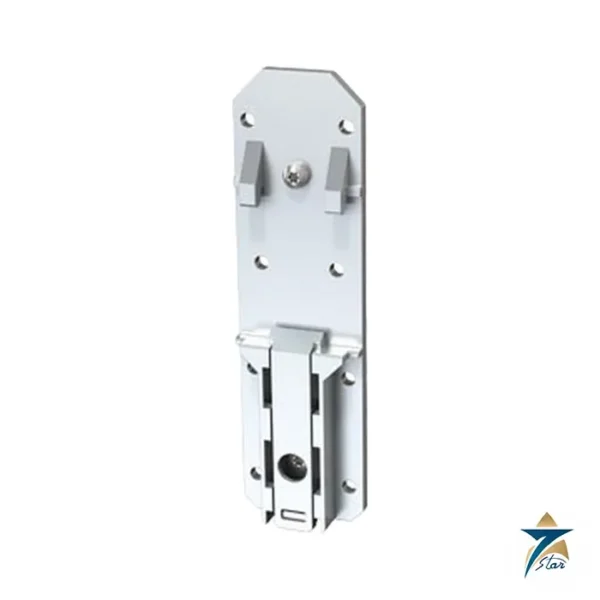
Engineering resilience against severe electrical anomalies is the defining characteristic of the Advantech ADAM-4520. The module integrates an internal opto-isolator that provides an exceptional 3000 VDC galvanic isolation protection layer between the input RS-232 port and the output RS-422/485 stages. This isolation prevents dangerous high-voltage surges on the field network from travelling back to damage expensive central PLCs or industrial PCs. Furthermore, the RS-485 data lines are protected by advanced surge suppression components to arrest atmospheric or inductive transients. Housed in a compact, industrial-grade ABS enclosure, the ADAM-4520 is optimized for space-constrained installations. It can be easily DIN-rail or panel mounted within existing control cabinets, operating reliably across wide input power profiles.
The Advantech ADAM-4520 is packed with technical advantages designed for professional B2B automation. It supports transmission speeds up to 115.2 Kbps, making it highly suitable for high-density Modbus RTU polling networks. The module features an integrated, high-visibility LED indicator system that allows maintenance technicians to instantly monitor power status and active data transmission (TX/RX) lines. This simplifies on-site troubleshooting in complex Middle Eastern industrial plants. The internal layout also allows users to configure the RS-422/RS-485 mode and baud rate settings via internal DIP switches, eliminating the need for external configuration software. Its low power consumption, typically 0.8 W at 24 VDC, makes it a standard choice for remote, unmanned monitoring stations.
Seven Star LLC supplies the Advantech ADAM-4520 for critical data conversion and protection duties across diverse GCC sectors:
SCADA and Telemetry Networks: Connecting remote field flowcomputers and RTUs to central wireless modems or fiber gateways in Oman.
Building Automation Systems (BAS): Interfacing legacy HVAC and lighting controllers with modern IP-based building management networks.
Power Substation Monitoring: Enabling secure communication between smart energy meters and central electrical distribution PLCs.
Water Treatment and Desalination: Bridging chemical dosing controllers and level transmitters with the main control room DCS.
Manufacturing and CNC Automation: Facilitating stable program transfers and data logging for machine tools subjected to high electrical noise.
| Specification | Technical Data |
| Product Model | Advantech ADAM-4520 |
| Conversion Protocol | RS-232 to RS-422 / RS-485 |
| Isolation Protection | 3000 VDC (Galvanic Opto-Isolation) |
| Data Flow Control | Automatic RS-485 Direction Control |
| Maximum Baud Rate | 115.2 Kbps |
| Maximum Distance | 1.2 km (4000 feet) over RS-422/485 |
| Diagnostic Indicators | LED for Power and Data Flow Status |
| Surge Protection | Integrated on RS-485 Data Lines |
| Power Requirements | +10 to +30 VDC (Unregulated) |
| Mounting Configuration | DIN-Rail, Panel, or Piggyback Mount |
| RS-232 Connector | 1 × DB9 female |
| RS-422/485 Connector | 1 × plug-in screw terminal block (#14 to 22 AWG) |
| Speed Modes | 1200, 2400, 4800, 9600, 19.2 k, 38.4 k, 57.6 k, 115.2 k bps (switch selectable) |
| Power Consumption | Typical 0.8 W, max. 1 W at 24 VDC |
| Operating Temperature | -10 to 70 °C |
| Storage Temperature | -25 to 85 °C |
| Operating Humidity | 5 to 95 % RH |
| Orderable Part Number | ADAM-4520-F |
Advantech documents the ADAM-4520 together with three related modules, and the choice depends on what sits on each side of the link. The ADAM-4520 converts an RS-232 port (DB9) into isolated two-wire RS-485 or four-wire RS-422 with 3000 VDC isolation. The ADAM-4510 is an RS-422/485 repeater for extending or segmenting an existing bus, and the ADAM-4510S is the same repeater with 3000 VDC isolation. Both repeaters and the ADAM-4520 use the same switch-selectable speed steps from 1200 bps to 115.2 kbps.
The ADAM-4521 works in the opposite direction: it is an addressable RS-422/485 to RS-232 converter that lets an RS-232 device be placed on an RS-485 network. It has a built-in microprocessor and watchdog timer, 1000 VDC isolation, software-configurable speeds from 300 bps to 115.2 kbps, and the RS-232 and RS-485 sides can run at different baud rates. All four modules share the unregulated 10 to 30 VDC power input with power reversal protection, so they can be fed from the same panel supply as other ADAM-4000 modules.
The ADAM-4520 has no software configuration. Advantech lists eight fixed speed modes from 1200 bps to 115.2 kbps, plus a switchable RTS control mode and RS-422 mode, so the network baud rate must be one of these steps and rates below 1200 bps are not covered. The rated operating temperature is -10 to 70 °C at 5 to 95 % relative humidity, which should be compared with the expected temperature inside outdoor or unventilated panels. The RS-422/485 side is wired to a plug-in terminal block that accepts #14 to 22 AWG conductors.
It converts RS-232 signals to RS-422 or RS-485, letting standard computers connect to long-distance multi-drop industrial networks up to 1.2 km.
No. Automatic RS-485 data flow control switches direction itself, so standard RS-232 software works without code changes.
3000 VDC galvanic isolation between the RS-232 input and the RS-422/485 output.
Up to 115.2 Kbps, suitable for Modbus RTU polling networks.
Seven Star LLC supplies the Advantech ADAM-4520 across Oman and the GCC. Request a quote below.
Seven Star LLC is a premier supplier of Advantech industrial networking and data acquisition modules in Oman and the Middle East. For a formal B2B quotation, bulk pricing, or to request the official technical datasheet for the Advantech ADAM-4520 Isolated Converter, contact our engineering sales department today.
Most problems with RS-485 networks come from wiring and settings rather than hardware. The following points cover the majority of installations:
Because the ADAM-4520 is a transparent physical-layer converter, it passes any serial protocol unchanged. It is commonly used with Modbus RTU, ADAM ASCII command sets, proprietary meter protocols and legacy SCADA polling. The converter does not change addressing or timing, so each slave on the RS-485 segment still needs a unique address, and the polling software should allow sufficient response time for the slowest device and the cable length.
The ADAM-4520 is a common spare in water and wastewater telemetry panels, power plant energy metering, tank gauging systems, HVAC and building management retrofits, and on older DCS and PLC systems that still use RS-232 serial ports to reach modern RS-485 field devices such as power meters, flow computers and analyzers.
We supply genuine Advantech modules with manufacturer documentation and can also quote matching ADAM I/O modules, repeaters and DIN-rail power supplies for complete serial network upgrades. Send your quantity and application details to request a quotation.
Browse Advantech products by category: Industrial Computer, PLC & I/O Cards, Industrial Communications.
Choose the option that best fits your needs to get the fastest response from our team.
Automatically fill the RFQ form with this product's details for a faster process.
Manually enter multiple part numbers, specific brands, or custom requirements.












Reviews
There are no reviews yet.