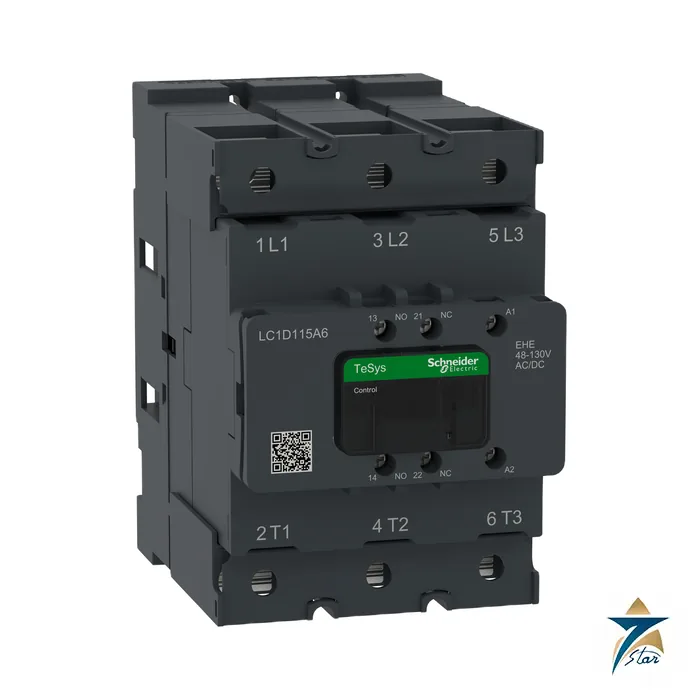
LC1D115A6EHE: 115 A TeSys Deca contactor with ring lugs and 48-130 V AC/DC coil
The LC1D115A6EHE is a Schneider Electric TeSys Deca contactor with ring lugs / busbars, a 48-130 V AC/DC coil and a 115 A AC-3 rating. The datasheet title reads: Contactor Deca 115A 3P 48-130V ACDC Lug. The LC1D115 is the 115 A frame of the TeSys Deca range, a heavy contactor rated 115 A in AC-3 and AC-3e at up to 440 V and 200 A in AC-1. It is built for motors of 55 kW at 400 V and for large resistive or capacitor-free switching duties, in a body 152 mm tall, about 99 mm wide and 155 mm deep. Seven Star LLC supplies the LC1D115A6EHE in Oman and the GCC as an independent supplier based in Muscat.
Reading the reference: LC1D115 is the 115 A TeSys Deca frame, the A6 group marks the ring lugs / busbars version, and EHE is the coil code for 48 to 130 V AC 50/60 Hz and 48 to 130 V DC. The same coil on the other terminal style is LC1D115AEHE. The datasheet gives a body of 152 x 99 x 155 mm (H x W x D) and a net weight of 2.2 kg.
Technical specifications of the LC1D115A6EHE
| Parameter |
Specification |
| Manufacturer / part number |
Schneider Electric / LC1D115A6EHE |
| Description |
Contactor Deca 115A 3P 48-130V ACDC Lug |
| Range of product |
TeSys Deca Advanced (range: TeSys Deca) |
| Device short name |
LC1D |
| Product or component type |
Contactor |
| Contactor application |
Motor control; resistive load |
| Utilisation category |
AC-3; AC-3e; AC-1; AC-4; DC-1; DC-3; DC-5 |
| Poles / contact composition |
3P; 3 NO |
| Rated operational voltage [Ue] |
Power circuit: up to 1000 V AC (16.67 to 400 Hz); up to 300 V DC |
| Rated operational current [Ie] |
115 A at <60 °C at up to 440 V AC (AC-3 and AC-3e); 200 A in AC-1 |
| Control circuit voltage [Uc] |
48 to 130 V AC 50/60 Hz and 48 to 130 V DC |
| Control voltage limits |
0.8 Uc min to 1.1 Uc max operational; 0.1 Uc max drop-out (-40 to 60 °C) |
| Coil technology |
Built-in bidirectional peak limiting diode suppressor |
| Inrush power |
170 VA; 120 W (at 20 °C) |
| Hold-in power |
7.5 VA; 5.1 W (at 20 °C) |
| Motor power (AC-3), 400 V |
55 kW at 400 V |
| Motor power, 60 Hz |
75 hp at 460/480 V |
| Conventional free-air thermal current |
200 A at 60 °C |
| Making / breaking capacity at 440 V |
1560 A at 440 V / 1100 A at 440 V |
| Associated fuse rating |
125 A aM at up to 440 V, 100 A aM at up to 690 V, 200 A gG at up to 690 V |
| Power dissipation |
6 W per pole in AC-3, 22 W in AC-1 |
| Mechanical durability |
8 Mcycles |
| Electrical durability |
1 Mcycles at 115 A AC-3; 0.5 Mcycles at 200 A AC-1 |
| Maximum operating rate |
2400 cycles per hour at 60 °C; 3600 at Uc, 20 °C |
| Operating time |
20 to 90 ms closing; 10 to 80 ms opening |
| Power terminals |
Ring lugs (25 mm external diameter) or busbars 5 x 25 mm |
| Tightening torque (power) |
12 N.m on M8 hexagonal head (13 mm) |
| Auxiliary contacts |
1 NO + 1 NC, mechanically linked; NC mirror contact |
| Mounting support |
Plate |
| IP degree of protection |
IP20 front face (IEC 60529) |
| Protective treatment |
None (IEC 60068-2-30) |
| Ambient temperature |
-40 to 60 °C operation; 60 to 70 °C with derating; storage -60 to 80 °C |
| Operating altitude |
0 to 3000 m without derating |
| Dimensions (H x W x D) |
152 x 99 x 155 mm |
| Net weight |
2.2 kg |
| Product certifications |
CB Scheme; CCC; cULus; CE; UKCA; EU-RO-MR by DNV-GL |
Ring lugs and busbars on the LC1D115A6EHE
The power circuit of the LC1D115A6EHE is terminated with ring lugs (external diameter 25 mm) or with busbars of 5 x 25 mm cross section, and the datasheet specifies 12 N.m on the M8 hexagonal head (13 mm). The control terminals are separate screw clamps for 1 to 4 mm² flexible conductors, tightened to 1.7 N.m.
In the references of this family, the A6 in the part number marks the lug and busbar version, in contrast to the connector version without the 6. This reading comes from the datasheet titles, which describe A6 references as ‘lugs-ring or bars’ and the others as ‘connector’.
48-130 V AC/DC coil and control circuit of the LC1D115A6EHE
The coil of the LC1D115A6EHE is a wide-range AC/DC type: 48 to 130 V AC 50/60 Hz and 48 to 130 V DC. The datasheet states operational limits of 0.8 Uc minimum to 1.1 Uc maximum and a drop-out at or below 0.1 Uc, over -40 to 60 °C, for both AC and DC. Applied to this range, 0.8 x 48 V is 38.4 V and 1.1 x 130 V is 143 V. The coil carries a built-in bidirectional peak limiting diode suppressor, so a separate suppressor is not normally needed. At the bottom of the range the contactor needs 0.8 Uc to close, which for the 48 V end works out to about 38 V, and at the top 1.1 Uc is about 143 V. A 110 V DC battery system on float charge stays well inside that window, which is why this coil is a common choice in 110 V DC protection and control panels.
Commissioning check on a 48 to 130 V coil: on a DC battery supply, measure the voltage at the contactor with the charger off and the battery under load, since the lowest operating voltage is what decides pull-in at 0.8 times 48 V. On AC, check the transformer secondary sits between 38 V and 143 V under load.
Wiring a 48 to 130 V coil: a 110 V DC battery distribution is normally fed through DC-rated breakers, so the stop contacts in series with the coil must also be DC-rated. The datasheet gives 120 W inrush and 5.1 W hold for this coil, so size the control path for the closing demand.
Typical homes for the LC1D115A6EHE: substation and generator-set control panels on 110 V DC, utility and power station auxiliaries, and plants that standardise on a 110 V AC control transformer. One reference covers both control supplies, which is why this coil is a common spare in energy and utilities plants.
Ratings, motor sizes and short-circuit data of the LC1D115A6EHE
At 115 A AC-3 the datasheet lists 30 kW at 230 V, 55 kW at 400 V, 59 kW at 415 V, 75 kW at 500 V, 80 kW at 690 V and 65 kW at 1000 V. The utilisation categories listed are AC-3, AC-3e, AC-1, AC-4, DC-1, DC-3 and DC-5.
| Supply voltage (AC-3) |
Motor power |
| 230 V |
30 kW |
| 400 V |
55 kW |
| 415 V |
59 kW |
| 500 V |
75 kW |
| 690 V |
80 kW |
| 1000 V |
65 kW |
Making capacity is 1560 A at 440 V and breaking capacity 1100 A at 440 V. Power dissipation per pole is 6 W in AC-3 and 22 W in AC-1.
Mechanical life is 8 million cycles; electrical life is 1 million cycles at 115 A AC-3 and 0.5 million at 200 A AC-1 (all at up to 440 V). The datasheet’s maximum operating rate is 2400 cycles per hour at 60 °C, and the safety data gives B10d of 684932 cycles at nominal load.
Power circuit insulation is rated 1000 V to IEC 60947-4-1 with an impulse withstand of 8 kV, overvoltage category III and pollution degree 3. Contact impedance is 0.45 mΩ at 200 A and 50 Hz.
The LC1D115A6EHE among the LC1D115 lug-terminal references
The table lists the 115 A ring lugs / busbars references in this series; the coil code is the only difference inside the group. The connector twin with the same coil is LC1D115AEHE.
Against the other coil bands of this frame, the 48 to 130 V AC/DC coil is the mid-low choice. It overlaps the 24 to 60 V band at 48 to 60 V and the 100 to 250 V band at 100 to 130 V, so in an overlap region either could work, but at 110 V this is the best fit and the 100 to 250 V band only just starts there.
| Part number |
Coil band |
Terminals |
Note |
| LC1D115A6BNE |
24-60 V AC/DC |
lugs-ring or bars |
Same frame |
| LC1D115A6EHE |
48-130 V AC/DC |
lugs-ring or bars |
This page |
| LC1D115A6KUE |
100-250 V AC/DC |
lugs-ring or bars |
Same frame |
| LC1D115A6LSE |
200-500 V AC/DC |
lugs-ring or bars |
Same frame |
| LC1D115ABNE |
24-60 V AC/DC |
connector |
Same frame |
| LC1D115AEHE |
48-130 V AC/DC |
connector |
Same frame |
| LC1D115AKUE |
100-250 V AC/DC |
connector |
Same frame |
| LC1D115ALSE |
200-500 V AC/DC |
connector |
Same frame |
Selection checklist for the LC1D115A6EHE
- Motor size: up to 55 kW at 400 V in AC-3, 59 kW at 415 V.
- Whether the starter is direct-on-line or a star-delta or soft-starter bypass, since the contactor sees different currents.
- Coil voltage band (24-60, 48-130, 100-250 or 200-500 V AC/DC) and available control power.
- Terminal style: ring lugs or busbars (A6 references) versus connector (A references).
- Fuse or breaker for short-circuit protection: 125 A aM at up to 440 V per the datasheet.
- Overload protection: electronic overload relay or motor protection suitable for 115 A frames.
- Check whether the control source is 110 V AC or DC and confirm the series contacts are DC-rated if it is DC.
- Confirm the 48-130 V AC/DC control supply can deliver the 170 VA inrush at the lowest voltage it reaches in operation.
Typical applications of the LC1D115A6EHE in Oman and the GCC
A 115 A contactor typically starts 45 to 55 kW pumps, large fans, compressors and crushers, and is also used for switching resistive banks and transformer-fed heating. In Oman and the GCC it is found in MCC starter buckets for water treatment, in desalination feed pump drives and in industrial ventilation.
The datasheet lists a protective treatment of ‘None’ for this frame, against ‘TH’ on the compact 9 to 25 A contactors, so a heavy contactor in a humid or salt-laden coastal atmosphere should be inside a sealed, ventilated panel instead of exposed to air. Summer temperatures in the region also call for attention to the 60 °C operating limit and the derating up to 70 °C given in the datasheet.
Information to send with an RFQ for the LC1D115A6EHE
- The reference LC1D115A6EHE and the quantity required
- The coil voltage on any contactor it replaces, and whether the control is AC or DC
- Motor power, supply voltage and starter type, so the 115 A frame can be confirmed
- Terminal style on site: ring lugs or busbars, or connector terminals
- Delivery location and timing, and whether the item is a spare or new installation
Documents and quotation
A datasheet for this product is attached on this page. It lists the electrical, mechanical and environmental data summarised above.
Send us the part number LC1D115A6EHE, the quantity and the application and we will confirm availability and a quotation. Seven Star LLC is an independent supplier in Muscat and is not affiliated with the manufacturer.
Other Models in the Se Lc1d115 Lug Range
Seven Star LLC supplies models from the Se Lc1d115 Lug range in Oman and the GCC. Compare the related models below and request a quote for the one that matches your application.





















Reviews
There are no reviews yet.