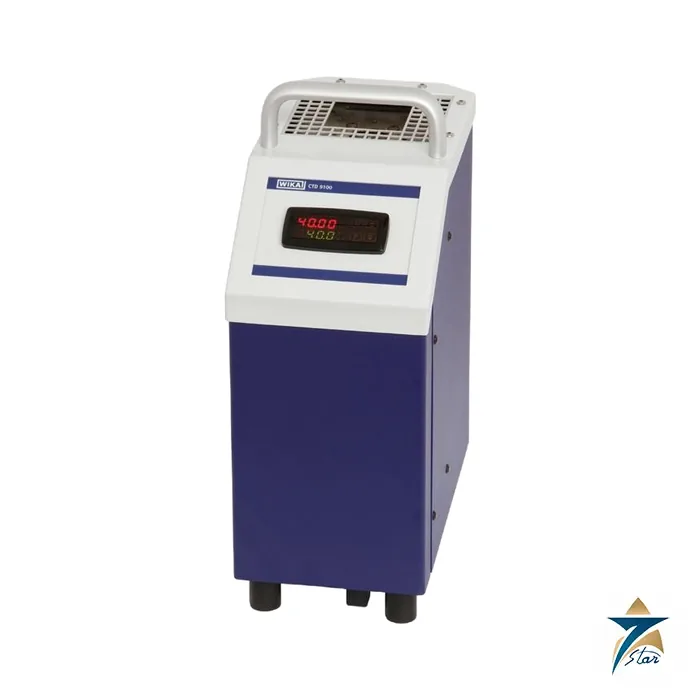
WIKA CTD9100 temperature dry-well calibrator, industrial series from -50 to +650 °C
The WIKA CTD9100 series is a family of portable dry-well calibrators for checking and adjusting industrial temperature sensors on site or in a laboratory. This data sheet covers four models: CTD9100-COOL (-50 … +200 °C), CTD9100-165 (-35 … +165 °C), CTD9100-450 (+40 … +450 °C) and CTD9100-650 (+40 … +650 °C), together covering -50 to +650 °C [-58 to +1,202 °F]. Measurement uncertainties are quoted from 0.15 to 0.8 K. Seven Star LLC supplies the CTD9100 in Oman and the GCC as an independent supplier in Muscat, and this page explains the four models so an RFQ can name the right one and its inserts.
How a dry-well calibrator like the CTD9100 works
A dry-well calibrator heats (and in some models cools) a temperature-controlled metal block with drilled inserts. A thermometer under test is inserted to the bottom of the bore and the block is brought to a set temperature, which is controlled by a built-in Pt100 reference sensor. When the block is stable, the reading of the thermometer under test is compared with the display of the calibrator, so deviations can be found or the thermometer adjusted. In the CTD9100, the actual and set temperature of the block appear at the same time on a large four-digit high-contrast LED display, and the set point is changed with two buttons. The immersion depth is 150 mm [5.91 in], which reduces heat conduction error along the sensor stem; a new block design improves temperature homogeneity at the lower range.
Technical specifications of the CTD9100 models
| Parameter |
COOL |
165 |
450 |
650 |
| Manufacturer / part number |
WIKA / CTD9100-COOL |
WIKA / CTD9100-165 |
WIKA / CTD9100-450 |
WIKA / CTD9100-650 |
| Temperature range |
-50 … +200 °C |
-35 … +165 °C (-30 for X version) |
+40 … +450 °C |
+40 … +650 °C |
| Heating principle |
Peltier element |
Peltier element |
Resistance heating |
Resistance heating |
| Accuracy |
±0.25 K |
±0.20 K |
±0.30 K |
±0.50 K |
| Stability |
±0.05 K |
±0.05 K |
±0.05 K to 100 °C; ±0.1 K to 450 °C |
±0.05 K to 100 °C; ±0.1 K to 600 °C |
| Insert |
Ø 28 x 150 mm |
Ø 28 x 150 mm, or Ø 60 mm (X) |
Ø 60 x 150 mm |
Ø 28 x 150 mm |
| Block material |
Aluminium 3.2315 |
Aluminium 3.2315 |
Aluminium 3.4365 |
Brass 2.0375 |
| Heating time (from 20 °C) |
To 200 °C approx. 10 min |
To 165 °C approx. 25 min (35 min X) |
To 450 °C approx. 14 min |
To 600 °C approx. 20 min |
| Power |
AC 100 … 230 V, 555 VA |
AC 100 … 230 V, 375 VA |
AC 230 V, 2,000 VA |
AC 230 V or 100 … 240 V, 1,000 VA |
| Weight |
11 kg |
11 kg |
7.5 kg |
8 kg |
Common features, display and communication of the CTD9100
All four models share a two-line, four-digit LED display (range -199.9 to +999.9 °C, resolution 0.01 up to 100 °C and 0.1 above), units selectable in °C or °F, and a communication interface RS-485 to USB with Modbus RTU at 9,600 baud. Cooling from 20 to -20 °C takes about 10 minutes in the COOL model and about 15 minutes in the 165 model. From 450 or 600 °C down to 100 °C takes about 60 minutes. The calibrators are for indoor use only, up to 2,000 m, operating temperature 0 to 50 °C, humidity below 80 % to 31 °C, non-condensing, mounted upright. The size of the COOL and 165 body is 215 x 305 x 425 mm including handle, and of the 450 and 650 about 150 x 270 x 400 mm without handle.
Calibration certificates available are a 3.1 inspection certificate per EN 10204 and a DAkkS certificate traceable and accredited per ISO/IEC 17025. Calibration is carried out as standard at six temperatures evenly distributed over the range, and a recommended calibration interval of one year is given. Approvals listed are CE (EMC, low voltage) and RoHS.
Which CTD9100 model to choose
- COOL: the widest span from -50 to +200 °C with active cooling. WIKA associates it with biotechnology, pharmaceutical and food uses where sub-ambient points matter.
- 165: the best accuracy (±0.20 K) in a narrower range, with an X version with a 60 mm insert for several probes at once.
- 450: the middle-temperature model with a 60 mm insert, suitable for several probes and large sensor housings.
- 650: the high-temperature model for exhaust gas, test benches and power generation work, with 28 mm insert and a brass block.
Where the CTD9100 fits and related WIKA equipment
WIKA lists the CTD9100-1100 and the CTD9100-ZERO on separate data sheets, and the CTM9100-150 as a multi-function calibrator. The CTD9100 is a comparison calibrator, and a reference such as the CTR2000 precision thermometer with a calibrated Pt100 probe can be used to determine the actual block temperature with the lowest uncertainty. For gauge and transmitter work, pressure calibration equipment is separate. Typical objects under test are resistance thermometers such as the TR10 and TR33 and thermocouples such as the TC10-B, all of which Seven Star LLC can also supply as separate products.
Ordering checklist for the CTD9100
- Temperature range needed and the lowest and highest test point.
- Model: COOL, 165 (standard or X), 450 or 650.
- Insert bore sizes for the sensors to be tested; inserts are drilled to suit.
- Mains supply: 230 V or 100 … 240 V (650 version) and the power cord type.
- Calibration certificate: factory 3.1 or DAkkS.
- Reference thermometer, if the user needs traceability of the block temperature.
- Number of units and delivery site.
Use, handling and maintenance of the CTD9100
Allow the calibrator to stabilise after reaching the set point, because stabilisation time depends on temperature and on the probe under test. Insert the probe fully to the 150 mm depth and use an insert with the closest fitting bore, as air gaps raise the stem conduction error. Let the high-temperature models cool before moving them, and keep the vents free. Do not use the instrument in wet places. The one-year calibration interval is a recommendation, and conditions of use decide whether it should be shortened. If the unit sees heavy use at 600 °C, expect the insert fit to change, which is a reason to have spare inserts.
Typical applications in Oman and the GCC
In Oman and the Gulf the CTD9100 is used by instrument technicians and calibration laboratories in oil and gas, power and desalination plants to verify RTDs and thermocouples during turnarounds, to calibrate thermowell sensors and to maintain traceability records for audits. The 650 model matches exhaust and furnace thermocouple checks, while the COOL and 165 models serve food, pharma and utilities.
Information to send with an RFQ
- Model: COOL, 165, 165-X, 450 or 650
- Insert drilling plan (diameters of sensors)
- Supply voltage and plug type
- Certificate type
- Quantity and delivery site
Documents and quotation
The WIKA data sheet for the CTD9100 is attached on this page and contains all four models.
Send the model, insert diameters and supply details and Seven Star LLC will confirm availability and a quotation.




















Reviews
There are no reviews yet.