Fisher 1190 low-pressure gas blanketing regulator: what is in the package
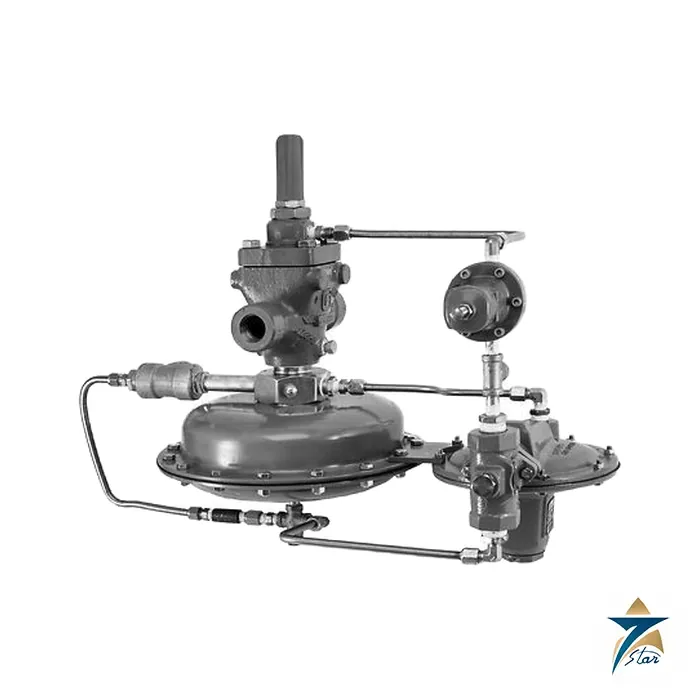
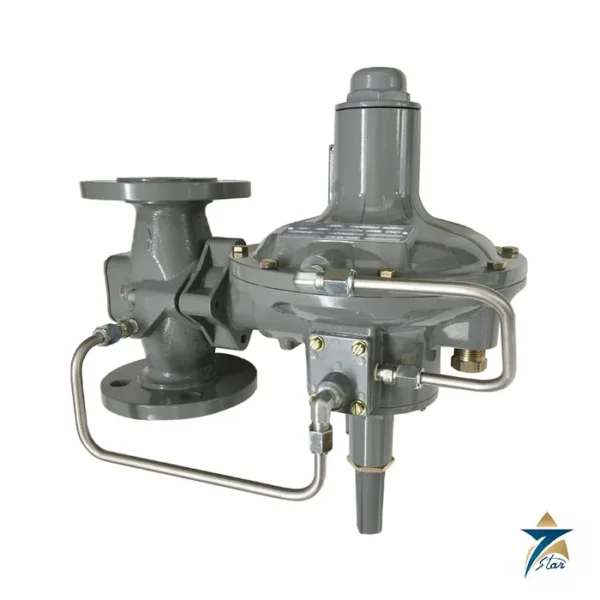
The Fisher Type 1190 is a pilot-operated blanketing regulator for very low pressure settings on larger tanks and vessels. It is a built-up assembly rather than a single device: a Type EGR main valve with a Type 1098 actuator, a Type T205P sensing pilot, and a Type MR95H supply pressure regulator that feeds the pilot. Seven Star LLC supplies the 1190 in Oman and the GCC as an independent supplier in Muscat; this page explains the package so your enquiry is complete the first time.
The 1190 designation is therefore a family name, and what you specify is the main valve body size and end connection, the main valve spring (which controls how much differential pressure is available), the pilot spring that sets the blanket pressure, the trim style, and the elastomers. Compared with direct-operated units such as the Type Y692, pilot operation gives much higher capacity and a steadier setpoint when tank demand is large.
Fisher 1190 technical specifications
| Parameter |
Specification |
| Manufacturer / part number |
Fisher (Emerson) / Type 1190, instruction manual D101644X012 (August 2020) |
| Design |
Pilot-operated pressure reducing regulator with Type T205P pilot and Type MR95H supply regulator |
| Main valve |
Type EGR with Type 1098 actuator, linear flow characteristic |
| Body sizes |
NPS 1, 2, 3, 4, 6, 8 x 6 and 12 x 6 (DN 25, 50, 80, 100, 150, 200 x 150, 300 x 150) |
| End connections |
Cast iron NPT, CL125 FF or CL250 RF; WCC steel or CF8M stainless NPT, SWE, BWE, CL150, CL300 or CL600 RF, or PN 16/25/40, depending on size |
| Maximum main valve inlet pressure |
400 psig / 27.6 bar |
| Maximum operating inlet pressure |
200 psig / 13.8 bar (cast iron) or 300 psig / 20.7 bar (steel or stainless) |
| Maximum outlet (casing) pressure |
75 psig / 5.2 bar for steel or stainless |
| Pilot outlet pressure ranges |
0.25 to 2.5 in. w.c. up to 4.5 to 7.0 psig (0.6 mbar to 0.48 bar), seven springs |
| Pressure registration |
External control line |
| Main valve temperature limits |
NBR and FEP -20 to 180°F / -29 to 82°C; FKM 40 to 300°F / 4 to 149°C; EPDM -20 to 275°F / -29 to 135°C; FFKM -20 to 300°F / -29 to 149°C |
| Pilot temperature limits |
NBR -20 to 180°F / -29 to 82°C; FKM 40 to 180°F / 4 to 82°C |
| Approximate weights |
NPS 1: 85 lb / 39 kg; NPS 2: 100 lb / 45 kg; NPS 3: 145 lb / 66 kg; NPS 4: 195 lb / 88 kg; NPS 6: 380 lb / 172 kg; NPS 8 x 6: 740 lb / 336 kg; NPS 12 x 6: 1265 lb / 574 kg |
A low-temperature construction for process temperatures down to -76°F / -60°C is stated to be available on request; it was laboratory tested for lockup and external leakage at that temperature.
How the 1190 pilot loop works
The tank pressure is carried by a control line to both the pilot diaphragm and the main valve actuator. High-pressure inert gas, first reduced by the MR95H, becomes the loading pressure that drives the main valve. When tank pressure drops under the pilot setting, the pilot spring opens the pilot plug, loading pressure builds on the actuator diaphragm and the EGR main valve opens to deliver gas.
As the tank recovers, the pilot closes and the loading pressure bleeds off downstream through a fixed restriction, letting the main valve spring close the plug. The combination of spring force and plug unbalance gives positive shutoff. One caution from the manual: because normal pressure drop assists shutoff on the EGR valve, a reverse pressure drop can cause backflow, so protect the line against reverse flow if the tank pressure could exceed the supply.
1190 flow coefficients and spring selection
With a linear cage and line size equal to body size, the wide-open Cv values are 17.7 for NPS 1, 66.7 for NPS 2, 139 for NPS 3, 213 for NPS 4, 418 for NPS 6, 608 for NPS 8 x 6 and 697 for NPS 12 x 6. A drilled-hole Whisper Trim cage is also offered and has lower values, for example 57.8 at NPS 2 and 310 at NPS 6.
| Pilot spring colour |
Outlet pressure range |
| Orange |
0.25 to 2.5 in. w.c. / 0.6 to 6 mbar |
| Red |
2 to 7 in. w.c. / 5 to 17 mbar |
| Unpainted |
5 to 16 in. w.c. / 12 to 40 mbar |
| Yellow |
0.5 to 1.2 psig / 34 to 83 mbar |
| Green |
1.1 to 2.5 psig / 76 to 172 mbar |
| Light blue |
2.5 to 4.5 psig / 172 mbar to 0.31 bar |
| Black |
4.5 to 7.0 psig / 0.31 to 0.48 bar |
The main valve spring is chosen from green, blue and red options per size. For NPS 2, for instance, the green spring suits differentials up to 60 psig with at least 4 psig for full stroke, while the red spring handles up to 300 psig or the body rating but needs 10 psig. The supply regulator MR95H then has to be set to a minimum supply pressure that depends on the spring pair; for NPS 2 with a green spring and a 2 to 7 in. w.c. pilot, it is 6 psig / 0.41 bar. If the available inlet pressure is below the table value, an external pilot supply is required.
Where the 1190 fits and related Fisher parts
Fisher offers blanketing hardware across three capacity levels. The ACE95jr is a small self-contained valve, the Y692 is a direct-operated regulator in NPS 1-1/2 and 2, and the Type 1190 reaches NPS 12 x 6 for large-diameter nozzles and high nitrogen demand. For very large tanks with high pump-out rates, or when the supply pressure is only a few bar above the blanket pressure, the pilot system of the 1190 can deliver far more flow than a direct-operated unit.
Selection and ordering checklist for Type 1190
- Nitrogen or other inert gas demand, from pump-out rate and thermal cooling, in SCFH or Nm³/h.
- Minimum and maximum inlet pressure, to select body material and check the MR95H supply setting.
- Blanket pressure setpoint, to choose the T205P pilot spring.
- Body size, end connection and flange class matching the pipe.
- Trim: standard linear cage or Whisper Trim drilled-hole cage.
- Elastomers for diaphragms and soft parts, with temperature limits.
- Low-temperature construction, if required below -29°C.
Installation, startup and spares
Install the unit so that flow follows the arrow on the main valve body and keep the T205P spring case pointing down, since changing orientation shifts the spring range. Run a 3/4 NPT downstream control line to the tank in a straight pipe, and point or pipe the vents away from moisture and hazardous areas. Before startup, check the body interior and tubing for debris. Open the upstream block valve slowly, then the downstream valve, and monitor the blanket pressure.
The only normal field adjustment is the pilot spring setpoint. Keep a repair kit of diaphragms and O-rings, and note that the trim package can be removed from the body for inspection. Fit a filter ahead of the regulator on dirty gas, since the pilot orifices are small.
Typical applications in Oman and the GCC
Large blanketing systems of this kind appear on crude and condensate storage, naphtha and solvent tanks, large chemical storage and some process vessels in gas plants and petrochemical complexes. The wide range of body sizes lets one regulator family cover everything from a small day tank to a large floating-product tank, and the stainless steel body option is useful in coastal plants where salt air is aggressive.
Information to send with an RFQ
- Part number 1190, quantity and preferred body size.
- Tank volume, product, pump-out rate and design pressure and vacuum.
- Blanketing gas, inlet pressure range and outlet setpoint.
- End connection, flange class and body material.
- Trim style, elastomers and any low-temperature requirement.
Documents and quotation
The instruction manual for the Type 1190 is attached on this page and includes the supply pressure tables and maintenance procedures for the package.
Please send the part number 1190 and the details above and Seven Star LLC will prepare a quotation for delivery to Oman and the GCC.
Other Models in the Fisher Tank Blanketing Range
Seven Star LLC supplies models from the Fisher Tank Blanketing range in Oman and the GCC. Compare the related models below and request a quote for the one that matches your application.























Reviews
There are no reviews yet.