AMETEK Land 4650-PM forward-scatter dust monitor and what the name tells you
The AMETEK Land 4650-PM is a laser-based particulate matter monitor for stacks and ducts. It measures dust concentration by forward scatter: a 650 nm diode laser crosses the gas stream, particles scatter some of that light, and a detector collects the strongest part of it, the portion travelling in the forward direction. The 4650-PM uses a low angle of incidence and large-area collection optics, which the manufacturer links to a lower detection limit and reduced sensitivity to particle size.
The designation is simple. “4650” is the model number in the AMETEK Land opacity and dust range, and “PM” stands for particulate matter. The same instrument can be used as a PM-CEMS (continuous emissions monitoring system) or as a PM-CPMS (continuous parametric monitoring system), depending on how the plant uses the signal. Seven Star LLC supplies the 4650-PM in Oman and the GCC as an independent supplier in Muscat; the exact configuration should be confirmed against your stack and compliance requirement before ordering.
4650-PM technical specifications
| Parameter |
Specification |
| Manufacturer / part number |
AMETEK Land (LAND Instruments International) / 4650-PM |
| Measuring technique |
Forward-scatter optical detection |
| Light source |
Diode laser, 650 nm, Class 3R |
| Measurement range |
0–15 mg/m³ up to 0–200 mg/m³ (selectable range) |
| Detection limit |
< 0.1 mg/m³ |
| Probe operating (ambient) temperature |
-20 to 50 °C (-4 to 122 °F) |
| Maximum flue gas temperature |
250 °C (480 °F) standard; 500 °C (930 °F) with the high-temperature option |
| Insertion depth |
550 mm (21.7 in) |
| Stack mounting flange |
DN80 PN10/16 or 3 in 150 lb ANSI; minimum hole diameter 88 mm (3.5 in) |
| Materials |
Enclosure: powder-coated aluminium; probe: 316 stainless steel |
| Air purge |
30–40 litres/minute (1.05–1.41 cfm) |
| Sealing |
IP66 |
| Probe power supply |
24 V DC, provided by the control unit |
| Compliance listed |
PS-11; 40 CFR 1040.10 and 1040.11 |
| Controller options |
Single (1 probe, 1 × 4–20 mA) or Multi (up to 16 sensor channels, 4 × 4–20 mA) |
| Digital output |
1 × RS485 Modbus on either controller |
| Controller supply |
100–240 V AC, 1 A |
How the 4650-PM measures dust
When dust particles pass through the laser beam they scatter light in every direction, and the strongest scatter is in the forward direction. The 4650-PM places its collection optics to capture that forward component at a shallow angle. The scattered signal rises with dust concentration, so after calibration against reference gravimetric samples the signal is converted into mg/m³.
The optical path is fixed and there are no moving parts in the measurement path. The only moving part in the system is the automatic calibration device, which performs a check of zero and upscale response. Separate filter audit units allow periodic linearity checks, which is the usual route for demonstrating that a PM-CEMS still responds correctly between annual test campaigns. A built-in data log stores measurements for troubleshooting and for data security.
Probe and control unit: the two-part design
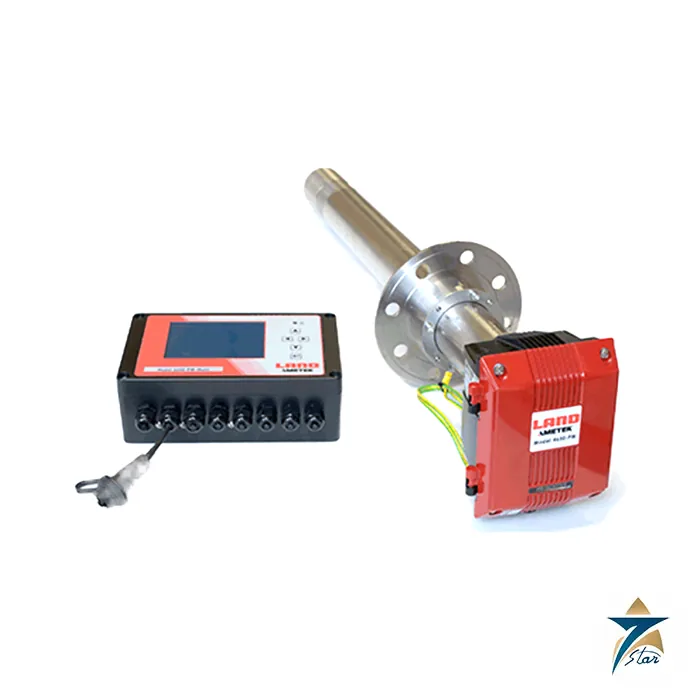
The 4650-PM is delivered as a stack-mounted measuring probe plus a separate control unit. The control unit supplies the 24 V DC to the probe, carries the communications and provides the user interface with a graphical display, so routine settings are made at an accessible location rather than on the stack.
Two control units exist. The Single controller serves one probe and gives one 4–20 mA output. The Multi controller handles up to 16 sensor channels and provides four 4–20 mA outputs; both have one RS485 Modbus port. The Single unit measures 8.7 × 4.8 × 3.2 in and the Multi unit 10.4 × 6.3 × 3.6 in (H × W × D).
Where the 4650-PM fits in the emissions system
The manufacturer positions the 4650-PM for combustion processes where condensed water is not present, and it can be installed downstream of a baghouse or an electrostatic precipitator. A wet-scrubbed stack with water droplets is therefore outside the intended use and needs a different technique.
Within the same AMETEK Land dust and opacity family, the 4750-PM is the back-scatter laser monitor with a single-body sensor, the 4500MkIII is the compliance opacity and dust monitor, and the 4400 is the opacity and dust monitor. These are alternatives rather than accessories. The 4650-PM output is normally wired to a plant DCS, a PLC or an emissions data acquisition system through 4–20 mA or Modbus.
Selection and ordering checklist for 4650-PM
- Expected dust range: standard ranges run from 0–15 up to 0–200 mg/m³; state the permit limit and typical level.
- Flue gas temperature: standard probe to 250 °C, or the high-temperature option to 500 °C.
- Flange: DN80 PN10/16 or 3 in 150 lb ANSI, with a hole of at least 88 mm.
- Stack condition: the monitor is for gas streams without condensed water.
- Control unit: Single for one probe, or Multi when several probes or four outputs are wanted.
- Purge air: a clean supply of 30–40 litres/minute for the probe.
- Role: PM-CEMS for compliance reporting, or PM-CPMS for parametric monitoring.
- Audit accessories: whether filter audit units are needed for linearity checks.
Installation, commissioning and maintenance
The probe is inserted 550 mm into the gas stream through a flange welded to the stack, so flange alignment and a gas-tight joint matter. Air purge keeps the optical windows clean; loss of purge air is the most common cause of drifting readings on optical dust monitors, so the purge supply, filter and hoses deserve a place on the regular inspection list.
During commissioning, the instrument is zeroed and checked with its automatic calibration device and then correlated against manual isokinetic sampling to build the site calibration. After that, routine work is periodic zero and upscale checks, purge inspection, window cleaning when the probe is withdrawn, and filter audit checks at the interval your permit demands. The Class 3R laser requires the usual laser safety awareness when the probe is opened.
Typical applications in Oman and the GCC
The brochure lists electricity generating units, industrial boilers, glass works, cement plants, metals refining and process heaters. In Oman and the Gulf these map onto gas- and oil-fired power stations, auxiliary boilers at refineries and petrochemical plants, cement kilns and metal smelting. Where fabric filters or precipitators are used, a dust monitor after the filter shows bag failure or field problems at an early stage.
Site conditions in the region add practical points: high ambient heat in summer is within the -20 to 50 °C probe rating, but sun load on a stack-top platform should be considered, and fine desert dust in the purge air intake means the purge filter needs regular attention.
4650-PM variants at a glance
| Item |
Standard |
Option |
| Flue gas temperature |
250 °C |
500 °C high-temperature option |
| Controller |
Single: 1 probe, 1 × 4–20 mA |
Multi: up to 16 channels, 4 × 4–20 mA |
| Flange |
DN80 PN10/16 |
3 in 150 lb ANSI |
| Role |
PM-CEMS |
PM-CPMS |
Information to send with your 4650-PM RFQ
- Stack diameter, wall thickness and available flange size
- Flue gas temperature range and expected dust concentration, plus the permit limit
- Fuel or process, and whether a baghouse or ESP is upstream
- Number of probes and the signals required (4–20 mA, Modbus)
- Compliance reference needed, for example PS-11
- Quantity, delivery location and required date
Documents and quotation
The AMETEK Land brochure for the 4650-PM is attached on this page, with the specification table summarised above. Please check the figures against your application before ordering.
Send us the 4650-PM part number together with your stack data and we will prepare a quotation. Seven Star LLC is an independent supplier in Muscat and does not act as a manufacturer representative.
























Reviews
There are no reviews yet.