ZBRRA: Harmony XB5R programmable wireless receiver
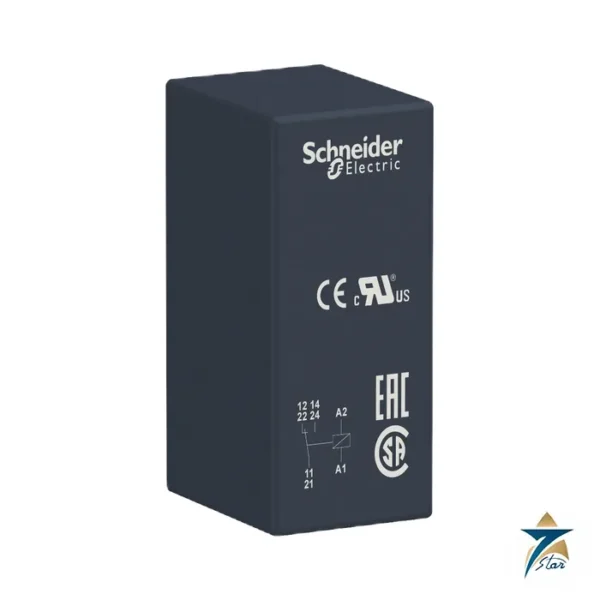
The ZBRRA is a Schneider Electric Harmony XB5R programmable receiver with two relay outputs and a wide 24 to 240 V AC/DC supply. It is the DIN-rail receiving end of the wireless push-button system, and it answers radio commands sent by Harmony XB5R transmitters. Seven Star LLC supplies the ZBRRA in Oman and the GCC as an independent supplier in Muscat.
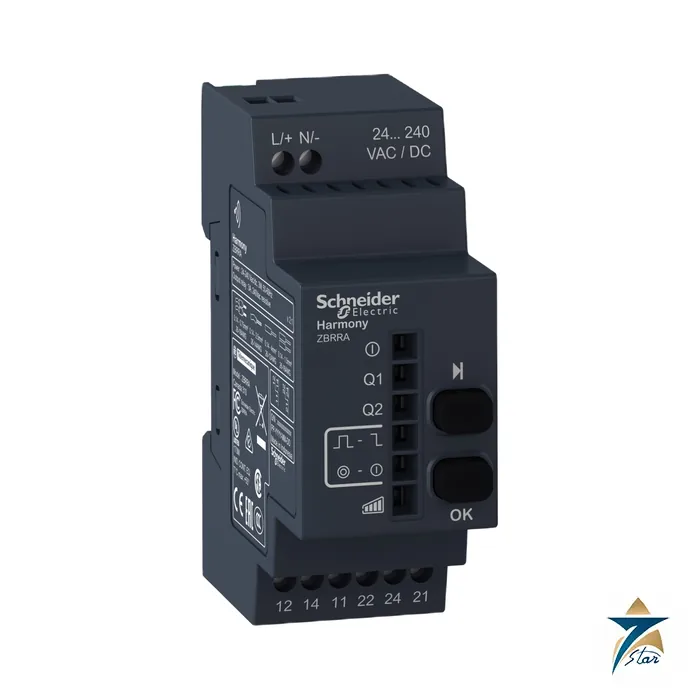
The datasheet lists the ZBRRA as an interface to actuators, with two changeover relay outputs, galvanic isolation between input and output, and six status LEDs plus two push-buttons on the front. Because it is a receiver that is programmed on site, the same part number can serve for latching, momentary or enable/disable duty, depending on the mode chosen at commissioning.
Relay outputs and wiring
The outputs of ZBRRA are two changeover relays with a nominal current of 3 A, a maximum switching voltage of 250 V AC/DC and a switching capacity of 1250 VA, with a breaking capacity of 750 VA. The utilisation categories are AC-15 (B300) and DC-13 (R300). Short-circuit protection is a 0.5 A fast-blow fuse as specified on the datasheet.
Terminals take one 0.14 to 2.5 mm² solid conductor or one 0.14 to 4 mm² flexible conductor with ferrule, or two conductors of 0.14 to 1.5 mm², with a tightening torque of 0.6 N.m. The case is polycarbonate, 36 mm wide, 108 mm high and 75 mm deep, and it mounts on a 35 mm symmetrical DIN rail in any position without derating.
Commissioning, status LEDs and maintenance
The front of ZBRRA carries a green power LED, two green relay LEDs, two green function-mode LEDs and a green and yellow LED for the reception signal, together with two push-buttons. These are used when the transmitter is learned and the function mode is selected, and later they help to tell a power problem from a radio problem. During commissioning of ZBRRA, work through each relay with its real load connected.
Keep a note of the learned transmitters and the mode of each channel, because the receiver must be reprogrammed if it is replaced. Power-supply range, 24 to 240 V AC/DC with 50/60 Hz and a tolerance of ±10 %, means one spare covers most panel supplies.
Function modes and timing
The datasheet lists three function modes for ZBRRA: bi-stable, monostable and enable/disable. In bi-stable mode a relay stays in the position of the last command, which suits a lamp or a latching contactor. In monostable mode the relay follows the transmitter for as long as it is pressed, which is the usual wiring for a crane or a door control. Enable/disable mode gates a function on or off. The time delay range is 0.5 s with a tolerance of ±15 %, and the reset time is a 1 s delay.
The response time is below 30 ms after the transmitter is clicked, so ZBRRA reacts without perceptible lag for ordinary start and stop duty. It is not described on the datasheet as a safety function, and it should not be used as an emergency stop channel.
Radio link, range and antenna
The transmission frequency of ZBRRA is 2405 MHz, with an omnidirectional antenna of 0 dBi gain, and the standards listed include IEEE 802.15.4 and ETSI EN 300 328. The datasheet gives a maximum sensing distance of 100 m in free field, and 15 m when the transmitter sits in a plastic XAL D box and the receiver is inside a metal enclosure. The big difference between those two figures is a reminder that a steel cabinet strongly attenuates the signal.
In practice, mount ZBRRA where the antenna has a reasonable path to the transmitter, and test the link at the planned positions before the installation is finalised. Heavy structures, tanks and process pipework in industrial plants will reduce the usable range below the free-field figure.
Technical data of the ZBRRA
| Parameter |
Specification |
| Manufacturer / part number |
Schneider Electric / ZBRRA |
| Range |
Harmony XB5R |
| Product type |
Programmable receiver |
| Application |
Interface to actuators |
| Function modes |
Bi-stable, Monostable, Enable/disable |
| Number of channels |
1 |
| Output type |
2 relays |
| Output contacts |
2 C/O |
| Nominal output current |
3A |
| Maximum switching voltage |
250 V AC/DC |
| Maximum switching current |
3 A AC/DC |
| Switching capacity |
1250 VA |
| Breaking capacity |
750 VA |
| Utilisation category |
AC-15 : B300, DC-13 : R300 |
| Input / output isolation |
Galvanic isolation |
| Rated supply voltage [Us] |
24–240 V AC/DC 50/60 Hz ± 10 % |
| Power consumption |
3 W at 240 V AC; 2 W at 24 V DC |
| Short-circuit protection |
0.5 A fuse type fast blow |
| Transmission frequency |
2405 MHz |
| Antenna |
Omnidirectional, gain 0 dBi |
| Sensing distance |
100 m in free field; 15 m with transmitter in a plastic XAL D box and receiver in a metal enclosure |
| Response time |
< 30 ms after transmitter clicks |
| Time delay range |
0.5 s (tolerance: ± 15 %) |
| Reset time |
1 s time delay |
| Housing material |
Polycarbonate |
| Mounting |
35 mm symmetrical DIN rail |
| Dimensions (W / H / D) |
36 / 108 / 75 mm |
| Net weight |
0.13 kg |
| Degree of protection |
IP20 |
| Storage temperature |
−40 to 70 °C |
| Relative humidity |
5–90 % |
| Certifications |
CE, UL, CB, UKCA, FCC, IC, CCC, Giteki |
Standards, approvals and environment
For ZBRRA, the datasheet cites IEC 61010, UL 61010, EN 61010, IEC 60947-1 and radio standards including ETSI EN 301 489 and FCC CFR 47 part 15 class B. Certifications are CE, UL, CB, UKCA, FCC, IC, CCC and Giteki. The degree of protection is IP20, pollution degree 2 and overvoltage category II, relative humidity is 5 to 90 %, and storage temperature is -40 to 70 °C. The datasheet extract does not give an operating temperature, so confirm that value with us if the panel will run hot. For wireless products, radio approvals vary by country, and the entries above should be checked against local rules for this unit in Oman and other GCC states.
Typical uses in Oman and the GCC
A receiver like this unit is used where running a cable to a push-button station is awkward or costly: overhead cranes and hoists, gates and barriers, mobile or movable equipment, and extensions to existing panels. In workshops, ports, water and utility sites it replaces long control runs, although the metal construction of many industrial buildings must be taken into account when the radio range is planned.
Information to send with an RFQ for ZBRRA
The points below let us confirm the part number against the datasheet and check stock in one reply.
- Part number this unit and the quantity.
- The transmitters that will be paired, with their part numbers.
- The function mode needed: bi-stable, monostable or enable/disable.
- Load type and current on each of the two relay outputs.
- Supply voltage and type at the panel.
- Distance and obstructions between transmitter and receiver.
- Delivery location and lead time.
Radio equipment rules differ by country, so tell us the site country and we will confirm what documents are available.
Documents and quotation
A copy of the Schneider Electric datasheet for the ZBRRA is attached on this page for your technical file. It holds the electrical, mechanical and environmental values that are summarised above.
To request a quotation, send the part number and the quantity through the enquiry form and we will reply with availability and delivery terms. Seven Star LLC is an independent supplier and does not act for the manufacturer, so please compare the datasheet with your project requirements before you order.



















Reviews
There are no reviews yet.