- Automation & ControlView all 3,186 products
- Automation Accessories
- AC Drives
- PLC & I/O Cards
- Industrial Communications
- Vibration Monitoring
- Controllers & Data Acquisition
- Isolator & Barrier
- Safety Switches & Guard Locking
- Encoders
- Motor Soft Starters
- CCTV & Security
- Pneumatic Cylinders
- HMI Displays
- Servo Drives
- Industrial Computers
- Machine Vision
- Automation Software
- Robotics
Brand: Met One Instruments
Met One Instruments 034E Wind Speed and Direction Sensor
Description
Overview
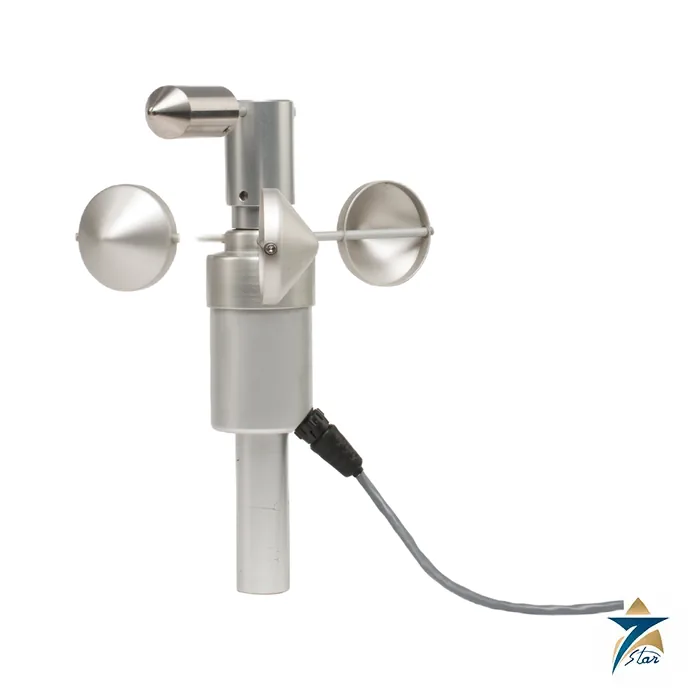
The Met One Instruments 034E wind sensor puts wind speed and wind direction into one compact sensing unit. It is intended for continuous, long-term monitoring in hostile environments, installs in minutes, and connects through a quick-connect sensor cable that may run hundreds of feet without affecting measurement performance. Its three-cup rotor, vane and aluminium and stainless steel construction make it a familiar sight on meteorological masts at industrial sites, and the manufacturer lists ambient monitoring, environmental surveys and fence line monitoring as its main uses.
Many air quality stations pair a particulate monitor with a wind sensor so that a rise in dust or gas concentration can be tied to a direction. The 034E is built for exactly that role, and it is a sensible companion to the BAM-1020 or ES-405 instruments in the same catalogue.
How Met One Instruments 034E senses wind
Wind speed is measured with a sealed magnetic reed switch. As the cup rotor turns, the switch closes in step with rotation and produces a pulsed contact closure output that a logger counts and converts into speed. Wind direction comes from an aluminium vane coupled to a precision potentiometer, giving a resistance output of 0 to 10 kilohms across the electrical range. Because the two outputs are simple contacts and resistance, the sensor can be read by a digital logger or by analog conditioning circuits, and it draws very little power.
Met One Instruments 034E performance and physical data
| Characteristic | Datasheet value |
|---|---|
| Wind speed range | 0 to 167 mph (0 to 75 m/s) |
| Starting threshold | 0.9 mph (0.4 m/s) |
| Speed accuracy below 22.7 mph | 0.25 mph (0.1 m/s) |
| Speed accuracy above 22.7 mph | Plus or minus 1.0 percent of true |
| Direction range, mechanical | 0 to 360 degrees |
| Direction range, electrical | 0 to 356 degrees |
| Direction threshold | 0.9 mph (0.4 m/s) |
| Direction accuracy | Plus or minus 3 degrees |
| Damping ratio | 0.25 standard; 0.4 to 0.6 optional |
| Direction resolution | Better than 0.5 degree |
| Temperature range | -30 to +70 C in minimal icing conditions |
| Speed output | Pulsed contact closure |
| Direction output | Potentiometer, 0 to 10 kilohms |
| Weight | 0.81 kg (1 lb 12.5 oz) |
| Finish | Clear anodised aluminium |
| Cable assembly | P/N 3013, length specified in feet or metres |
| Mounting adapter | P/N 2954 mounting and alignment adapter, fits 1 inch tube or pipe |
| Horizontal arm | P/N 7156 |
Choosing 034E for Gulf conditions
The Gulf climate rewards a sensor with a low starting threshold and a metal body. The 034E begins turning at 0.9 mph, so it picks up the light breezes that matter for plume dispersion at night, and it keeps measuring up to 167 mph, far beyond any wind expected in Oman, which leaves a wide margin during cyclones and strong shamal conditions. Aluminium and stainless steel resist heat and the coastal atmosphere, and the temperature rating of minus 30 to plus 70 C covers desert summers. Note that the rating applies to minimal icing, which is irrelevant to most of the region but worth knowing for mountain installations.
Cables, mounting and alignment for 034E
Order the cable assembly P/N 3013 and state the length required, in feet or metres. Mount the sensor with the P/N 2954 alignment adapter on a 1 inch diameter tube or pipe; the adapter keeps the north reference when the sensor is removed for maintenance, so there is no need to realign it every time. For a boom-style installation, the horizontal sensor mounting arm is P/N 7156, and the maker invites enquiries for special mounting. Site the sensor at the standard height, clear of buildings, trees and stacks whose turbulence would distort the reading, and align the vane to a surveyed true or magnetic north reference.
Logger configuration and commissioning
Connect the 034E pulse output to a counter or frequency input on the logger and the potentiometer to an excitation and analog input. The electrical direction range is 0 to 356 degrees, which means a small dead band remains near north; handle this in logger programming by checking the transition at the north point. Verify operation by turning the cups by hand, rotating the vane through its range and confirming the logger reads sensible values. The damping ratio of 0.25 is standard, with optional values from 0.4 to 0.6 available for different response needs.
Maintenance
With no active electronics in the sensor head of the 034E, maintenance is mostly mechanical: inspect the bearings, vane and cup condition at routine site visits, and check the cable connector for corrosion. The manufacturer highlights easy maintenance and re-alignment and a long field life. A performance check against a reference wind source or a known good sensor is a sensible practice before critical monitoring campaigns.
How 034E differs from other weather sensors
The 034E is a contact-closure and potentiometer instrument with moving parts, a 0.9 mph start threshold and a 75 m/s range. Sonic sensors in the Met One range, such as the AIO 2 listed as an accessory for the ES-405, have no moving parts. Choose the 034E where a rugged, low-power, analog or pulse input is wanted and the logger is already configured for those signals.
Typical monitoring configurations
At a fence line station the wind sensor is read together with a particulate or gas analyser, so each exceedance can be coupled with wind direction and speed and traced to its source sector. At an environmental survey site the sensor, a logger and a small solar supply form a self-contained mast. Because the pulse and potentiometer outputs are simple signals, they are also easy to bring into existing PLC or SCADA analog and counter cards at industrial sites, and cable runs of hundreds of feet do not affect performance. For permanent stations, document the sensor serial number, installation height and north alignment in the station log, and repeat the alignment check after any storm that may have disturbed the mast. When you are comparing wind data from different sites, confirm they use the same averaging period and units, since the 034E speed range is given in both mph and metres per second.
Related items you may also need: TSI P-Trak 8525 Ultrafine Particle Counter 0.02 to 1 micrometre | Extech AN310 Large Vane CFM/CMM Anemometer and Psychrometer | Extech SL130W Sound Level Alert with Alarm Output | All Met One Instruments products.
Documents and quotation
The manufacturer’s datasheet for the 034E is attached to this page. Seven Star LLC is an independent supplier serving Oman and the GCC. To obtain a quotation for 034E, send an RFQ giving the part number 034E, the quantity, the cable length you need under P/N 3013, whether the P/N 2954 alignment adapter or P/N 7156 arm is required, and the delivery location.
Datasheets & Documents
- Datasheet Met One Instruments 034E Datasheet Download
Reviews (0)
How would you rate this product? Cancel reply
About brand
Met One Instruments is an American maker of ambient air quality and meteorological instruments, best known for its BAM beta attenuation mass monitors and its laser-scattering particle counters and profilers. The company was founded in 1989 in Grants Pass, Oregon, with the stated aim of simplifying and improving the user's experience, and it grew by adding products, services and acquisitions until it became a global supplier. Since 2021 Met One Instruments has operated as part of the Acoem Group, with its head office still in Grants Pass.
Met One Instruments company profile
| Founded | 1989 |
|---|---|
| Headquarters | Grants Pass, Oregon, USA |
| Ownership | Part of the Acoem Group since 2021 |
| Core technology | Beta attenuation mass monitoring and laser light-scatter particle counting and profiling, plus meteorological sensors |
| Typical applications | Ambient air quality networks, fenceline and dust monitoring, cleanrooms and indoor air quality, emergency response, weather stations |
| Standards | Registered ISO 9001:2015 company; BAM-1020 holds US-EPA equivalent method designations for PM10, PM2.5 and PM10-2.5 |
Milestones
- 1989: Met One Instruments, Inc. is founded with a focus on ease of use and customer service.
- Mid-1990s: The company develops its Beta Attenuation Mass (BAM) monitor technology, widening its focus to air particle monitoring.
- BAM-1020 designations: The BAM-1020 becomes the first instrument to receive a US-EPA Federal Equivalent Method designation for continuous PM2.5 monitoring, alongside its PM10 designation.
- 2021: Met One Instruments joins the Acoem Group, gaining access to gas analysers, noise and vibration monitors and emission monitoring technology.
- Today: BAM monitors are installed at US Embassies and Consulates around the world, and thousands of BAM 1020 units are deployed worldwide.
How a Met One Instruments beta attenuation monitor works
A BAM monitor draws ambient air through a strip of glass fibre filter tape at a controlled flow, typically 16.7 litres per minute. Particles collect on the tape while a small carbon-14 source sends beta rays through it to a scintillator and photomultiplier detector. The more mass sits in the beam, the more the rays are attenuated, and that attenuation is converted into a concentration in micrograms per cubic metre. Because attenuation depends on mass rather than on colour, shape or chemistry, the method treats diesel soot, road dust and sea salt alike, and it is accepted for regulatory use. The tape advances automatically, and a controlled inlet heater limits the effect of humidity on the sample. When a faster view is enough, Met One Instruments uses laser light scatter instead, which gives size-resolved particle data in seconds. Choose beta attenuation for compliance and reference work, and optical sensors for coverage, profiling and screening.
Where Met One Instruments products are used in Oman and the GCC
Air quality stations near ports, cement plants and refineries, fenceline dust monitoring at construction and mining sites, indoor air and cleanroom checks in hospitals and laboratories, and weather masts at industrial facilities all use this type of equipment. The humid coast and dust-laden interior make continuous, well-heated sampling and reliable calibration particularly important in the region.
Met One Instruments models we list
| Family | Examples |
|---|---|
| Beta attenuation mass monitors | BAM-1020, BAM-1022 |
| Particulate profilers and dust monitors | ES-405, ES-642 |
| Handheld particle counters and mass monitors | 804, Aerocet 831 |
| Meteorological sensors | 034E |
Ordering Met One Instruments products: what we need
Send the exact model, for example BAM-1020 or ES-642, with the quantity and delivery location. For monitors, also tell us the size fraction or designation you need (PM10, PM2.5 or PM10-2.5), the supply voltage, and any inlets, cyclones, filter tape, cables or software. For replacement and spare parts, include the instrument serial number. Seven Star LLC is an independent supplier serving Oman and the GCC, and we reply to each RFQ with availability and lead time.
Facts checked against the Met One Instruments company page and published Met One datasheets, November 2026.
Browse Met One Instruments products by category: Air Flow, IAQ & Sound Meters.
FAQ
Questions about the Met One Instruments 034E Wind Speed and Direction
Answers from our engineering team on installation, compatibility and integration.
01What measurement range does the 034E have for wind speed?
It measures 0 to 167 mph (0 to 75 m/s) with a starting threshold of 0.9 mph (0.4 m/s).
02What outputs does the 034E provide?
Wind speed is a pulsed contact closure from a sealed magnetic reed switch, and wind direction is a potentiometer output of 0 to 10 kilohms.
03How accurate is the 034E wind sensor?
Speed accuracy is 0.25 mph (0.1 m/s) below 22.7 mph and plus or minus 1.0 percent of true above it; direction accuracy is plus or minus 3 degrees.
04How is the 034E mounted and cabled?
Use mounting and alignment adapter P/N 2954 on 1 inch tube or pipe, optional horizontal arm P/N 7156, and cable assembly P/N 3013 in the length you specify.
05What temperature range is the 034E rated for?
It is rated from minus 30 to plus 70 C in minimal icing conditions, with a clear anodised aluminium finish and 0.81 kg weight.


Reviews
There are no reviews yet.