Met One Instruments BAM-1022 Portable Beta Attenuation Monitor

Description

Overview

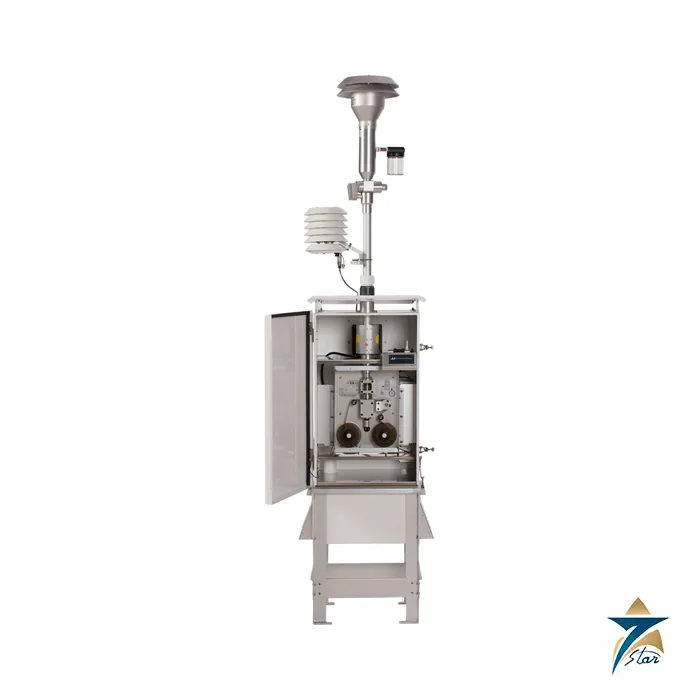
The Met One Instruments BAM-1022 is a real-time portable beta attenuation mass monitor for PM2.5, holding the EPA Class III Federal Equivalent Method designation EQPM-1013-209. It collects ambient particulate on a glass fibre filter tape and measures the mass with beta rays, delivering results with a one minute time resolution while still producing the automatic hourly value that the equivalent method requires. Everything needed for outdoor service, including the weatherproof enclosure, is integrated, which is why it is chosen where a monitoring station has to be set up quickly or moved between sites.

Two design ideas distinguish the BAM-1022 from older tape monitors. First, it uses an in-line sampling geometry, so sampling and beta measurement happen at the same time and ambient sampling continues for virtually all sixty minutes of each hour. Second, it keeps the beta measurement at a nearly fixed temperature above ambient, an in-situ technique that limits the loss of semi-volatile particulate and the error caused by excessive moisture in the sample stream.

Technical data for Met One Instruments BAM-1022

Item Value from the datasheet
Measurement principle Beta attenuation
Designation PM2.5 EPA Class III FEM, EQPM-1013-209
Measurement range -15 to 10,000 micrograms per cubic metre
Resolution 1.0 microgram per cubic metre
Lower detection limit Under 4.8 (hourly, 2 sigma); under 1.0 (24 hour, 2 sigma)
Measurement cycles Hourly automatic; selectable short-term averages 15 to 60 minutes
Flow 16.7 litres per minute, accuracy plus or minus 2.0 percent
Filter tape Glass fibre, 30 mm by 21 m, up to 2 months per roll
Maintenance interval 8 weeks minimum
Span check Manual audits using zero and span foils (included)
Beta source Carbon-14, 60 microcuries plus or minus 15, half-life 5730 years
Detector Scintillation photomultiplier tube
Operating temperature -30 to +50 C
Operating humidity 0 to 90 percent RH, non-condensing
Interface 4.3 inch graphical touch screen
Analog outputs Two channels, optically isolated, 0-1, 0-2.5, 0-5 VDC
Alarm contact 1 channel dry NO, 1 A at 125 VAC or 60 VDC maximum
Serial RS-232 and USB (shared), RS-485, Ethernet; baud 2400 to 115200
Data memory 22,528 records (2.6 years at one per hour)
Dimensions 55.9 cm wide, 45.7 cm deep, 139.7 cm high
Weight 38.6 kg fully assembled
Supply 100 to 240 VAC, 50/60 Hz; 12 VDC at 8.5 A
Approvals NRC, ISO 9001, RoHS, US-EPA

Reading the Met One Instruments BAM-1022 numbers

A few entries deserve explanation. The range starts below zero, at minus 15 micrograms per cubic metre, because a mass monitor measuring very clean air shows small negative values from normal noise; allowing them avoids biasing long-term averages upward. The 1.0 microgram resolution is coarser than the 0.1 of the BAM-1020 but fully adequate for PM2.5 in the field. The 16.7 litres per minute flow is held to plus or minus 2.0 percent, and the datasheet lists a data logger of 22,528 records, equal to 2.6 years at one record per hour or 15.6 days at one record per minute.

Applications for BAM-1022 in the Gulf

For BAM-1022 the manufacturer names criteria-grade air quality networks, near-roadside monitoring, rapid deployment, academic and climate research, and monitoring in places affected by smoke from forest fires or controlled burns. In Oman and the wider GCC, the BAM-1022 portable format suits a temporary baseline survey before a plant expansion, a roadside study near a new highway or port access road, or a quick response to a haze or dust event when the permanent network has a gap. Because the enclosure is integrated and weatherproof, no separate shelter is needed, but summer solar load is serious, so shade the cabinet where possible and confirm the 50 C upper limit is respected.

Power and communications planning

Do not underestimate the supply of the BAM-1022. The datasheet gives about 300 W for a 115 VAC setup and about 850 W for a 230 VAC setup, including the monitor, inlet heater, pump and fans, so a remote site needs a properly rated mains feed, generator or solar and battery system. Communication is flexible: touch screen for local operation, RS-232 with USB, RS-485, Ethernet, a dry alarm contact, and two isolated analog channels. The monitor works with COMET, Air Plus and terminal programs, and advanced features allow remote operation and cloud-based communication.

Commissioning and servicing BAM-1022

Level the BAM-1022 unit on its stand, fit the inlet and sensors, load the tape, and complete leak and flow checks before the first hourly cycle. A manual audit uses the supplied zero and span foils. The maintenance interval is a minimum of 8 weeks, with up to two months of operation per roll, so plan visits around tape changes. The datasheet notes a reduced frequency of background determination and advanced diagnostics, which shorten each site visit.

How BAM-1022 differs from BAM-1020

Choose the BAM-1022 when the target is PM2.5 only, the monitor must live outdoors and the station may relocate: it weighs 38.6 kg complete and works down to minus 30 C. Choose the BAM-1020 for bench or rack operation in a shelter, for PM10 or PM10-2.5 methods, or for finer 0.1 microgram resolution. The BAM-1022 touch screen is 4.3 inches and the tape is 21 metres long.

Selecting between a beta monitor and an optical sensor

Beta attenuation measures mass directly and does not depend on the colour, refractive index or shape of the particles, which is why the technique is accepted for regulatory work and why the manufacturer publishes an equivalent method number for this model. Optical instruments in the same catalogue, such as the ES-405 profiler, give fast multi-fraction information but report an optical estimate. A practical approach for many Gulf projects is to place one beta monitor at a reference location and use optical sensors for spatial coverage, comparing them regularly. The BAM-1022 is also built for high dew point operation, where accuracy and performance remain strong, which matters on humid coastal sites near Muscat, Sohar or Salalah in the morning hours. Plan the sample inlet orientation, tape stock and span foils before shipment so the first deployment goes smoothly, and record the instrument serial number against each site log for later audits.

Related items you may also need: TSI VelociCalc 5725 Rotating Vane Anemometer 100 mm | Extech SL130W Sound Level Alert with Alarm Output | Extech LT300 Digital Light Meter, 400,000 Lux | All Met One Instruments products.

Documents and quotation

The manufacturer datasheet for the BAM-1022 is attached to this page. Seven Star LLC is an independent supplier serving Oman and the GCC. To obtain a quotation for BAM-1022, send an RFQ listing the part number BAM-1022, quantity, voltage (115 or 230 VAC), spare tape and accessories, and the delivery location.

Datasheets & Documents
  • PDF Datasheet Met One Instruments BAM-1022 Datasheet Download
Reviews (0)

Reviews

There are no reviews yet.

How would you rate this product?

It takes about 10 seconds — just tap a star. Your email is never published.

About brand

Met One Instruments is an American maker of ambient air quality and meteorological instruments, best known for its BAM beta attenuation mass monitors and its laser-scattering particle counters and profilers. The company was founded in 1989 in Grants Pass, Oregon, with the stated aim of simplifying and improving the user's experience, and it grew by adding products, services and acquisitions until it became a global supplier. Since 2021 Met One Instruments has operated as part of the Acoem Group, with its head office still in Grants Pass.

Met One Instruments company profile

Founded 1989
Headquarters Grants Pass, Oregon, USA
Ownership Part of the Acoem Group since 2021
Core technology Beta attenuation mass monitoring and laser light-scatter particle counting and profiling, plus meteorological sensors
Typical applications Ambient air quality networks, fenceline and dust monitoring, cleanrooms and indoor air quality, emergency response, weather stations
Standards Registered ISO 9001:2015 company; BAM-1020 holds US-EPA equivalent method designations for PM10, PM2.5 and PM10-2.5

Milestones

  • 1989: Met One Instruments, Inc. is founded with a focus on ease of use and customer service.
  • Mid-1990s: The company develops its Beta Attenuation Mass (BAM) monitor technology, widening its focus to air particle monitoring.
  • BAM-1020 designations: The BAM-1020 becomes the first instrument to receive a US-EPA Federal Equivalent Method designation for continuous PM2.5 monitoring, alongside its PM10 designation.
  • 2021: Met One Instruments joins the Acoem Group, gaining access to gas analysers, noise and vibration monitors and emission monitoring technology.
  • Today: BAM monitors are installed at US Embassies and Consulates around the world, and thousands of BAM 1020 units are deployed worldwide.

How a Met One Instruments beta attenuation monitor works

A BAM monitor draws ambient air through a strip of glass fibre filter tape at a controlled flow, typically 16.7 litres per minute. Particles collect on the tape while a small carbon-14 source sends beta rays through it to a scintillator and photomultiplier detector. The more mass sits in the beam, the more the rays are attenuated, and that attenuation is converted into a concentration in micrograms per cubic metre. Because attenuation depends on mass rather than on colour, shape or chemistry, the method treats diesel soot, road dust and sea salt alike, and it is accepted for regulatory use. The tape advances automatically, and a controlled inlet heater limits the effect of humidity on the sample. When a faster view is enough, Met One Instruments uses laser light scatter instead, which gives size-resolved particle data in seconds. Choose beta attenuation for compliance and reference work, and optical sensors for coverage, profiling and screening.

Where Met One Instruments products are used in Oman and the GCC

Air quality stations near ports, cement plants and refineries, fenceline dust monitoring at construction and mining sites, indoor air and cleanroom checks in hospitals and laboratories, and weather masts at industrial facilities all use this type of equipment. The humid coast and dust-laden interior make continuous, well-heated sampling and reliable calibration particularly important in the region.

Met One Instruments models we list

Family Examples
Beta attenuation mass monitors BAM-1020, BAM-1022
Particulate profilers and dust monitors ES-405, ES-642
Handheld particle counters and mass monitors 804, Aerocet 831
Meteorological sensors 034E

Ordering Met One Instruments products: what we need

Send the exact model, for example BAM-1020 or ES-642, with the quantity and delivery location. For monitors, also tell us the size fraction or designation you need (PM10, PM2.5 or PM10-2.5), the supply voltage, and any inlets, cyclones, filter tape, cables or software. For replacement and spare parts, include the instrument serial number. Seven Star LLC is an independent supplier serving Oman and the GCC, and we reply to each RFQ with availability and lead time.

Facts checked against the Met One Instruments company page and published Met One datasheets, November 2026.

FAQ

Questions about the Met One Instruments BAM-1022 Portable Beta

Answers from our engineering team on installation, compatibility and integration.

01What is the BAM-1022 designation for PM2.5?
It holds the US-EPA Class III Federal Equivalent Method designation for PM2.5, number EQPM-1013-209.
02What measurement range and resolution does the BAM-1022 have?
The range is minus 15 to 10,000 micrograms per cubic metre with 1.0 microgram resolution and a lower detection limit under 4.8 hourly or under 1.0 for 24 hours.
03What power does the BAM-1022 need?
Supply is 100 to 240 VAC at 50/60 Hz; the datasheet gives about 300 W for a 115 VAC setup and about 850 W for a 230 VAC setup including heater, pump and fans.
04What is the maintenance interval of the BAM-1022?
The minimum interval is 8 weeks, and one 30 mm by 21 m glass fibre tape roll lasts up to two months.
05Can the BAM-1022 work in cold or humid conditions?
It operates from minus 30 to plus 50 C and 0 to 90 percent non-condensing humidity, and the datasheet highlights high accuracy under high dew point operation.