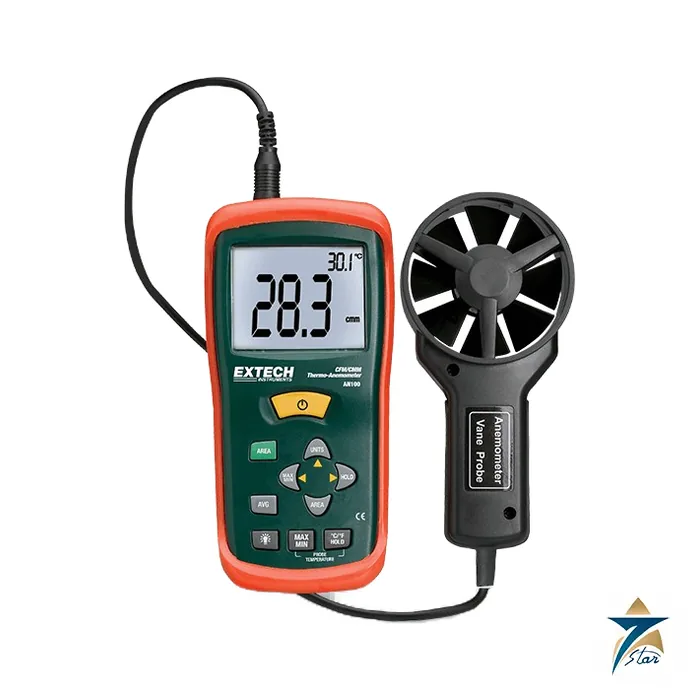
Extech AN100 CFM/CMM thermo-anemometer with vane sensor
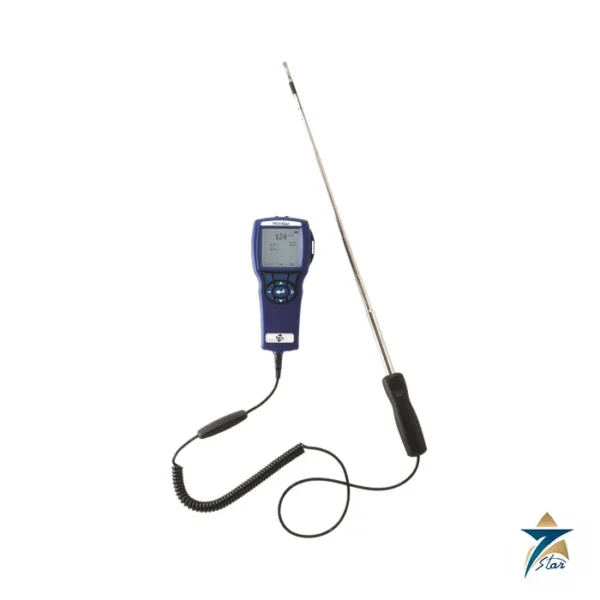
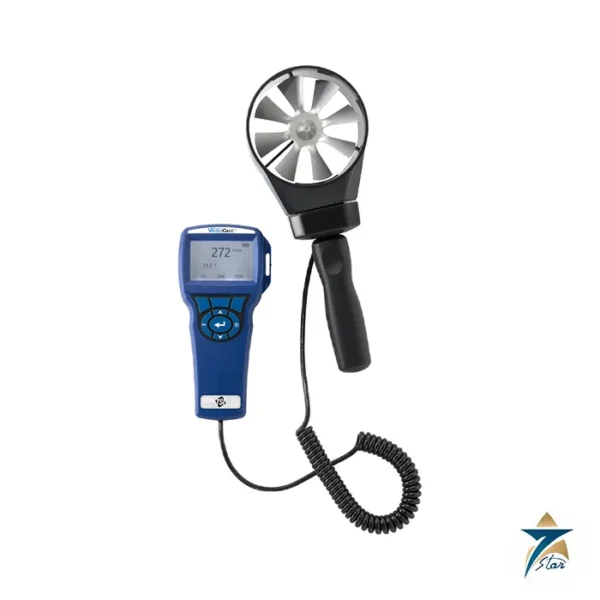
The Extech AN100 is a handheld thermo-anemometer that shows air velocity or airflow volume together with air temperature, using a 72 mm (2.83 in) low-friction ball-bearing vane wheel on a 120 cm cable. It reads velocity in m/s, km/h, ft/min, mph or knots, calculates volume flow in CFM or CMM from a stored duct area, and keeps up to eight area values in memory, so repeat measurements need no re-entry.
A 20-point average function helps with duct traverses, and data hold, min/max and auto power off are standard. The AN100 is supplied with the vane sensor, a 9 V battery, a protective rubber holster and a carrying case. The AN200 is the version with an added IR thermometer and laser pointer.
Technical specifications of the AN100
| Parameter |
Specification |
| Manufacturer / part number |
Extech / AN100 (AN100-NIST available with calibration traceable to NIST) |
| Air velocity |
0.40 to 30.00 m/s (0.01 m/s); 1.4 to 108.0 km/h; 80 to 5906 ft/min; 0.9 to 67.2 mph; 0.8 to 58.3 knots; accuracy ±3% |
| Air flow |
0 to 9999 CMM (m³/min) and 0 to 9999 CFM (ft³/min), 0.1 resolution |
| Air temperature |
-10 to 60 °C (14 to 140 °F), 0.1 resolution |
| Sensor |
72 mm (2.83 in) ball-bearing vane wheel, 120 cm (3.9 ft) cable |
| Area memory |
Up to 8 area dimensions in cm² or ft² |
| Functions |
20-point average, data hold, min/max, auto power off |
| Power / supplied items |
9 V battery, protective rubber holster, carrying case |
The figures above are from the AN100/AN200 datasheet.
How to calculate airflow with the AN100
Volume flow is the average air velocity multiplied by the cross-sectional area of the duct or opening. The AN100 does this multiplication for you once the area has been entered, and it stores up to eight areas for repeat use. For a rectangular duct, enter the width times the height; for a round duct, the area of the circle. In a large duct the air speed varies across the section, so take readings at several points and use the 20-point average function to obtain a representative value.
The 3% velocity accuracy is obtained with a vane wheel that turns freely on a low-friction ball bearing, so the sensor should be kept clean and not struck. Hold the vane so that the airflow is directed straight through the wheel, with the arrow marking on the sensor pointing downstream.
Typical uses of the AN100
- HVAC balancing of supply and return grilles and ducts.
- Fume hood face velocity checks and verification.
- Ventilation system installation and servicing.
- Ionizer flow monitoring and environmental wind checks.
- General facility maintenance with air temperature at the same time.
For an anemometer with IR surface temperature, the AN200 is the choice; the AN100 is the simpler model without IR.
Selection checklist for the AN100
- Confirm that the velocity range of 0.4 to 30 m/s covers your air systems.
- Decide whether volume flow in CFM or CMM is required, which needs the duct area.
- Decide whether an IR thermometer is needed (AN200).
- Consider the NIST calibration version for reporting.
- Plan to protect the vane sensor between jobs.
Care of the AN100
Never blow compressed air on the vane wheel and do not touch the blades. Keep the sensor in its holder when not in use, clean it gently with a soft brush and let it dry. The AN100 is not intended for hot, dusty or oily air above its temperature range of 60 °C. Replace the 9 V battery when the display dims, and check calibration at a regular interval if readings are used for compliance.
Applications of the AN100 in Oman and the GCC
Air conditioning and ventilation dominate energy use in the Gulf, and facility teams measure airflow to confirm that fresh air and exhaust meet design values. Laboratories, clean rooms and fume cupboards in hospitals, universities and industry need periodic velocity checks. In industrial sites, the same meter checks ventilation in electrical rooms and battery rooms where heat and gas build-up must be controlled.
Traverse method for duct measurements
Divide the duct cross-section into equal areas, take a reading at the centre of each, and average them. Round ducts are usually measured along two perpendicular diameters; rectangular ducts on a grid. Keep the measurement plane as far as possible from bends, dampers and fans, since turbulence near them gives scattered readings. Record the date, the damper positions and the fan speed so that balancing reports can be repeated.
Common mistakes when using the AN100
The most frequent error is measuring right at the face of a grille, where the flow is uneven and the vane sees a distorted profile; move a short distance into the duct or use the manufacturer-recommended correction for the grille. A second error is entering the wrong duct area, for example using the outside dimension of an insulated duct instead of the inside dimension, which gives an error in volume flow even when velocity is correct. A third is holding the vane at an angle to the flow, which lowers the reading. Check these three points before questioning the instrument, and keep a note of the area used in every report.
Information to send with an RFQ for the AN100
- Part number AN100 and the required quantity
- Duct or grille sizes and the expected velocity range
- Whether an IR version (AN200) or NIST calibration is required
- Delivery location in Oman or the GCC and the required lead time
- Whether calibration documentation or a traceable calibration certificate is required
Documents and quotation
A datasheet for the Extech AN100 is attached on this page. It covers the AN100 and AN200 models.
Send us the part number AN100, the quantity and the delivery location in Oman or the GCC, and we will reply with availability and a quotation. Seven Star LLC is an independent supplier in Muscat and is not affiliated with the manufacturer.


















Reviews
There are no reviews yet.