
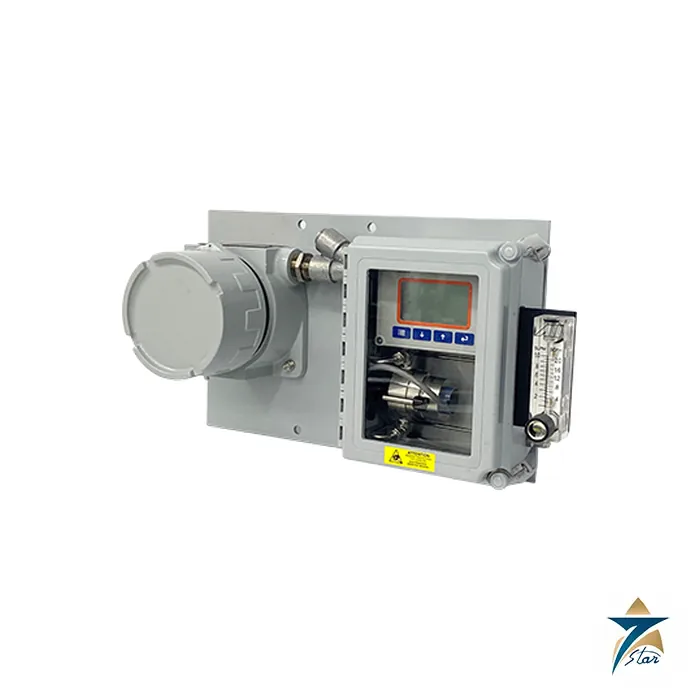
The AII GPR-1800 (A)IS is a hazardous-area trace oxygen analyzer series from Analytical Industries Inc. (AII) for ppm-level O2 measurement in flammable gases or in classified plant areas. It is offered in two configurations: the GPR-1800 IS, a loop-powered transmitter, and the GPR-1800 AIS, a line-powered analyzer that adds Modbus communication and two configurable alarm relays. Both versions measure on ranges of 0–10, 0–100 and 0–1000 ppmV and 0–1 %, with a lower detection limit of 0.05 ppmV, and both are built on a panel-mounted sample system with an explosion-proof junction housing and flow indication.
Seven Star LLC supplies the AII GPR-1800 series to oil, gas and chemical operators in Oman and the GCC, with engineering support in Muscat. We help clients decide between the IS and AIS versions, choose a sensor suited to their gas, and plan sample handling, so the analyzer can be commissioned quickly on a blanketing header, a natural gas line or a reactor purge system.
As general engineering background, trace oxygen in this class of analyzer is measured with a galvanic fuel-cell sensor. Oxygen molecules diffuse to a cathode where they are electrochemically reduced, producing a current that is proportional to the oxygen partial pressure, while a consumable anode completes the reaction. With no pump, heater or reference gas inside the cell, power demand is tiny, which is why the transmitter version can operate on intrinsically safe loop power.
The manufacturer states that the AII GPR-1800 series can measure oxygen in inert gas, hydrocarbon gas streams, mixed acidic gases, hydrogen and helium by selecting the appropriate sensor. The datasheet lists GPR-12-333 and GPR-12-333-LD cells for the standard temperature window and XLT-12-333 and XLT-12-333-LD cells for operation down to −10 °C, with a stated life expectancy of 24 months in 1000 ppmV oxygen. Accuracy is better than 2 % of the selected range at constant conditions, resolution is 0.01 ppmV, and T90 response is under two minutes.
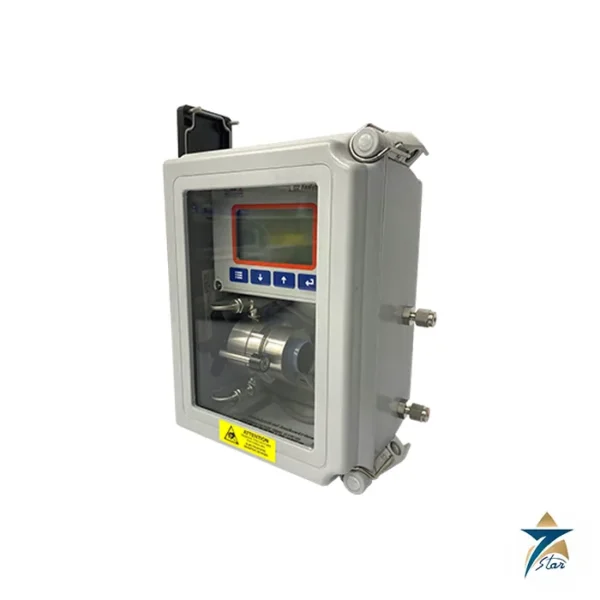
The analyzer enclosure is fibreglass and painted aluminium rated NEMA 3R, mounted on a backplate for wall or vertical surface installation alongside its sample components. Certification covers ATEX II 2 G Ex db ia IIC T4 Gb, IECEx Ex db ia IIC T4 Gb and cMETus Class I, Division 1, Groups B, C and D, T4, with Class I, Zone 1 AEx db ia IIB+H2 T4 Gb marking, all for an ambient range of −20 to +50 °C. Sample gas is supplied at 5–30 psi (0.3–2 bar) and 1–2 SCFH, and AII offers a range of sampling options for different process conditions.
Electrically, the two versions of the AII GPR-1800 differ clearly. The GPR-1800 IS is loop powered at 18–24 V DC and consumes about 1 W, sending a 4–20 mA signal over the same pair. The GPR-1800 AIS is line powered at 12–24 V DC, consumes up to 28 W, and adds Modbus digital communication and two user-configurable alarm relays for local alarm or interlock duty. Both carry an LCD and the common AII keypad interface, and compliance includes EMC Directive 2014/30/EU with EN 50270:2015 and EN 61000-4-2:2009.
The main strengths of the AII GPR-1800 series for hazardous trace oxygen measurement are listed here.
AII identifies blanketing and inerting of vessels, oxygen in natural gas and biogas for safety, and pharmaceutical reactor and centrifuge safety as key applications for the AII GPR-1800, and the datasheet adds steel production and heat treatment, solder re-flow and food and beverage feed gases. In the GCC this translates into tank blanketing on crude and product storage terminals, oxygen checks on fuel gas and sales gas lines, nitrogen purge systems on compressor seals and flare headers, and inert atmospheres in chemical batch plants where solvent vapours make the surrounding area hazardous.
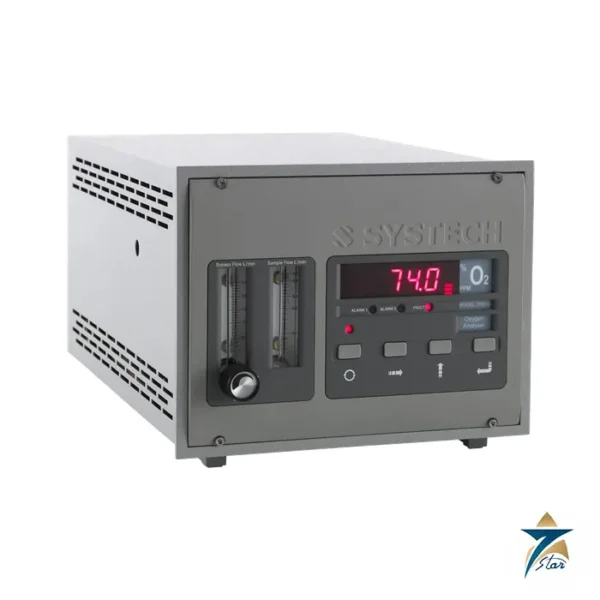
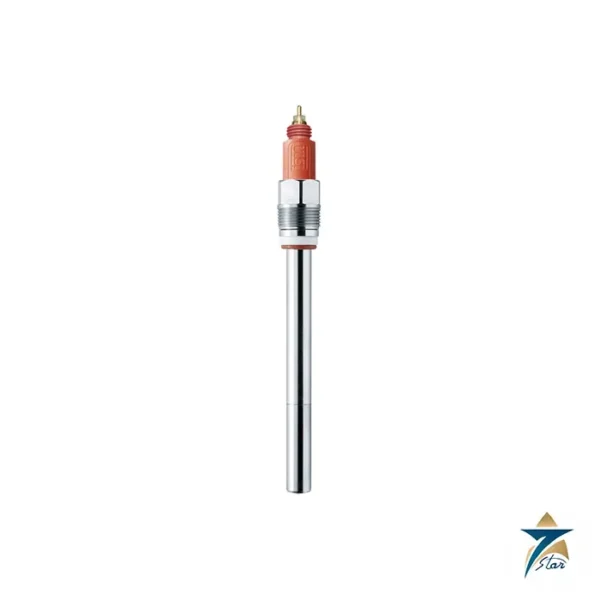
For operators in Oman, the AII GPR-1800 suits terminals and refineries around Sohar and Mina Al Fahal, gas facilities in the interior and biogas or wastewater projects where hydrogen sulphide and methane are present. Seven Star LLC supplies the AII GPR-1800 series with spare sensors and sample system parts, supported by our Muscat engineers. Related analyzers on our site include the Servomex NanoTrace DF-550E trace oxygen analyzer, the Systech ZR810 analyzer for argon and hydrogen and the Mettler Toledo InPro 6850i G gas-phase oxygen sensor.
Figures for the AII GPR-1800 (A)IS series below are taken from the AII GPR-x800 (A)IS datasheet (PST-DS-3001-00, 07/2024); performance is application dependent.
| Parameter | Specification |
|---|---|
| Model | AII GPR-1800 IS (loop powered) and GPR-1800 AIS (line powered) trace oxygen analyzers |
| Sensors | Electrochemical; GPR-12-333, GPR-12-333-LD, XLT-12-333, XLT-12-333-LD |
| Measuring ranges | 0–10, 0–100, 0–1000 ppmV, 0–1 %; 0–25 % for calibration only |
| Accuracy | Better than 2 % of selected range at constant conditions |
| Output resolution | 0.01 ppmV |
| Lower detection limit | 0.05 ppmV |
| Response time (T90) | Less than 2 minutes |
| Sample flow / pressure | 1–2 SCFH (0.5–1 L/min); 5–30 psi (0.3–2 bar) |
| Operating temperature | +5 to +45 °C (GPR sensors); −10 to +45 °C (XLT sensors) |
| Sensor life expectancy | 24 months in 1000 ppmV (application dependent) |
| Outputs | 4–20 mA; Modbus and two configurable alarm relays (AIS only) |
| Power supply | 18–24 V DC loop powered, 1 W (IS); 12–24 V DC line powered, 28 W (AIS) |
| Enclosure | NEMA 3R, fibreglass and painted aluminium, wall / vertical surface mounting |
| Hazardous area | ATEX II 2 G Ex db ia IIC T4 Gb; IECEx Ex db ia IIC T4 Gb; cMETus Class I Div 1 Groups B, C, D T4, Zone 1 AEx db ia IIB+H2 T4 Gb; Tamb −20 to +50 °C |
To order the AII GPR-1800 series, send Seven Star LLC an RFQ stating IS or AIS version, background gas, oxygen range and area classification, and our instrumentation division will confirm the configuration and sample options. Download the manufacturer datasheet from this page and contact our Muscat office for availability, lead time and engineering support in Oman and the GCC.
Choose the option that best fits your needs to get the fastest response from our team.
Automatically fill the RFQ form with this product's details for a faster process.
Manually enter multiple part numbers, specific brands, or custom requirements.












Reviews
There are no reviews yet.