
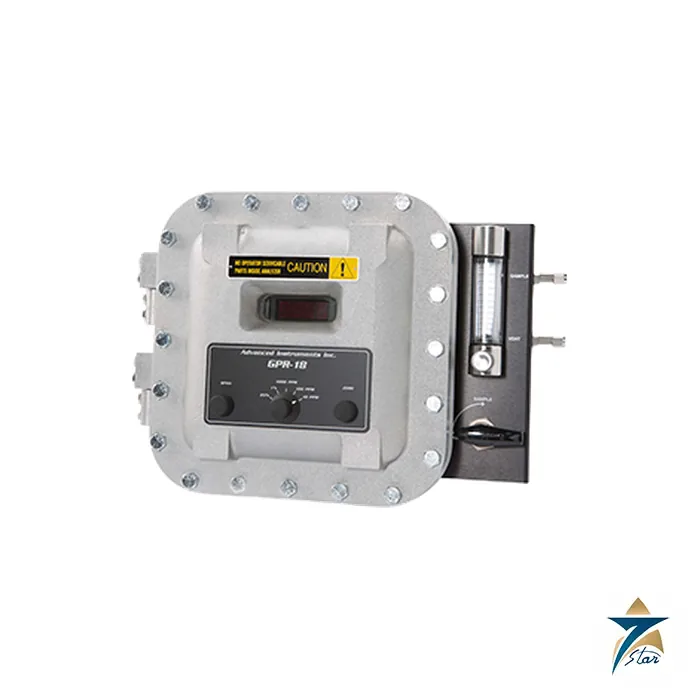
The AII GPR-18 is an explosion-proof trace oxygen analyzer from Analytical Industries Inc. (AII), designed specifically for petrochemical and refinery streams that contain hydrogen and other flammable gases. The electronics and sensor are encased in a flameproof Ex d enclosure fitted with flame arrestors as standard, so the AII GPR-18 can be mounted directly in a classified area and measure oxygen in process gas or inert purge gas without a purged cabinet. The standard version reads 0–10, 0–100 and 0–1000 ppmV, and the ultra-trace GPR-18 MS2 variant extends the bottom of the scale to 0–1 ppmV. Units in the field often show the legacy Advanced Instruments Inc. name on the front panel.
Seven Star LLC supplies the AII GPR-18 and its percent-range companion, the GPR-28, to refineries, petrochemical complexes and gas processing plants in Oman and the GCC, with engineering support in Muscat. For hydrogen-rich service, where many oxygen analyzers cannot be used safely, the IIB+H2 gas group rating of this instrument is often the deciding factor, and our engineers help confirm the sensor choice against the actual process composition.
As general background, the analyzer relies on a galvanic electrochemical cell: oxygen passing through a diffusion barrier is reduced at the cathode, a sacrificial anode is oxidised, and the cell current is proportional to oxygen partial pressure. Because the cell needs no heater or reference air, it suits continuous trace measurement in streams such as hydrogen, ethylene, natural gas and nitrogen, provided acid gases and liquids are kept away from the sensing face.
AII offers three sensor variations for the AII GPR-18 family to match different gas compositions. The standard GPR-18 uses the GPR-12-333 (or -H) cell or the cold-tolerant XLT-12-333, giving a 0.05 ppmV lower detection limit and 0.01 ppmV resolution with up to 24 months of life. The GPR-18 MS2 uses the GPR-12-2000-MS2E sensor, with a 0.005 ppmV detection limit, 0.001 ppmV resolution and 12–18 months of expected life. The datasheet quotes accuracy of ±1 % of the selected range at constant conditions and 0.5 % of full-scale sensitivity, with temperature compensation built in.
The analyzer housing is unpainted aluminium rated NEMA 4, carrying ATEX II 2 G Ex db IIB+H2 T6 Gb and IECEx Ex db IIB+H2 T6 Gb certification for ambient temperatures from −20 to +60 °C. The front cover shows a digital display with a range selector and adjustment controls behind the flameproof window, while a side-mounted flowmeter panel carries the sample and vent connections. Sample gas is supplied at 5–30 psi (0.3–2 bar) and 1.5–2 SCFH (0.75–1 L/min); flame arrestors on the gas ports are fitted as standard.
Unlike loop-powered transmitters, the AII GPR-18 is line powered from 100/120 to 220/240 V AC and uses analog electronics. It provides both 0–1 V and 4–20 mA outputs plus two user-configurable alarm relays, so it can drive a DCS input and a local shutdown or alarm circuit at the same time. Power demand is 30 W without the optional heater and 93 W with it, which is worth noting when sizing the supply for outdoor installations exposed to cold winter nights inland.
Engineers choose the AII GPR-18 for flammable-gas oxygen service because of the following features.
AII lists petrochemical catalyst monitoring, natural gas quality, hydrocarbon feedstock monitoring, ethylene pipeline quality and sodium benzoate production as target applications for the AII GPR-18, along with blanketing and inerting of vessels and oxygen in natural gas and biogas. In the GCC these duties appear across refinery hydrotreaters and reformers, polymer plants where trace oxygen poisons catalysts, ethylene and propylene pipelines, and gas processing trains that must meet oxygen limits in sales gas specifications.
In Oman, typical sites include the refinery and aromatics complexes in Sohar, gas processing facilities in the interior and the growing petrochemical cluster at Duqm. Seven Star LLC supplies the AII GPR-18 with replacement sensors and accessories for these customers and can advise on sample conditioning upstream of the analyzer. For other process gas analysis technologies on our site, see the Servomex SERVOPRO 4900 multigas analyzer, the Systech ZR810 oxygen analyzer for nitrogen and the Teledyne 3000RS series oxygen analyzer.
The values below for the AII GPR-18 come from the AII GPR-x8 datasheet (AII-DS-3000-3.2, 07/2024); performance is application dependent.
| Parameter | Specification |
|---|---|
| Model | AII GPR-18 explosion-proof trace oxygen analyzer (GPR-18 MS2 ultra-trace variant available) |
| Sensors | GPR-12-333 / GPR-12-333-H, XLT-12-333 (GPR-18); GPR-12-2000-MS2E (GPR-18 MS2) |
| Measurement ranges | 0–10, 0–100, 0–1000 ppmV (GPR-18); 0–1, 0–10, 0–100, 0–1000 ppmV (GPR-18 MS2); 0–1 % and 0–25 % for calibration |
| Accuracy | ±1 % of selected range at constant conditions |
| Output resolution | 0.01 ppmV (GPR-18); 0.001 ppmV (GPR-18 MS2) |
| Lower detection limit | 0.05 ppmV (GPR-18); 0.005 ppmV (GPR-18 MS2) |
| Sample flow rate | 1.5–2 SCFH (0.75–1 L/min) |
| Pressure range | 5–30 psi (0.3–2 bar) |
| Operating temperature | +5 to +45 °C; −10 to +45 °C with XLT-12-333 |
| Sensor life expectancy | Up to 24 months (GPR-12-333, XLT-12-333); 12–18 months (MS2E) |
| Calibration interval | 30 days recommended |
| Outputs | 0–1 V and 4–20 mA; two user-configurable alarm relays |
| Power supply | 100/120 to 220/240 V AC; 30 W (93 W with heater) |
| Enclosure | NEMA 4, unpainted aluminium, flame arrestors standard |
| Hazardous area | ATEX II 2 G Ex db IIB+H2 T6 Gb; IECEx Ex db IIB+H2 T6 Gb; Tamb −20 to +60 °C |
For a quotation on the AII GPR-18, send Seven Star LLC your process gas composition, required range, power supply and area classification, and our instrumentation division will propose the right sensor variant. Download the manufacturer datasheet from this page and contact our Muscat office for availability, lead time and engineering support in Oman and the GCC.
Choose the option that best fits your needs to get the fastest response from our team.
Automatically fill the RFQ form with this product's details for a faster process.
Manually enter multiple part numbers, specific brands, or custom requirements.








Reviews
There are no reviews yet.