- Automation & ControlView all 3,158 products
- Automation Accessories
- AC Drives
- PLC & I/O Cards
- Industrial Communications
- Vibration Monitoring
- Controllers & Data Acquisition
- Isolator & Barrier
- Safety Switches & Guard Locking
- Encoders
- Motor Soft Starters
- CCTV & Security
- Pneumatic Cylinders
- HMI Displays
- Servo Drives
- Industrial Computers
- Machine Vision
- Automation Software
- Robotics
Brand: Metrohm
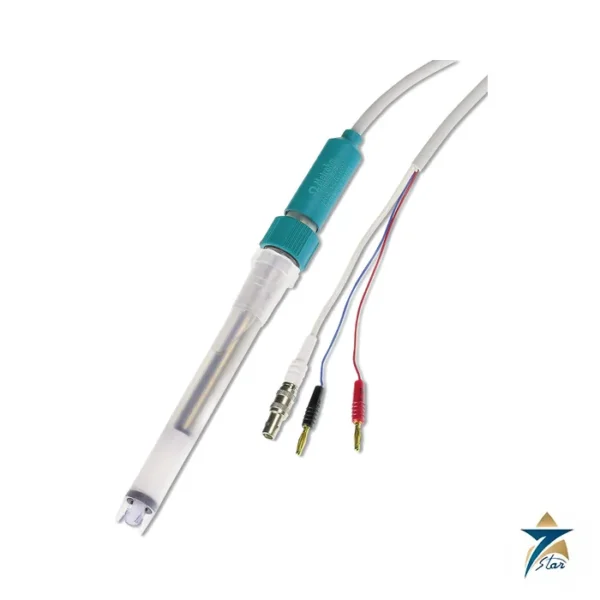
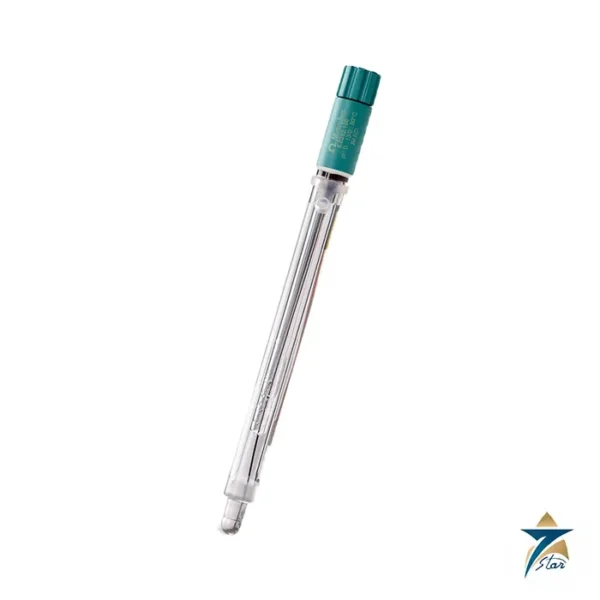
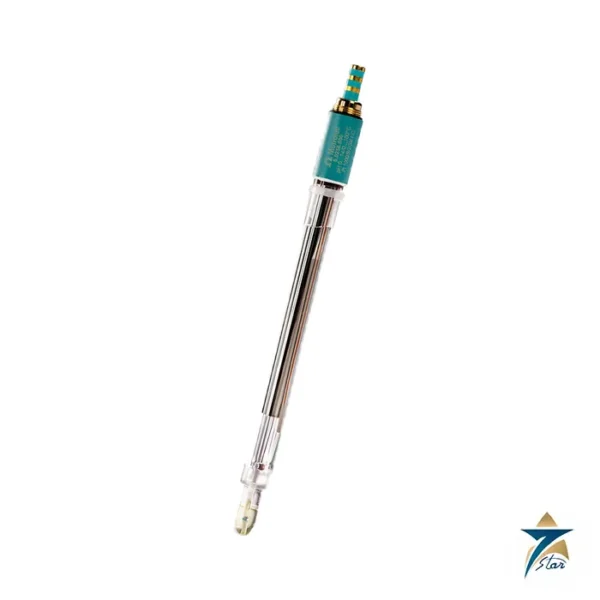
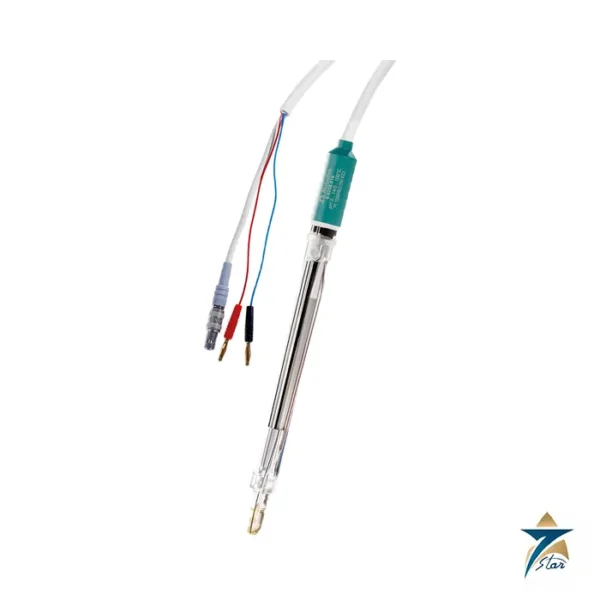
Metrohm 6.0451.100 Combined Pt Ring Electrode for Redox
Description
Overview
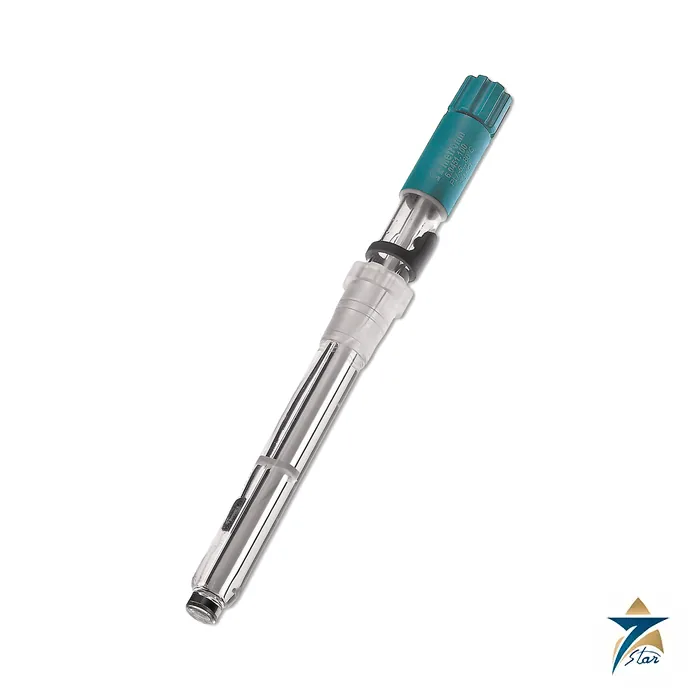
Redox titrations depend on a platinum surface that reports the oxidising or reducing power of the sample, and the Metrohm 6.0451.100 supplies that surface in a combined electrode: a platinum ring as indicator and a ceramic-pin reference system in the same glass shaft. Metrohm lists it as well suited to redox titrations in which the pH value varies, and names the Winkler determination of oxygen content, the determination of hydrogen peroxide with permanganate and diazotisation titrations as examples. The reference electrolyte, which doubles as the storage solution, is potassium chloride at 3 mol/L. Seven Star LLC is an independent supplier serving Oman and the GCC.
The ring geometry gives a large, evenly wetted metal surface close to the diaphragm, and the combined layout means that only one electrode has to be clamped into the titration head.
Data table for Metrohm 6.0451.100
| Characteristic | Metrohm data |
|---|---|
| Order number | 6.0451.100, combined Pt ring electrode |
| Indicator | Platinum, ring shape |
| Measuring range | minus 2000 to plus 2000 mV |
| Temperature range | minus 5 to 80 degrees C, long-term and short-term |
| pH range of use | 0 to 14 |
| Sleeve | Flexible ground-joint sleeve |
| Diaphragm | Ceramic pin; resistance 0.4 to 0.9 kOhm |
| Reference electrolyte | KCl 3 mol/L, LL system |
| Electrolyte flow | 10 to 25 microlitres per hour at 10 cm water column |
| Electrode resistance | 5 kOhm |
| Installation length | 113 mm maximum |
| Minimum immersion depth | 15 mm |
| Shaft | Glass, 12 mm |
| Plug-in head | Metrohm plug-in head G |
When to choose a combined ring electrode
A redox electrode has to be matched to the chemistry. In a titration where the pH keeps changing, the potential of an electrode that uses a glass membrane as its reference would drift, so a conventional Ag/AgCl reference with a liquid junction is preferred. That is exactly the situation covered by the 6.0451.100. In contrast, Metrohm’s Pt Titrode 6.0431.100 uses a pH glass membrane as the reference and is meant for titrations where the pH stays constant, such as iodometry, chromatometry, cerimetry and permanganometry. Picking the wrong one is a common cause of flat curves and poor reproducibility.
How Metrohm 6.0451.100 differs from other redox electrodes
The Titrode 6.0431.100 has a measuring length of 125 mm, an immersion depth of 20 mm, a temperature range of 0 to 80 degrees C and needs storage in deionised water. The 6.0451.100 has 113 mm, 15 mm, minus 5 to 80 degrees C and storage in KCl 3 mol/L. The separate gold ring electrode 6.0352.100 reaches minus 20 degrees C but needs its own reference. The double Pt wire electrodes for Karl Fischer titration, 6.0338.100 and 6.0341.100, work with a polarising current instead of a reference electrode and are rated only to 70 degrees C.
Typical applications in Oman and the GCC
Hydrogen peroxide solutions are used for bleaching, disinfection and in desalination pretreatment, and permanganate titration is a classic way to check their strength. Winkler titrations for dissolved oxygen are relevant for boiler feed water and seawater quality programmes. Industrial laboratories also use redox titrations to determine reducing sugars in food products, chlorite or hypochlorite in biocides, and iron in process water. Because many of these samples change pH while the titrant is added, a combined ring electrode with a separate reference path is a sound and economical choice.
Handling and cleaning
The Metrohm leaflet for metal electrodes asks users to check the electrode immediately after delivery and to keep the metal surface clean and free of grease; fingers should never touch it. The filler opening must stay open during measurements, and the electrolyte indicated on the electrode should be used for refilling. Do not clean in an ultrasonic bath. If contamination persists, the platinum ring can be cleaned cautiously with a moist paper towel and toothpaste or with the polishing set 6.2802.000, though abrasive cleaning should not be frequent. Trichloroethylene may be used for degreasing.
Storage and troubleshooting
Combined platinum electrodes are stored in potassium chloride at 3 mol/L with the filler opening closed. A sluggish response or small potential jumps in a titration usually indicate a dirty metal surface or a partly blocked diaphragm. Clean the ring, refresh the electrolyte, and compare against a redox standard solution such as 250 mV. Metrohm lists regeneration procedures for the related double Pt sheet electrode, but the ring of this electrode is best restored by gentle polishing.
Reading potential curves from a ring electrode
A redox titration produces an S-shaped curve whose inflection marks the equivalence point, and the sharpness of that jump depends strongly on the condition of the platinum. A clean ring with a stable diaphragm gives a jump of several hundred millivolts and a short settling time, while a fouled surface produces a lazy curve and a shifted endpoint. Because the diaphragm resistance of 0.4 to 0.9 kOhm is low, the electrode is not sensitive to electrical noise, and the electrolyte flow of 10 to 25 microlitres per hour keeps the junction steady. Technicians who see unusually slow drift should check the cable plug first, then the electrolyte level, and only then the platinum ring itself.
Compatibility
The Metrohm plug-in head G fits standard Metrohm electrode cables, and the electrode can be used with Titrando titrators and pH or ion meters that provide a millivolt measuring mode. Choose the instrument’s redox or mV measurement mode, not the pH mode, and enter the correct stop criterion. Keep records of the redox standard reading at the start of each shift to document the health of the platinum surface.
Ordering the Metrohm 6.0451.100
Provide the order number and quantity, and tell us whether you also need cables, electrolyte or polishing sets. For warranty, the leaflet states that defective electrodes must be returned within two months of delivery, so inspect the item immediately after unpacking.
Related items you may also need: Metrohm 2035 Process Analyzer | Metrohm 905 Titrando Potentiometric Titrator | Metrohm 888 Titrando Potentiometric Titrator | All Metrohm products.
Documents and quotation
The Metrohm leaflet on metal electrodes accompanies this page. Please send an RFQ with Metrohm 6.0451.100, quantity and delivery location in Oman or the GCC.
Datasheets & Documents
- Datasheet Metrohm 6.0451.100 Combined Pt Ring Electrode for Redox Datasheet Download
Reviews (0)
How would you rate this product? Cancel reply
About brand
Metrohm is a Swiss maker of instruments for chemical analysis, founded in 1943 by Bertold Suhner in Herisau, where it is still headquartered. It is best known for titration and also makes ion chromatography, electrochemistry, spectroscopy and process analysers. Metrohm is owned by a foundation.
Seven Star LLC lists the Metrohm 905 Titrando, the 916 Ti-Touch and the 2035 Process Analyzer, and supplies Metrohm instruments and accessories to laboratories and plants in Oman and the GCC.
Metrohm company profile
| Founded | 1943, Herisau, Switzerland |
|---|---|
| Founder | Bertold Suhner |
| Headquarters | Herisau, Switzerland |
| Ownership | Metrohm Foundation |
| Product families | Titrando and Ti-Touch titrators, ion chromatography systems, 2035 and 2060 process analysers, electrodes |
Metrohm instruments listed here
The 905 Titrando is a high-end potentiometric titrator for use with Dosino dosing units. It runs dynamic (DET), monotonic (MET) and set endpoint (SET) titrations, takes up to four 800 Dosino units, recognizes intelligent iTrode electrodes, and is operated from tiamo or OMNIS software or a Touch Control. The 2035 Process Analyzer is an online wet-chemistry analyzer for automatic analysis of samples drawn from the process.
Metrohm products we list
| Family | Examples |
|---|---|
| Liquid Analytical Systems | 2035 Process Analyzer, 905 Titrando Potentiometric Titrator, 916 Ti-Touch Compact Potentiometric Titr… |
Ordering Metrohm equipment: what we need
Metrohm article numbers follow a fixed pattern (the 905 Titrando is 2.905.0010), and that number is the best reference for instruments, electrodes and accessories. For a new application, tell us the sample, the parameter and its concentration range, the method or standard you follow, and for a process analyzer the number of sample streams and the signals your control system needs.
Facts checked against Metrohm's published company history, October 2026.
Browse Metrohm products by category: Liquid Analytical Systems.
FAQ
Questions about the Metrohm 6.0451.100 Combined Pt Ring Electrode for
Answers from our engineering team on installation, compatibility and integration.
01What is the Metrohm 6.0451.100 used for?
It is a combined platinum ring electrode for redox titrations when the pH varies, for example Winkler oxygen determination, hydrogen peroxide with permanganate and diazotisation.
02How should the Metrohm 6.0451.100 be stored?
Combined Pt electrodes are stored in KCl 3 mol/L with the filler opening closed, according to the Metrohm metal electrodes leaflet.
03What is the measuring range of the Metrohm 6.0451.100?
The theoretical measuring range is minus 2000 to plus 2000 mV, with a temperature range of minus 5 to 80 degrees C.
04How does the 6.0451.100 differ from the Pt Titrode 6.0431.100?
The 6.0451.100 uses an Ag/AgCl reference with ceramic pin for varying pH, while the Titrode uses a pH glass membrane reference for constant pH and is stored in water.
05How can the platinum ring of the Metrohm 6.0451.100 be cleaned?
Cautiously with a moist paper towel and toothpaste or the polishing set 6.2802.000; the leaflet advises against frequent abrasive cleaning and ultrasonic baths.


Reviews
There are no reviews yet.