WIKA TR10-C threaded resistance thermometer with protection tube
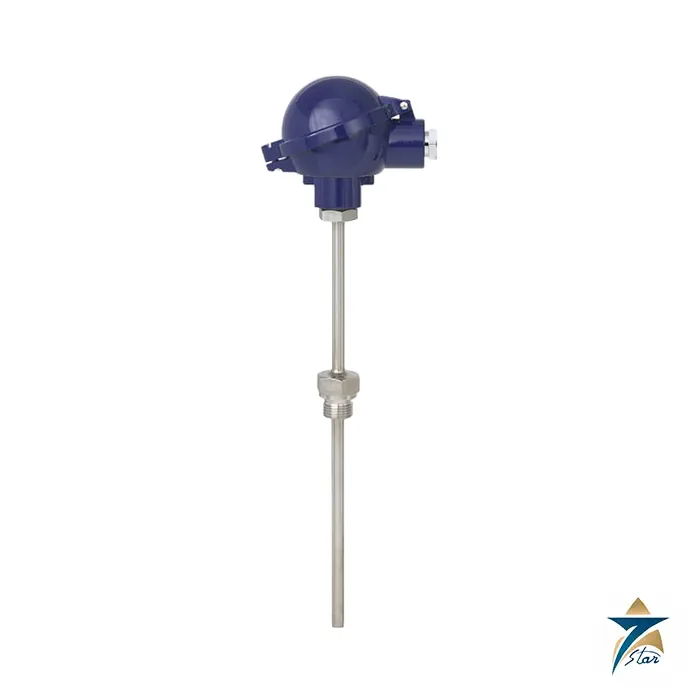
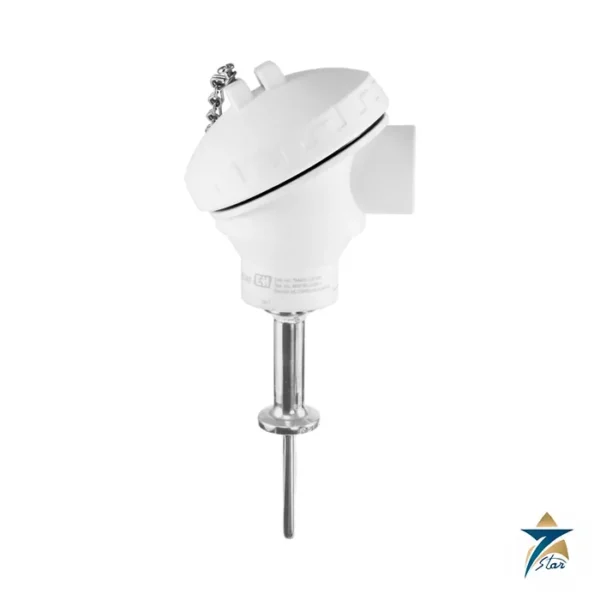
The WIKA TR10-C is a threaded resistance thermometer that screws straight into a vessel or pipeline and carries its own protection tube, so the sensor does not need a separate thermowell. A replaceable, spring-loaded measuring insert sits inside a welded stainless steel tube, and the whole assembly ends in a connection head. WIKA states a sensor range of -196 … +600 °C [-320 … +1,112 °F]. Seven Star LLC supplies the TR10-C in Oman and the GCC as an independent supplier in Muscat; this page explains how the model is built, which options matter, and what to send us so that the quotation matches your plant.
What the TR10-C is and how it differs from its relatives
The maker positions the TR10-C for liquid and gaseous media under moderate mechanical stress and normal chemical conditions, mainly in tanks and process pipes. The thermowell is drawn tube, fully welded, and screwed into the connection head with a swivel connection (male nut). Loosening that nut lets you turn the head to the position where the cable outlet is easiest to reach. Because the insert can be pulled out through the head, inspection, calibration checks or replacement can be carried out while the plant keeps running; the one exception is the perforated-thermowell version made for air-duct measurement.
Within the same family, the TR10-B is the version meant for an existing, separately ordered thermowell, while the TR10-C brings the protection tube with it. A thermocouple counterpart, the TC10-C, is listed by WIKA for applications that need a thermocouple rather than an RTD.
TR10-C technical specifications
| Parameter |
Specification |
| Manufacturer / part number |
WIKA / TR10-C (data sheet TE 60.03) |
| Type |
Threaded resistance thermometer with protection tube |
| Sensor element |
Pt100 or Pt1000, single or dual |
| Measuring range |
-196 … +600 °C [-321 … +1,112 °F], depending on class and design |
| Accuracy classes (IEC 60751) |
Class B, Class A, Class AA depending on connection method and range |
| Class B tolerance |
±(0.30 + 0.0050 |t|) in °C |
| Class A tolerance |
±(0.15 + 0.0020 |t|) in °C |
| Class AA tolerance |
±(0.10 + 0.0017 |t|) in °C |
| Measuring current |
0.1 … 1.0 mA |
| Connection methods |
1 x or 2 x 2-wire, 3-wire, 4-wire (dual 4-wire not for 3 mm and ⅛ in inserts) |
| Measuring insert diameter |
3 mm, 6 mm, 8 mm (also 6 mm with sleeve), sheath material 1.4571 |
| Insert construction |
Vibration-resistant MIMS cable, spring travel max. 10 mm |
| Thermowell material |
Stainless steel 1.4571 as standard; other materials on request |
| Connection to head |
M24 x 1.5 swivel connection (male nut) |
| Ambient and storage temperature |
-40 … +80 °C standard; -60 °C special version on request |
| Ingress protection |
IP65 standard head; cable gland up to IP66 |
Reading the accuracy classes correctly
The datasheet ties each IEC 60751 class to a validity range. Class B is valid over the widest span, up to -196 … +600 °C for the chosen design. Class A is listed for -100 … +450 °C and Class AA for -50 … +250 °C, -30 … +300 °C or 0 … 150 °C depending on the version. Class A and AA are not permitted with a 2-wire connection, because the lead resistance of the mineral-insulated cable would cancel the better sensor tolerance. WIKA also advises a 4-wire connection for longer probes, since in that method the cable length does not affect the reading, and says a 2-wire Pt100 is technically possible but not recommended.
A drift-detection variant is offered as a single 4-wire element in class B (-50 … +500 °C or -50 … +200 °C) or class A (-30 … +300 °C). It pairs with the WIKA T38 transmitter, which watches the resistance sensor against a reference thermocouple built into the same 6 mm probe tip and signals deviations per NAMUR NE043.
Connection heads, cable entries and displays
The TR10-C can be ordered with European heads per EN 50446 / DIN 43735, including BSZ, BSZ-H, BSZ-H with two cable outlets, BSS, BSS-H, BVS and the stainless steel 1/4000 to 7/8000 designs, plus the KN4-A aluminium screw-on lid head. Cable-entry threads are M20 x 1.5 or ½ NPT, and the head connects to the neck with M24 x 1.5. Standard cable inlets are IP65; plastic, nickel-plated brass or stainless steel glands raise this to IP66, and Ex e glands are listed separately. A built-in M12 x 1 four-pin connector is another option for plug-in wiring.
A digital display can sit in the BSZ-H head: the DIH10 LED display works with any 4 … 20 mA loop transmitter, while the TND LC display needs a T38 transmitter. WIKA can also mount its T15 or T38 head transmitters at the factory, either on the insert in place of the terminal block or, preferably, inside the head cover, which gives better thermal insulation and easier service.
Thermowell and process connection options for the TR10-C
| Thermowell form |
Dimensions |
Typical process connection |
| Straight, form 2G |
9 x 1, 11 x 2 or 14 x 2.5 mm |
G¼ B, G½ B, G¾ B, G1 B, M18 x 1.5, M20 x 1.5, M27 x 2, ½ NPT, ¾ NPT (by diameter) |
| Tapered, form 3G |
12 x 2.5 mm tapering to 9 mm |
G½ B, G¾ B, G1 B mounting thread |
| Plain, form 2 / 3 |
9 x 1, 11 x 2, 12 x 2.5 mm |
Compression fitting G½ B or ½ NPT with metal ferrule, or without thread |
| Tapered weld-on solid tip |
9 x 1 mm, tapered to 6 mm |
Mounting thread, for 3 mm insert |
The process connection is either welded on at the factory, which fixes the insertion length, or fitted as a compression fitting for variable depth. WIKA recommends an immersion depth of at least ten times the outer diameter of the tube to limit heat conduction errors. Versions with a double-threaded hex bushing screw directly into the head, but then the head cannot be rotated.
Vibration, fit and installation notes
For heat to reach the sensor quickly, the insert diameter and length must match the thermowell. The bore may be at most 1 mm larger than the insert, and gaps above 0.5 mm slow the response. The insert must be spring-loaded so that the tip is pressed against the bottom of the tube; the maximum spring travel is 10 mm. When commissioning, check polarity or wire colours against the terminal block, make sure the gland matches the cable diameter (6 … 10 mm plastic, 6 … 12 mm brass, 7 … 12 mm stainless), and seal unused entries. Keep the ambient temperature at the head within the stated limits; a longer neck helps when a transmitter is fitted and the process is hot.
Maintenance is simple because of the replaceable insert: keep a spare insert of each diameter and length in stock, check the zero point at an ice or dry-block reference at your usual interval, and record the serial number so the replacement matches.
Explosion protection and functional safety
The datasheet lists a wide range of explosion-protection approvals for the TR10-C (for example Ex i for gas and dust, Ex e, Ex t and Ex nA, depending on the head and cable gland), with scheme coverage varying by region. Always state the zone and gas or dust group in your enquiry; we confirm the approval for the exact combination before quoting. For safety loops, selected TR10-C versions with the TUV-certified SIL version of the T38 transmitter are suitable per IEC 61508 / IEC 61511, and WIKA recommends two separate TR10-C probes with one SIL-certified T38 for SIL 3 use.
Typical applications in Oman and the GCC
The listed applications are machine building and plant construction, energy and power plants, the chemical industry, food and beverage, and sanitary, heating and air-conditioning technology. In the Gulf that translates into lube-oil and cooling-water lines in power stations, heat-exchanger and chilled-water loops in desalination and district cooling, process lines in petrochemical sites and utilities in food plants. Outdoor installations see strong sun, dust and humidity, so choose a sealed head and gland, point the cable entry downward and consider a transmitter in the head cover for stable 4 … 20 mA transmission over long cable runs.
Ordering checklist for a TR10-C
- Sensor: Pt100 or Pt1000, single or dual, accuracy class and 2-, 3- or 4-wire connection
- Measuring range and process pressure and temperature, including peaks
- Insert diameter (3, 6 or 8 mm) and whether vibration-resistant tips are required
- Thermowell form, diameter, material, insertion length and neck length
- Process connection and thread standard (G, NPT, metric) and whether a compression fitting is needed
- Connection head type, cable entry thread and gland, ingress rating
- Transmitter or display (T15, T38, DIH10, TND) and output signal
- Hazardous-area zone and approval, or SIL requirement
Information to send with an RFQ
Send the tag number, the complete TR10-C configuration from your data sheet or specification, the quantity, the required approvals and any material or calibration certificates. If you only have a loop drawing, give us the medium, line size, temperature and pressure and we will propose a matching configuration for you to confirm.
Documents and quotation
The WIKA data sheet TE 60.03 for the TR10-C is attached on this page. Send us the complete configuration and quantity and we will reply with a quotation as an independent supplier in Muscat.
Other Models in the Wika Tr10 Range
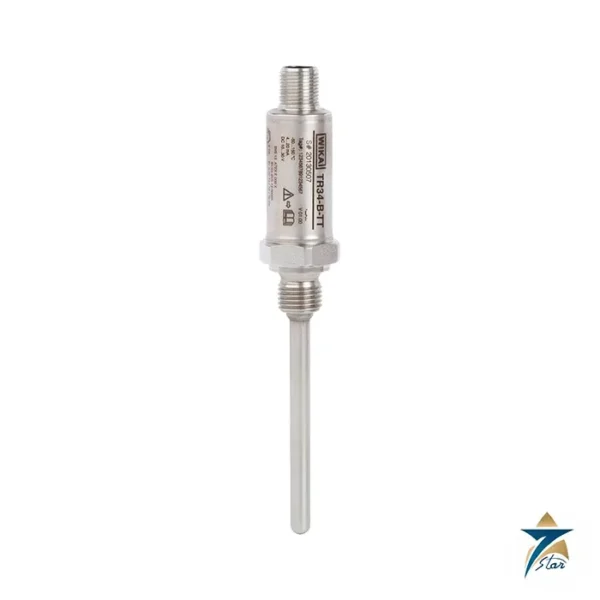
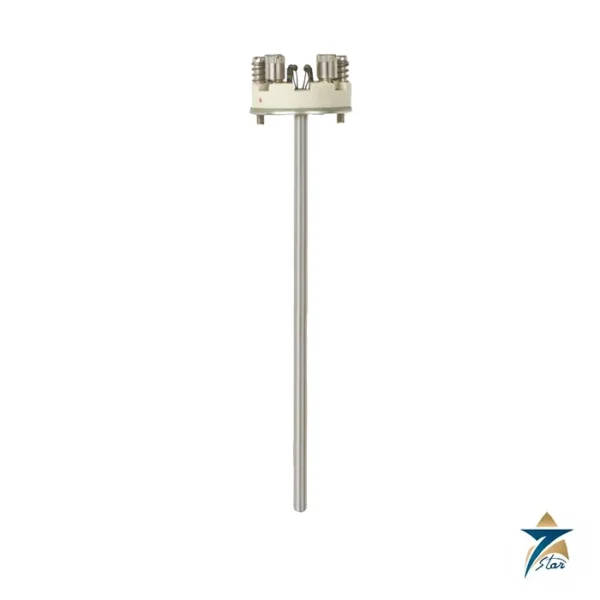
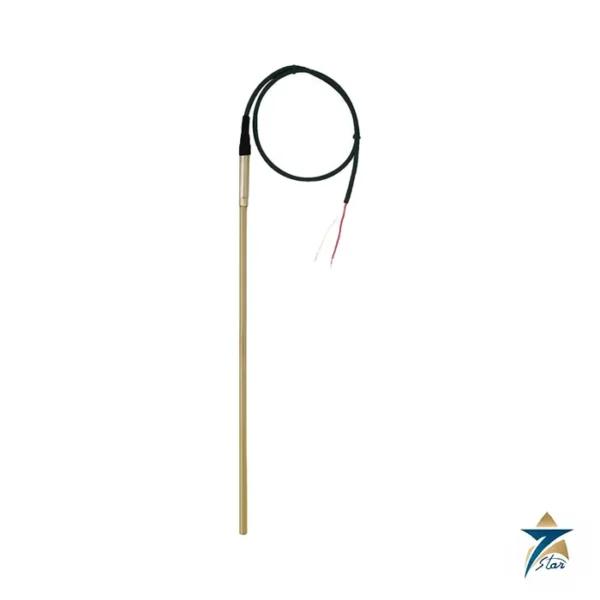
Seven Star LLC supplies models from the Wika Tr10 range in Oman and the GCC. Compare the related models below and request a quote for the one that matches your application.






















Reviews
There are no reviews yet.